Problems
Filters
2017 Paper 3 Q5
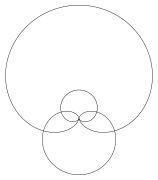
The point with cartesian coordinates \((x,y)\) lies on a curve with polar equation \(r=\f(\theta)\,\). Find an expression for \(\dfrac{\d y}{\d x}\) in terms of \(\f(\theta)\), \(\f'(\theta)\) and \(\tan\theta\,\). Two curves, with polar equations \(r=\f(\theta)\) and \(r=\g(\theta)\), meet at right angles. Show that where they meet \[ \f'(\theta) \g'(\theta) +\f(\theta)\g(\theta) = 0 \,. \] The curve \(C\) has polar equation \(r=\f(\theta)\) and passes through the point given by \(r=4\), \(\theta = - \frac12\pi\). For each positive value of \(a\), the curve with polar equation \(r= a(1+\sin\theta)\) meets~\(C\) at right angles. Find \(\f(\theta)\,\). Sketch on a single diagram the three curves with polar equations \(r= 1+\sin\theta\,\), \ \(r= 4(1+\sin\theta)\) and \(r=\f(\theta)\,\).
Solution: \((x, y) = (f(\theta)\cos(\theta), f(\theta)\sin(\theta))\) so \begin{align*} \frac{dy}{d\theta} &= -f(\theta)\sin(\theta) + f'(\theta)\cos(\theta) \\ \frac{dx}{d\theta} &= f(\theta)\cos(\theta) + f'(\theta)\sin(\theta) \\ \frac{dy}{dx} &= \frac{-f(\theta)\sin(\theta) + f'(\theta)\cos(\theta)}{f(\theta)\cos(\theta) + f'(\theta)\sin(\theta) } \\ &= \frac{-f(\theta)\tan(\theta) + f'(\theta)}{f(\theta) + f'(\theta)\tan(\theta) } \end{align*} If the curves meet at right angles then the product of their gradients is \(-1\), ie \begin{align*} \frac{-f(\theta)\tan(\theta) + f'(\theta)}{f(\theta) + f'(\theta)\tan(\theta) } \cdot \frac{-g(\theta)\tan(\theta) + g'(\theta)}{g(\theta) + g'(\theta)\tan(\theta) } &= -1 \\ f(\theta)g(\theta)\tan^2 \theta - f(\theta)g'(\theta)\tan \theta - f'(\theta)g(\theta)\tan \theta + f'(\theta)g'(\theta) &= \\ \quad - \l f(\theta)g(\theta) + f(\theta)g'(\theta)\tan(\theta) + f'(\theta)g(\theta)\tan(\theta) + f'(\theta)g'(\theta)\tan^2 \theta \r \\ \tan^2\theta \l f(\theta)g(\theta) + f'(\theta)g'(\theta) \r + f'(\theta)g'(\theta) + f(\theta)g(\theta) &= 0 \\ (\tan^2\theta + 1) \l f(\theta)g(\theta) + f'(\theta)g'(\theta) \r &= 0 \\ f(\theta)g(\theta) + f'(\theta)g'(\theta) &= 0 \end{align*} \(g(\theta) = a(1+\sin\theta), g'(\theta) = a\cos\theta\) Therefore \(f'(\theta)a\cos \theta+f(\theta)a(1+\sin(\theta)) = 0\) \begin{align*} && \frac{f'(\theta)}{f(\theta)} &= -\sec(\theta) - \tan(\theta) \\ \Rightarrow && \ln(f(\theta)) &= -\ln |\tan(\theta) + \sec(\theta)| + \ln |\cos(\theta)| + C \\ \Rightarrow && f(\theta) &= A \frac{\cos \theta}{\tan \theta + \sec \theta} \\ &&&= A \frac{\cos^2 \theta}{\sin \theta + 1} \\ &&&= A \frac{1-\sin^2 \theta}{\sin \theta + 1} \\ &&&= A (1-\sin \theta) \end{align*} When \(\theta = -\frac12 \pi, r = 4\), so \(A = 2\).
2017 Paper 3 Q6
In this question, you are not permitted to use any properties of trigonometric functions or inverse trigonometric functions. The function \(\T\) is defined for \(x>0\) by \[ \T(x) = \int_0^x \! \frac 1 {1+u^2} \, \d u\,, \] and $\displaystyle T_\infty = \int_0^\infty \!\! \frac 1 {1+u^2} \, \d u\,$ (which has a finite value).
- By making an appropriate substitution in the integral for \(\T(x)\), show that \[\T(x) = \T_\infty - \T(x^{-1})\,.\]
- Let \(v= \dfrac{u+a}{1-au}\), where \(a\) is a constant. Verify that, for \(u\ne a^{-1}\), \[ \frac{\d v}{\d u} = \frac{1+v^2}{1+u^2} \,. \] Hence show that, for \(a>0\) and \(x< \dfrac1a\,\), \[ \T(x) = \T\left(\frac{x+a}{1-ax}\right) -\T(a) \,. \] Deduce that \[ \T(x^{-1}) = 2\T_\infty -\T\left(\frac{x+a}{1-ax}\right) -\T(a^{-1}) \] and hence that, for \(b>0\) and \(y>\dfrac1b\,\), \[ \T(y) =2\T_\infty - \T\left(\frac{y+b}{by-1}\right) - \T(b) \,. \]
- Use the above results to show that \(\T(\sqrt3)= \tfrac23 \T_\infty \,\) and \(\T(\sqrt2 -1)= \frac14 \T_\infty\,\).
2017 Paper 3 Q7
Show that the point \(T\) with coordinates \[ \left( \frac{a(1-t^2)}{1+t^2} \; , \; \frac{2bt}{1+t^2}\right) \tag{\(*\)} \] (where \(a\) and \(b\) are non-zero) lies on the ellipse \[ \frac{x^2}{a^2} + \frac{y^2}{b^2} =1 \,. \]
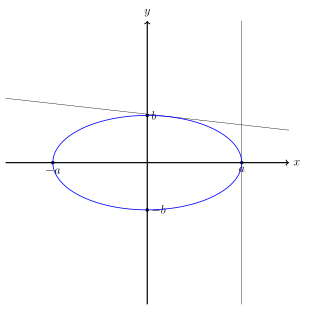
- The line \(L\) is the tangent to the ellipse at \(T\). The point \((X,Y)\) lies on \(L\), and \(X^2\ne a^2\). Show that \[ (a+X)bt^2 -2aYt +b(a-X) =0 \,.\] Deduce that if \(a^2Y^2>(a^2-X^2)b^2\), then there are two distinct lines through \((X,Y)\) that are tangents to the ellipse. Interpret this result geometrically. Show, by means of a sketch, that the result holds also if \(X^2=a^2\,\).
- The distinct points \(P\) and \(Q\) are given by \((*)\), with \(t=p\) and \(t=q\), respectively. The tangents to the ellipse at \(P\) and \(Q\) meet at the point with coordinates \((X,Y)\), where \(X^2\ne a^2\,\). Show that \[ (a+X)pq = a-X\] and find an expression for \(p+q\) in terms of \(a\), \(b\), \(X\) and \(Y\). Given that the tangents meet the \(y\)-axis at points \((0,y_1)\) and \((0,y_2)\), where \(y_1+y_2 = 2b\,\), show that \[ \frac{X^2}{a^2} +\frac{Y}{b}= 1 \,. \]
Solution:
- The tangent has equation:
\begin{align*}
&& 0 &= \frac{Xx}{a^2} + \frac{Yy}{b^2} -1 \\
\Rightarrow &&&= \frac{Xa(1-t^2)}{a^2(1+t^2)} + \frac{Y2bt}{b^2(1+t^2)} - 1 \\
\Rightarrow &&0&= Xb(1-t^2) + Y2at - ab(1+t^2)\\
&&&= -(b(a+X)t^2 -2aYt +b(a-X)) \\
\Rightarrow && 0 &= (a+X)bt^2-2aYt+b(a-X) \\
\\
&& 0 <\Delta &= 4a^2Y^2 - 4(a+X)b(a-X)b \\
&&&= 4(a^2Y^2-b^2(a^2-X^2)) \\
\Leftrightarrow && a^2Y^2 &> (a^2-X^2)b^2
\end{align*}
Therefore there are two roots to the quadratic, ie two values of the parameter \(t\) which works. The condition is equivalent to \(\frac{X^2}{a^2} + \frac{Y^2}{b^2} > 1\). ie from any point outside the ellipse there are two tangent lies.
Clearly there are two tangents when \(X = \pm a\) (except \((X,Y) = (\pm a, 0)\).
- We must have \(p\) and \(q\) are roots of \(0 = (a+X)bt^2-2aYt+b(a-X)\), ie \(pq = \frac{b(a-X)}{(a+X)b} \Rightarrow (a+X)pq = a-X\). Similarly \(p+q = \frac{2aY}{(a+X)b}\) Given that the tangents meet the \(y\)-axis at \((0, y_i)\) we must have \(abt^2-2ay_it + ab = 0\), so \begin{align*} && 0 &= abp^2-2ay_1p + ab \\ && 0 &= abq^2-2ay_2q + ab \\ \Rightarrow && y_1 &= \frac{ab(p^2+1)}{2ap} \\ && y_2 &= \frac{ab(q^2+1)}{2aq} \\ \Rightarrow && 2b &= \frac{ab(p^2+1)}{2ap} +\frac{ab(q^2+1)}{2aq} \\ &&&= \frac{ab(pq(p+q)+p+q)}{2apq} \\ \Rightarrow && 4pq &= pq(p+q)+p+q \\ \Rightarrow && 4 \frac{b(a-X)}{(a+X)b} &= \frac{2aY}{(a+X)b} \left ( \frac{b(a-X)}{(a+X)b} + 1 \right) \\ && &= \frac{2aY}{(a+X)b} \frac{2ab}{(a+X)b} \\ \Rightarrow && 4b^2(a^2-X^2) &= 4a^2bY \\ \Rightarrow && 1 &= \frac{Y}{b} + \frac{X^2}{a^2} \end{align*} as required.
2017 Paper 3 Q8
Prove that, for any numbers \(a_1, a_2, \ldots\,,\) and \(b_1, b_2, \ldots\,,\) and for \(n\ge1\), \[ \sum_{m=1}^n a_m(b_{m+1} -b_m) = a_{n+1}b_{n+1} -a_1b_1 -\sum_{m=1}^n b_{m+1}(a_{m+1} -a_m) \,. \]
- By setting \(b_m = \sin mx\), show that \[ \sum_{m=1}^n \cos (m+\tfrac12)x = \tfrac12 \big(\sin (n+1)x - \sin x \big) \cosec \tfrac12 x \,. \] Note: $\sin A - \sin B = \displaystyle 2 \cos \big( \tfrac{{\displaystyle A+B\vphantom{_1}}} {\displaystyle 2\vphantom{^1}} \big)\, \sin\big( \tfrac{{\displaystyle A-B\vphantom{_1}}}{\displaystyle 2\vphantom{^1}} \big)\, $.
- Show that \[ \sum_{m=1}^n m\sin mx = \big (p \sin(n+1)x +q \sin nx\big) \cosec^2 \tfrac12 x \,, \] where \(p\) and \(q\) are to be determined in terms of \(n\). Note: \(2\sin A \sin B = \cos (A-B) - \cos (A+B)\,\); Note: \(2\cos A \sin B = \sin (A+B) - \sin (A-B)\,\).
Solution: \begin{align*} \sum_{m=1}^n a_m(b_{m+1} -b_m) +\sum_{m=1}^n b_{m+1}(a_{m+1} -a_m) &= \sum_{m=1}^n \left (a_{m+1}b_{m+1}-a_mb_m \right) \\ &= a_{n+1}b_{n+1} - a_1b_1 \end{align*} And the result follows.
- Let \(b_m = \sin m x \), \(a_m = \cosec \frac{x}{2}\), so \begin{align*} && \sum_{m=1}^n \cosec \frac{x}{2} \left (\sin (m+1)x - \sin mx \right) &= \sum_{m=1}^n \cosec \frac{x}{2} 2 \cos \left ( \frac{2m+1}{2}x \right) \sin \left ( \frac{(m+1)-m}{2}x \right) \\ &&&=2 \sum_{m=1}^n\cos \left ( (m + \tfrac12)x \right)\\ \\ \Rightarrow && \sum_{m=1}^n\cos \left ( (m + \tfrac12)x \right) &= \tfrac12 \cosec \tfrac{x}{2}\left ( \sin(n+1)x - \sin x \right) \end{align*}
- \(\,\) \begin{align*} && b_{m+1}-b_m &= \sin m x \sin \tfrac12 x \\ &&&= \frac12 \left ( \cos (m-\tfrac12)x - \cos (m+\tfrac12)x \right)\\ \Rightarrow && b_m &= -\tfrac12 \cos (m - \tfrac12)x\\ && a_m &= m \\ \Rightarrow && \sum_{m=1}^n m \sin m x \sin \tfrac12 x &= (n+1) b_{n+1} - 1 \cdot b_1 - \sum_{m=1}^n b_{m+1} \cdot 1 \\ &&&= -(n+1) \tfrac12\cos(n+1-\tfrac12)x+\tfrac12\cos(\tfrac12x) + \tfrac12\sum_{m=1}^n \cos(m+\tfrac12)x \\ &&&= -(n+1) \tfrac12\cos(n+1-\tfrac12)x+\tfrac12\cos(\tfrac12x) + \tfrac14 \cosec \tfrac{x}{2}\left ( \sin(n+1)x - \sin x \right) \\ &&&= -(n+1) \tfrac12\cos(n+1-\tfrac12)x+ \tfrac14 \cosec \tfrac{x}{2}\sin(n+1)x \\ &&&= \tfrac12\cosec\tfrac{x}2 \left (\tfrac12 \sin (n+1)x-(n+1)\cos(n+\tfrac12)x\sin\tfrac12x \right) \\ &&&= \tfrac12\cosec\tfrac{x}2 \left (\tfrac12 \sin (n+1)x-(n+1)\tfrac12 \left ( \sin (n+1)x - \sin nx \right) \right) \\ &&&= \tfrac14 \cosec \tfrac{x}{2} \left ( -n \sin (n+1)x +(n+1) \sin n x \right) \end{align*} Therefore \(p = -\frac{n}4, q = \frac{n+1}{4}\)
2017 Paper 3 Q9
Two particles \(A\) and \(B\) of masses \(m\) and \(2 m\), respectively, are connected by a light spring of natural length \(a\) and modulus of elasticity \(\lambda\). They are placed on a smooth horizontal table with \(AB\) perpendicular to the edge of the table, and \(A\) is held on the edge of the table. Initially the spring is at its natural length. Particle \(A\) is released. At a time \(t\) later, particle \(A\) has dropped a distance \(y\) and particle \( B\) has moved a distance \(x\) from its initial position (where \(x < a\)). Show that \( y + 2x= \frac12 gt^2\). The value of \(\lambda\) is such that particle \(B\) reaches the edge of the table at a time \(T\) given by \(T= \sqrt{6a/g\,}\,\). By considering the total energy of the system (without solving any differential equations), show that the speed of particle \(B\) at this time is \(\sqrt{2ag/3\,}\,\).
2017 Paper 3 Q10
A uniform rod \(PQ\) of mass \(m\) and length \(3a\) is freely hinged at \(P\). The rod is held horizontally and a particle of mass \(m\) is placed on top of the rod at a distance~\(\ell\) from \(P\), where \(\ell <2a\). The coefficient of friction between the rod and the particle is \(\mu\). The rod is then released. Show that, while the particle does not slip along the rod, \[ (3a^2+\ell^2)\dot \theta^2 = g(3a+2\ell)\sin\theta \,, \] where \(\theta\) is the angle through which the rod has turned, and the dot denotes the time derivative. Hence, or otherwise, find an expression for \(\ddot \theta\) and show that the normal reaction of the rod on the particle is non-zero when~\(\theta\) is acute. Show further that, when the particle is on the point of slipping, \[ \tan\theta = \frac{\mu a (2a-\ell)}{2(\ell^2 + a\ell +a^2)} \,. \] What happens at the moment the rod is released if, instead, \(\ell>2a\)?
Solution:

2017 Paper 3 Q11
A railway truck, initially at rest, can move forwards without friction on a long straight \mbox{horizontal} track. On the truck, \(n\) guns are mounted parallel to the track and facing backwards, where \(n>1\). Each of the guns is loaded with a single projectile of mass \(m\). The mass of the truck and guns (but not including the projectiles) is \(M\). When a gun is fired, the projectile leaves its muzzle horizontally with a speed \(v-V\) relative to the ground, where~\(V\) is the speed of the truck immediately before the gun is fired.
- All \(n\) guns are fired simultaneously. Find the speed, \(u\), with which the truck moves, and show that the kinetic energy, \(K\), which is gained by the system (truck, guns and projectiles) is given by \[ K= \tfrac{1}{2}nmv^2\left(1 +\frac{nm}{M} \right) . \]
- Instead, the guns are fired one at a time. Let \(u_r\) be the speed of the truck when \(r\) guns have been fired, so that \(u_0= 0\). Show that, for \(1\le r \le n\,\), \[ u_r - u_{r-1} = \frac{mv}{M+(n-r)m} \tag{\(*\)} \] and hence that \(u_n < u\,\).
- Let \(K_r\)
be the total kinetic energy of the system
when \(r\) guns have been fired (one at a time), so that \(K_0 = 0\).
Using \((*)\), show that, for \(1\le r\le n\,\),
\[
K_r -K_{r-1} = \tfrac 12 mv^2 + \tfrac12 mv (u_r-u_{r-1})
\]
and hence
show that
\[
K_n = \tfrac{1}{2}nmv^2 +\tfrac{1}{2}mvu_n
\,.
\]
Deduce that \(K_n
2017 Paper 3 Q12
The discrete random variables \(X\) and \(Y\) can each take the values \(1\), \(\ldots\,\), \(n\) (where \(n\ge2\)). Their joint probability distribution is given by \[ \P(X=x, \ Y=y) = k(x+y) \,, \] where \(k\) is a constant.
- Show that \[ \P(X=x) = \dfrac{n+1+2x}{2n(n+1)}\,. \] Hence determine whether \(X\) and \(Y\) are independent.
- Show that the covariance of \(X\) and \(Y\) is negative.
Solution:
- \(\,\) \begin{align*} && \mathbb{P}(X = x) &= \sum_{y=1}^n \mathbb{P}(X=x,Y=y) \\ &&&= \sum_{y=1}^n k(x+y) \\ &&&= nkx + k\frac{n(n+1)}2 \\ \\ && 1 &= \sum_{x=1}^n \mathbb{P}(X=x) \\ &&&= nk\frac{n(n+1)}{2} + kn\frac{n(n+1)}2 \\ &&&= kn^2(n+1) \\ \Rightarrow && k &= \frac{1}{n^2(n+1)} \\ \Rightarrow && \mathbb{P}(X = x) &= \frac{nx}{n^2(n+1)} + \frac{n(n+1)}{2n^2(n+1)} \\ &&&= \frac{n+1+2x}{2n(n+1)} \\ \\ && \mathbb{P}(X=x)\mathbb{P}(Y=y) &= \frac{(n+1)^2+2(n+1)(x+y)+4xy}{4n^2(n+1)^2} \\ &&&\neq \frac{x+y}{n^2(n+1)} \end{align*} Therefore \(X\) and \(Y\) are not independent.
- \(\,\) \begin{align*} && \E[X] &= \sum_{x=1}^n x \mathbb{P}(X=x) \\ &&&= \sum_{x=1}^n x \mathbb{P}(X=x)\\ &&&= \sum_{x=1}^n x \frac{n+1+2x}{2n(n+1)} \\ &&&= \frac{1}{2n(n+1)} \left ( (n+1) \sum x + 2\sum x^2\right)\\ &&&= \frac{1}{2n(n+1)} \left ( \frac{n(n+1)^2}{2} + \frac{n(n+1)(2n+1)}{3} \right) \\ &&&= \frac{1}{2} \left ( \frac{n+1}{2} + \frac{2n+1}{3} \right)\\ &&&= \frac{1}{2} \left ( \frac{7n+5}{6} \right)\\ &&&= \frac{7n+5}{12} \\ \\ && \textrm{Cov}(X,Y) &= \mathbb{E}\left[XY\right] - \E[X] \E[Y] \\ &&&= \sum_{x=1}^n \sum_{y=1}^n xy \frac{x+y}{n^2(n+1)} - \E[X]^2 \\ &&&= \frac{1}{n^2(n+1)} \sum \sum (x^2 y+xy^2) - \E[X]^2 \\ &&&= \frac{1}{n^2(n+1)} \left (\sum y \right )\left (\sum x^2\right ) - \E[X]^2 \\ &&&=\frac{(n+1)(2n+1)}{12} - \left ( \frac{7n+5}{12}\right)^2 \\ &&&= \frac1{144} \left (12(2n^2+3n+1) - (49n^2+70n+25) \right)\\ &&&= \frac{1}{144} \left (-25n^2-34n-13 \right) \\ &&& < 0 \end{align*} since \(\Delta = 34^2 - 4 \cdot 25 \cdot 13 = 4(17^2-25 \times 13) = -4 \cdot 36 < 0\)
2017 Paper 3 Q13
The random variable \(X\) has mean \(\mu\) and variance \(\sigma^2\), and the function \({\rm V}\) is defined, for \(-\infty < x < \infty\), by \[ {\rm V}(x) = \E \big( (X-x)^2\big) . \] Express \({\rm V}(x)\) in terms of \(x\), \( \mu\) and \(\sigma\). The random variable \(Y\) is defined by \(Y={\rm V}(X)\). Show that \[ \E(Y) = 2 \sigma^2 %\text{ \ \ and \ \ } %\Var(Y) = \E(X-\mu)^4 -\sigma^4 . \tag{\(*\)} \] Now suppose that \(X\) is uniformly distributed on the interval \(0\le x \le1\,\). Find \({\rm V}(x)\,\). Find also the probability density function of \(Y\!\) and use it to verify that \((*)\) holds in this case.
Solution: \begin{align*} {\rm V}(x) &= \E \big( (X-x)^2\big) \\ &= \E \l X^2 - 2xX + x^2\r \\ &= \E [ X^2 ]- 2x\E[X] + x^2 \\ &= \sigma^2+\mu^2 - 2x\mu + x^2 \\ &= \sigma^2 + (\mu - x)^2 \end{align*} \begin{align*} \E[Y] &= \E[\sigma^2 + (\mu - X)^2] \\ &= \sigma^2 + \E[(\mu - X)^2]\\ &= \sigma^2 + \sigma^2 \\ &= 2\sigma^2 \end{align*} If \(X \sim U(0,1)\) then \(V(x) = \frac{1}{12} + (\frac12 - x)^2\). \begin{align*} \P(Y \leq y) &= \P(\frac1{12} + (\frac12 - X)^2 \leq y) \\ &= \P((\frac12 -X)^2 \leq y - \frac1{12}) \\ &= \P(|\frac12 -X| \leq \sqrt{y - \frac1{12}}) \\ &= \begin{cases} 1 & \text{if } y - \frac1{12} > \frac14 \\ 2 \sqrt{y - \frac1{12}} & \text{if } \frac14 > y - \frac1{12} > 0 \\ \end{cases} \\ &= \begin{cases} 1 & \text{if } y> \frac13 \\ \sqrt{4y - \frac1{3}} & \text{if } \frac13 > y > \frac1{12} \\ \end{cases} \end{align*} Therefore $f_Y(y) = \begin{cases} \frac{2}{\sqrt{4y-\frac{1}{3}}} & \text{if } \frac1{12} < y < \frac13 \\ 0 & \text{otherwise} \end{cases}$ \begin{align*} \E[Y] &= \int_{1/12}^{1/3} \frac{2x}{\sqrt{4x-\frac13}} \, dx \\ &= 2\int_{u = 0}^{u=1} \frac{\frac{1}{4}u +\frac1{12}}{\sqrt{u}} \,\frac{1}{4} du \tag{\(u = 4x - \frac13, \frac{du}{dx} = 4\)}\\ &= \frac{1}{2 \cdot 12}\int_{u = 0}^{u=1} 3\sqrt{u} +\frac{1}{\sqrt{u}} \, du \\ &= \frac{1}{2 \cdot 12} \left [2 u^{3/2} + 2u^{1/2} \right ]_0^1 \\ &= \frac{1}{2 \cdot 12} \cdot 4 \\ &= \frac{2}{12} \end{align*} as required