Problems
Filters
2003 Paper 3 Q3
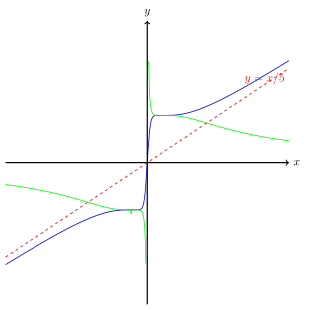
If \(m\) is a positive integer, show that \(\l 1+x \r^m + \l 1-x \r^m \ne 0\) for any real \(x\,\). The function \(\f\) is defined by \[ \f (x) = \frac{ (1+x )^m - ( 1-x )^m}{ (1+x )^m + (1-x )^m} \;. \] Find and simplify an expression for \(\f'(x)\). In the case \(m=5\,\), sketch the curves \(y = \f (x)\) and \(\displaystyle y = \frac1 { \f (x )}\;\).
Solution: If \(m\) is even, clearly that expression is positive since it's the sum of two (different) squares. If \(m\) is odd, then we can expand it as a sum of powers of \(x^2\) with a leading coefficient of \(1\) so it is also positive. \begin{align*} && f (x) = \frac{ (1+x )^m - ( 1-x )^m}{ (1+x )^m + (1-x )^m} \\ && f'(x) &= \frac{(m(1+x )^{m-1} + m( 1-x )^{m-1})((1+x)^m + (1-x)^m ) - ((1+x )^m - ( 1-x )^m)(m(1+x)^{m-1} - m(1-x)^{m-1} )}{\l (1+x)^m + (1-x)^m \r^2} \\ &&&= \frac{2m(1+x)^m(1-x)^{m-1}+2m(1+x)^{m-1}(1-x)^m}{\l (1+x)^m + (1-x)^m \r^2} \\ &&&= \frac{2m(1+x)^{m-1}(1-x)^{m-1}(1+x+1-x)}{\l (1+x)^m + (1-x)^m \r^2} \\ &&&= \frac{4m(1+x)^{m-1}(1-x)^{m-1}}{\l (1+x)^m + (1-x)^m \r^2} \\ \end{align*}
2003 Paper 3 Q4
A curve is defined parametrically by \[ x=t^2 \;, \ \ \ y=t (1 + t^2 ) \;. \] The tangent at the point with parameter \(t\), where \(t\ne0\,\), meets the curve again at the point with parameter \(T\), where \(T\ne t\,\). Show that \[ T = \frac{1 - t^2 }{2t} \mbox { \ \ \ and \ \ \ } 3t^2\ne 1\;. \] Given a point \(P_0\,\) on the curve, with parameter \(t_0\,\), a sequence of points \(P_0 \, , \; P_1 \, , \; P_2 \, , \ldots\) on the curve is constructed such that the tangent at \(P_i\) meets the curve again at \(P_{i+1}\). If \(t_0 = \tan \frac{ 7 } {18}\pi\,\), show that \(P_3 = P_0\) but \(P_1\ne P_0\,\). Find a second value of \(t_0\,\), with \(t_0>0\,\), for which \(P_3 = P_0\) but \(P_1\ne P_0\,\).
2003 Paper 3 Q5
Find the coordinates of the turning point on the curve \(y = x^2 - 2bx + c\,\). Sketch the curve in the case that the equation \(x^2 - 2bx + c=0\) has two distinct real roots. Use your sketch to determine necessary and sufficient conditions on \(b\) and \(c\) for the equation \(x^2 - 2bx + c = 0\) to have two distinct real roots. Determine necessary and sufficient conditions on \(b\) and \(c\) for this equation to have two distinct positive roots. Find the coordinates of the turning points on the curve \(y = x^3 - 3b^2x + c\) (with \(b>0\)) and hence determine necessary and sufficient conditions on \(b\) and \(c\) for the equation \(x^3 - 3b^2x + c = 0\) to have three distinct real roots. Determine necessary and sufficient conditions on \(a\,\), \(b\) and \(c\) for the equation \(\l x - a \r^3 - 3b^2 \l x - a \r + c = 0\) to have three distinct positive roots. Show that the equation \(2x^3 - 9x^2 + 7x - 1 = 0\) has three distinct positive roots.
Solution: \begin{align*} y &= x^2-2bx+c \\ &= (x-b)^2+c-b^2 \end{align*} Therefore the turning point is at \((b,c-b^2)\)


2003 Paper 3 Q6
Show that \[ 2\sin \frac12 \theta \, \cos r\theta = \sin\big(r+\frac12\big)\theta - \sin\big(r-\frac12\big)\theta \;. \] Hence, or otherwise, find all solutions of the equation \[ \cos a\theta + \cos (a + 1) \theta + \dots + \cos(b-2)\theta+\cos (b - 1 ) \theta = 0 \;, \] where \(a\) and \(b\) are positive integers with \(a < b-1\,\).
Solution: \begin{align*} && \sin\left(r+\frac12\right)\theta - \sin\left(r-\frac12\right)\theta &= \sin r \theta \cos \tfrac12 \theta+\cos r \theta \sin \tfrac12 \theta- \left (\sin r \theta \cos \tfrac12 \theta-\cos r \theta \sin \tfrac12 \theta \right)\\ &&&= 2 \cos r\theta \sin \tfrac12 \theta \end{align*} \begin{align*} && S &= \cos a\theta + \cos (a + 1) \theta + \dots + \cos(b-2)\theta+\cos (b - 1 ) \theta \\ && 2\sin\tfrac12 \theta S &= \sum_{r=a}^{b-1} 2\sin\tfrac12 \theta \cos r \theta \\ &&&= \sum_{r=a}^{b-1} \left ( \sin\left(r+\frac12\right)\theta - \sin\left(r-\frac12\right)\theta \right) \\ &&&= \sin \left (b-\frac12 \right)\theta - \sin \left (a -\frac12 \right)\theta \\ \Rightarrow && \sin \left (b-\frac12 \right)\theta &= \sin \left (a -\frac12 \right)\theta \\ \end{align*} Case 1: \(A = B + 2n\pi\) \begin{align*} && \left (b-\frac12 \right)\theta &= \left (a -\frac12 \right)\theta + 2n\pi \\ \Rightarrow && (b-a) \theta &= 2n \pi \\ \Rightarrow && \theta &= \frac{2n\pi}{b-a} \end{align*} Case 2: \(A = (2n+1)\pi - B\) \begin{align*} && \left (b-\frac12 \right)\theta &= (2n+1)\pi -\left (a -\frac12 \right)\theta \\ \Rightarrow && (b+a-1) \theta &= (2n+1) \pi \\ \Rightarrow && \theta &= \frac{2n\pi}{b+a-1} \end{align*}
2003 Paper 3 Q7
In the \(x\)--\(y\) plane, the point \(A\) has coordinates \((a\,,0)\) and the point \(B\) has coordinates \((0\,,b)\,\), where \(a\) and \(b\) are positive. The point \(P\,\), which is distinct from \(A\) and \(B\), has coordinates~\((s,t)\,\). \(X\) and \(Y\) are the feet of the perpendiculars from \(P\) to the \(x\)--axis and \(y\)--axis respectively, and \(N\) is the foot of the perpendicular from \(P\) to the line \(AB\,\). Show that the coordinates \((x\,,y)\) of \(N\) are given by \[ x= \frac {ab^2 -a(bt-as)}{a^2+b^2} \;, \ \ \ y = \frac{a^2b +b(bt-as)}{a^2+b^2} \;. \] Show that, if $\ds \ \left( \frac{t-b} s\right)\left( \frac t {s-a}\right) = -1\;\(, then \)N$ lies on the line \(XY\,\). Give a geometrical interpretation of this result.
2003 Paper 3 Q8
- Show that the gradient at a point \(\l x\,, \, y \r\) on the curve \[ \l y + 2x \r^3 \l y - 4x \r = c\;, \] where \(c\) is a constant, is given by \[ \frac{\d y}{\d x} = \frac{16 x -y}{2y-5x} \;. \]
- By considering the derivative with respect to \(x\) of \(\l y + ax \r^n \l y + bx \r\,\), or otherwise, find the general solution of the differential equation \[ \frac{\mathrm{d}y}{ \mathrm{d}x} = \frac{10x - 4y}{ 3x - y}\;. \]
Solution:
- \begin{align*} && c &= \left (y+2x \right)^3\left (y-4x \right) \\ \Rightarrow && 0 &= 3\left (y+2x \right)^2\left (y-4x \right)\left ( \frac{\d y}{\d x} + 2 \right) + \left (y+2x \right)^3 \left ( \frac{\d y}{\d x} - 4 \right) \\ \Rightarrow && 0 &= 3(y-4x)\left ( \frac{\d y}{\d x} + 2 \right) + \left (y+2x \right) \left ( \frac{\d y}{\d x} - 4 \right) \\ \Rightarrow &&&= \frac{\d y}{\d x} \left (3(y-4x) + (y+2x) \right) + 6(y-4x)-4(y+2x) \\ &&&= \frac{\d y}{\d x} \left ( 4y-10x\right) + 2y-32x \\ \Rightarrow && \frac{\d y}{\d x} &= \frac{16x-y}{2y-5x} \end{align*}
- \begin{align*} && c &= \left ( y + ax \right)^n \left ( y + bx \right) \\ \Rightarrow && 0 &= n\left ( y + ax \right)^{n-1} \left ( y + bx \right)\left ( \frac{\d y}{ \d x}+a \right) + \left ( y + ax \right)^{n} \left ( \frac{\d y}{ \d x}+b \right) \\ \Rightarrow && 0 &= n \left ( y + bx \right)\left ( \frac{\d y}{ \d x}+a \right) + \left ( y + ax \right) \left ( \frac{\d y}{ \d x}+b \right) \\ &&&= \frac{\d y}{\d x} \left ( (n+1)y + (nb+a)x \right) + an(y+bx) + by+bax \\ &&&= \frac{\d y}{\d x} \left ( (n+1)y + (nb+a)x \right) + (an+b)y+ab(n+1)x \\ \Rightarrow && \frac{\d y}{\d x} &= -\frac{(an+b)y+ab(n+1)x}{(n+1)y+(nb+a)x} \end{align*} We must have \(ab = 10, a+b = -7\) so say \(a=-5,b=-2,n=2\) and we have \((y-5x)^2(y-2) = c\) is our general solution to the differential equation
2003 Paper 3 Q9
A particle \(P\) of mass \(m\) is constrained to move on a vertical circle of smooth wire with centre~\(O\) and of radius \(a\). \(L\) is the lowest point of the circle and \(H\) the highest and \(\angle LOP = \theta\,\). The particle is attached to \(H\) by an elastic string of natural length \(a\) and modulus of elasticity~\(\alpha mg\,\), where \(\alpha > 1\,\). Show that, if \(\alpha>2\,\), there is an equilibrium position with \(0<\theta<\pi\,\). Given that \(\alpha =2+\sqrt 2\,\), and that \(\displaystyle \theta = \tfrac{1}{2}\pi + \phi\,\), show that \[ \ddot{\phi} \approx -\frac{g (\sqrt2+1)}{2a }\, \phi \] when \(\phi\) is small. For this value of \(\alpha\), explain briefly what happens to the particle if it is given a small displacement when \( \theta = \frac{1}{2}\pi\).
2003 Paper 3 Q10
A particle moves along the \(x\)-axis in such a way that its acceleration is \(kx \dot{x}\,\) where \(k\) is a positive constant. When \(t = 0\), \(x = d\) (where \(d>0\)) and \(\dot{x} =U\,\).
- Find \(x\) as a function of \(t\) in the case \(U = kd^2\) and show that \(x\) tends to infinity as \(t\) tends to \(\displaystyle \frac{\pi }{2 dk}\,\).
- If \(U < 0\), find \(x\) as a function of \(t\) and show that it tends to a limit, which you should state in terms of \(d\) and \(U\,\), as \(t\) tends to infinity.
Solution:
- \(\,\) \begin{align*} && \ddot{x} &= kx \dot{x} \\ \Rightarrow && \frac{\d v}{\d x} \dot{x} &= k x \dot{x} \\ \Rightarrow && \int \d v &= \int k x \d x \\ \Rightarrow && v &= \frac12kx^2 + C \\ t=0, x = d, \dot{x} = kd^2: && kd^2 &= \frac12kd^2 + C \\ \Rightarrow && \dot{x} &= \frac12k(x^2+d^2) \\ \Rightarrow && \frac{\d x}{\d t} &= \frac12k(x^2+d^2) \\ \Rightarrow && \int \d t &= \int \frac{1}{\frac12k(x^2+d^2)} \d x \\ &&&= \frac{2}{kd}\tan^{-1} \frac{x}{d} \\ \Rightarrow && t &= \frac{2}{kd}\tan^{-1} \frac{x}{d} + C' \\ t = 0, x = d: && 0 &= \frac{\pi}{2kd} + C' \\ \Rightarrow && t &= \frac{2}{kd}\tan^{-1} \frac{x}{d}-\frac{\pi}{2kd} \end{align*} As \(x \to \infty\), \(t \to \frac{2}{kd} \frac{\pi}{2} - \frac{\pi}{2kd} = \frac{\pi}{2kd} \)
- \(\,\) \begin{align*} && v &= \frac12kx^2 + C \\ t=0, x = d, \dot{x} = U && U &= \frac12kd^2 + C \\ \Rightarrow && \dot{x} &= \frac12k(x^2-d^2)+U \\ \Rightarrow && \frac{\d x}{\d t} &=\frac12k(x^2-d^2)+U \\ \Rightarrow && \int \d t &= \int \frac{1}{\frac12k(x^2-d^2)+U} \d x \\ && &=\frac{2}{k} \int \frac{1}{x^2-d^2+\frac{2U}k} \d x \\ &&&= \frac2{k} \frac{1}{2\sqrt{d^2-\frac{2U}k}} \ln \frac{ \sqrt{d^2-\frac{2U}k}-x}{x+\sqrt{d^2-\frac{2U}k}} \\ \Rightarrow && t &= \frac2{k} \frac{1}{2\sqrt{d^2-\frac{2U}k}} \ln \frac{ \sqrt{d^2-\frac{2U}k}-x}{x+\sqrt{d^2-\frac{2U}k}} + C'' \\ t = 0, \dot{x} = d: && 0 &= \frac2{k} \frac{1}{2\sqrt{d^2-\frac{2U}k}} \ln \frac{ \sqrt{d^2-\frac{2U}k}-d}{d+\sqrt{d^2-\frac{2U}k}} + C'' \\ \Rightarrow && t &= \frac2{k} \frac{1}{2\sqrt{d^2-\frac{2U}k}} \ln \left ( \frac{ \sqrt{d^2-\frac{2U}k}-x}{x+\sqrt{d^2-\frac{2U}k}} \frac{d+\sqrt{d^2-\frac{2U}k}}{ \sqrt{d^2-\frac{2U}k}-d} \right ) \end{align*} as \(t \to \infty\) the denominator needs to head to \(0\), ie \(x \to -\sqrt{d^2-\frac{2U}k}\)
2003 Paper 3 Q11
Point \(B\) is a distance \(d\) due south of point \(A\) on a horizontal plane. Particle \(P\) is at rest at \(B\) at \(t=0\), when it begins to move with constant acceleration \(a\) in a straight line with fixed bearing~\(\beta\,\). Particle \(Q\) is projected from point \(A\) at \(t=0\) and moves in a straight line with constant speed \(v\,\). Show that if the direction of projection of \(Q\) can be chosen so that \(Q\) strikes \(P\), then \[ v^2 \ge ad \l 1 - \cos \beta \r\;. \] Show further that if \(v^2 >ad(1-\cos\beta)\) then the direction of projection of \(Q\) can be chosen so that \(Q\) strikes \(P\) before \(P\) has moved a distance \(d\,\).
2003 Paper 3 Q12
Brief interruptions to my work occur on average every ten minutes and the number of interruptions in any given time period has a Poisson distribution. Given that an interruption has just occurred, find the probability that I will have less than \(t\) minutes to work before the next interruption. If the random variable \(T\) is the time I have to work before the next interruption, find the probability density function of \(T\,\). I need an uninterrupted half hour to finish an important paper. Show that the expected number of interruptions before my first uninterrupted period of half an hour or more is \(\e^3-1\). Find also the expected length of time between interruptions that are less than half an hour apart. Hence write down the expected wait before my first uninterrupted period of half an hour or more.