Problems
Filters
1997 Paper 3 Q3
By considering the solutions of the equation \(z^n-1=0\), or otherwise, show that \[(z-\omega)(z-\omega^2)\dots(z-\omega^{n-1})=1+z+z^2+\dots+z^{n-1},\] where \(z\) is any complex number and \(\omega={\rm e}^{2\pi i/n}\). Let \(A_1,A_2,A_3,\dots,A_n\) be points equally spaced around a circle of radius \(r\) centred at \(O\) (so that they are the vertices of a regular \(n\)-sided polygon). Show that \[\overrightarrow{OA_1}+\overrightarrow{OA_2}+\overrightarrow{OA_3} +\dots+\overrightarrow{OA_n}=\mathbf0.\] Deduce, or prove otherwise, that \[\sum_{k=1}^n|A_1A_k|^2=2r^2n.\]
1997 Paper 3 Q4
In this question, you may assume that if \(k_1,\dots,k_n\) are distinct positive real numbers, then \[\frac1n\sum_{r=1}^nk_r>\left({\prod\limits_{r=1}^n} k_r\right )^{\!\! \frac1n},\] i.e. their arithmetic mean is greater than their geometric mean. Suppose that \(a\), \(b\), \(c\) and \(d\) are positive real numbers such that the polynomial \[{\rm f}(x)=x^4-4ax^3+6b^2x^2-4c^3x+d^4\] has four distinct positive roots.
- Show that \(pqr,qrs,rsp\) and \(spq\) are distinct, where \(p,q,r\) and \(s\) are the roots of the polynomial \(\mathrm{f}\).
- By considering the relationship between the coefficients of \(\mathrm{f}\) and its roots, show that \(c > d\).
- Explain why the polynomial \(\mathrm{f}'(x)\) must have three distinct roots.
- By differentiating \(\mathrm{f}\), show that \(b > c\).
- Show that \(a > b\).
Solution:
- Suppose \(pqr = qrs\), since the roots are positive, we can divide by \(qr\) to obtain \(p=s\) (a contradiction. Therefore all those terms are distinct.
- \(4c^3 = pqr+qrs+rsp+spq\), \(d^4 = pqrs\). Applying AM-GM, we obtain: \begin{align*} && c^3 = \frac{ pqr+qrs+rsp+spq}{4} & > \sqrt[4]{p^3q^3r^3s^3} = d^{3} \\ \Rightarrow && c &> d \end{align*}
- There must be a turning point between each root (since there are no repeated roots).
- \(f'(x) = 4x^3-12ax^2+12b^2-4c^3 = 4(x^3-3ax^2+3b^2-c^3)\). Letting the roots of this polynomial be \(\alpha, \beta, \gamma\) and again applying AM-GM, we must have: \begin{align*} && b^2 = \frac{\alpha\beta + \beta \gamma+\gamma \alpha}{3} &> \sqrt[3]{\alpha^2\beta^2\gamma^2} = c^2 \\ \Rightarrow && b &> c \end{align*}
- Again, since there are turning points between the roots of \(f'(x)\) we must have distinct roots for \(f''(x)\), ie: \(f''(x) = 3x^2-6ax+6b^2 = 3(x^2-2ax+b^2)\) has distinct real roots. But for this to occur we must have that \((2a)^2-4b^2 = 4(a^2-b^2) > 0\), ie \(a>b\)
1997 Paper 3 Q5
Find the ratio, over one revolution, of the distance moved by a wheel rolling on a flat surface to the distance traced out by a point on its circumference.
Solution: The point on the circumference will have position \((a\cos t, a \sin t )\) relative to the circumference where \(t \in [0, 2\pi]\). the wheel will travel \(2\pi a\), therefore the position is \((a\cos t + at, a \sin t )\). The total distance travelled can be computed using the arc length: \begin{align*} && s &= \int_0^{2\pi} \sqrt{\left ( \frac{\d y}{\d t} \right)^2 +\left ( \frac{\d x}{\d t} \right)^2} \d t \\ &&&= \int_0^{2\pi} \sqrt{(a - a\sin t)^2 +(a \cos t)^2 } \d t \\ &&&= a \int_0^{2\pi} \sqrt{2 - 2 \sin t } \d t \\ &&&= \sqrt{2}a \int_0^{2 \pi} \sqrt{1 - \sin t} \d t \\ &&&= \sqrt{2}a \int_0^{2 \pi} \frac{|\cos t|}{\sqrt{1 + \sin t}} \d t \\ &&&= 2\sqrt{2} a \int_{-\pi/2}^{\pi/2} \frac{\cos t}{\sqrt{1+\sin t}} \d t \\ &&&= 2\sqrt{2} a \left [ 2\sqrt{1+\sin t} \right]_{-\pi/2}^{\pi/2} \\ &&& = 2\sqrt{2} a 2\sqrt{2} \\ &&&= 8a \end{align*} Therefore the ratio is \(\frac{4}{\pi}\)
1997 Paper 3 Q6
Suppose that \(y_n\) satisfies the equations \[(1-x^2)\frac{{\rm d}^2y_n}{{\rm d}x^2}-x\frac{{\rm d}y_n}{{\rm d}x}+n^2y_n=0,\] \[y_n(1)=1,\quad y_n(x)=(-1)^ny_n(-x).\] If \(x=\cos\theta\), show that \[\frac{{\rm d}^2y_n}{{\rm d}\theta^2}+n^2y_n=0,\] and hence obtain \(y_n\) as a function of \(\theta\). Deduce that for \(|x|\leqslant1\) \[y_0=1,\quad y_1=x,\] \[y_{n+1}-2xy_n+y_{n-1}=0.\]
1997 Paper 3 Q7
For each positive integer \(n\), let \begin{align*} a_n&=\frac1{n+1}+\frac1{(n+1)(n+2)}+\frac1{(n+1)(n+2)(n+3)}+\cdots;\\ b_n&=\frac1{n+1}+\frac1{(n+1)^2}+\frac1{(n+1)^3}+\cdots. \end{align*}
- Evaluate \(b_n\).
- Show that \(0
- Deduce that \(a_n=n!{\rm e}-[n!{\rm e}]\) (where \([x]\) is the integer part of \(x\)).
- Hence show that \(\mathrm{e}\) is irrational.
1997 Paper 3 Q8
Let \(R_{\alpha}\) be the \(2\times2\) matrix that represents a rotation through the angle \(\alpha\) and let $$A=\begin{pmatrix}a&b\\b&c\end{pmatrix}.$$
- Find in terms of \(a\), \(b\) and \(c\) an angle \(\alpha\) such that \(R_{-\alpha}AR_{\alpha}\) is a diagonal matrix (i.e. has the value zero in top-right and bottom-left positions).
- Find values of \(a\), \(b\) and \(c\) such that the equation of the ellipse \[x^2+(y+2x\cot2\theta)^2=1\qquad(0 < \theta < \tfrac{1}{4}\pi)\] can be expressed in the form \[\begin{pmatrix}x&y\end{pmatrix}A\begin{pmatrix}x\\y\end{pmatrix}=1.\] Show that, for this \(A\), \(R_{-\alpha}AR_{\alpha}\) is diagonal if \(\alpha=\theta\). Express the non--zero elements of this matrix in terms of \(\theta\).
- Deduce, or show otherwise, that the minimum and maximum distances from the centre to the circumference of this ellipse are \(\tan\theta\) and \(\cot\theta\).
Solution: \begin{questionparts} \item \begin{align*} R_{-\alpha}AR_{\alpha} &= \begin{pmatrix} \cos \alpha & \sin\alpha \\ -\sin \alpha & \cos \alpha \end{pmatrix}\begin{pmatrix} a & b \\ b & c \end{pmatrix} \begin{pmatrix} \cos \alpha & -\sin\alpha \\ \sin \alpha & \cos \alpha \end{pmatrix} \\ &= \begin{pmatrix} \cos \alpha & \sin\alpha \\ -\sin \alpha & \cos \alpha \end{pmatrix} \begin{pmatrix} a\cos \alpha + b \sin \alpha & -a\sin\alpha + b \cos\alpha \\ b\cos\alpha + c \sin\alpha & c\cos\alpha-b\sin\alpha \end{pmatrix} \\ &= \begin{pmatrix} a\cos^2\alpha+2b\sin\alpha\cos\alpha+c\sin^2\alpha & -a\sin\alpha\cos \alpha+b\cos^2\alpha +c\sin\alpha\cos\alpha-b\sin^2 \alpha\\ (c-a)\sin\alpha\cos \alpha +b(\cos^2\alpha-\sin^2 \alpha) & a\sin^2 \alpha -2b\sin\alpha\cos\alpha+c\cos^2\alpha \end{pmatrix} \\ &= \begin{pmatrix} * & \frac{c-a}{2}\sin2\alpha+b \cos 2\alpha\\\frac{c-a}{2}\sin2\alpha+b \cos 2\alpha & * \end{pmatrix} \end{align*} Therefore this will be diagonal if \(\tan 2\alpha = \frac{2b}{a-c} \Rightarrow \alpha = \frac12 \tan^{-1} \l \frac{2b}{a-c} \r\) \item \begin{align*} x^2+(y+2x\cot2\theta)^2 &= x^2(1 + 4\cot^22\theta) + 4\cot2\theta xy + y^2 \\ &= \begin{pmatrix}x&y\end{pmatrix}\begin{pmatrix} 1 + 4\cot^22\theta & 2\cot 2\theta \\ 2\cot 2\theta & 1 \end{pmatrix}\begin{pmatrix}x\\y\end{pmatrix} \end{align*} Plugging this \(\mathbf{A}\) in our result from before we discover \begin{align*} \frac12 \tan^{-1} \l \frac{2b}{a-c} \r &= \frac12 \tan^{-1} \l \frac{4\cot 2\theta}{1 + 4\cot^22\theta-1} \r \\ &= \frac12 \tan^{-1} \l \tan 2 \theta \r \\ &= \theta \end{align*} Therefore, the matrix will be: \begin{align*} & \textrm{diag}\begin{pmatrix} (1+4\cot^2 2\theta)\cos^2 \theta + 4\cot2\theta \sin\theta\cos\theta + \sin^2 \theta \\ (1+4\cot^2 2\theta)\sin^2 \theta - 4\cot2\theta \sin\theta\cos\theta + \cos^2 \theta \end{pmatrix} \\ =& \textrm{diag}\begin{pmatrix} \cos^2\theta + \frac{\cos^2 2\theta}{\sin^2 \theta} + 2\cos 2\theta + \sin^2 \theta \\ \sin^2\theta + \frac{\cos^2 2\theta}{\cos^2 \theta} - 2\cos 2\theta + \cos^2 \theta \end{pmatrix} \\ =& \textrm{diag}\begin{pmatrix} 1 + \cos 2\theta \l \frac{\cos2\theta}{\sin^2 \theta} + 2\r \\ 1 + \cos 2\theta \l \frac{\cos2\theta}{\cos^2 \theta} - 2\r \\ \end{pmatrix} \\ =& \textrm{diag}\begin{pmatrix} 1 + \cos 2\theta \l \frac{\cos^2 \theta + \sin^2 \theta}{\sin^2 \theta}\r \\ 1 -\cos 2\theta \l \frac{-\cos^2 \theta - \sin^2 \theta}{\cos^2 \theta}\r \\ \end{pmatrix} \\ =& \textrm{diag}\begin{pmatrix} 1 + (\cos^2\theta - \sin^2 \theta) \cosec^2 \theta \\ 1 - (\cos^2\theta - \sin^2 \theta) \sec^2 \theta \\ \end{pmatrix} \\ =& \textrm{diag}\begin{pmatrix} \cot^2 \theta \\ \tan^2 \theta \\ \end{pmatrix} \\ \end{align*} Therefore this is a rotation of an ellipse with equation: \((\cot \theta x)^2 + (\tan \theta y)^2 = 1\), ie the shortest side and longest side are \(\cot \theta\) and \(\tan \theta\) respectively, but we know since \(0 < \theta < \tfrac{1}{4}\pi\) the shortest will be \(\tan \theta\) and the longest \(\cot \theta\).
1997 Paper 3 Q9
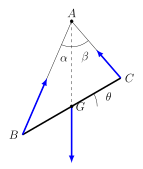
A uniform rigid rod \(BC\) is suspended from a fixed point \(A\) by light stretched springs \(AB,AC\). The springs are of different natural lengths but the ratio of tension to extension is the same constant \(\kappa\) for each. The rod is not hanging vertically. Show that the ratio of the lengths of the stretched springs is equal to the ratio of the natural lengths of the unstretched springs.
Solution:
1997 Paper 3 Q10
By pressing a finger down on it, a uniform spherical marble of radius \(a\) is made to slide along a horizontal table top with an initial linear velocity \(v_0\) and an initial {\em backward} angular velocity \(\omega_0\) about the horizontal axis perpendicular to \(v_0\). The frictional force between the marble and the table is constant (independent of speed). For what value of \(v_0/(a\omega_0)\) does the marble
- slide to a complete stop,
- come to a stop and then roll back towards its initial position with linear speed \(v_0/7\).
Solution:
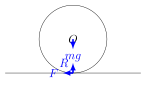
- If the ball completely stops, then \(\omega = v = 0 \Rightarrow \frac{2}{5}a \omega_0 - v_0 = 0 \Rightarrow \frac{v_0}{a \omega_0} = \frac25\).
- If the ball rolls backwards with linear speed \(v_0/7\), \(v = - \frac{v_0}{7}\) and \(a \omega = \frac{v_0}{7}\), \begin{align*} && \frac{2}{5}a \omega_0 - v_0 &= \frac{2}{5} \frac{v_0}{7} + \frac{v_0}{7} \\ && &= \frac{1}{5} v_0 \\ \Rightarrow && \frac{v_0}{a \omega_0} &= \frac{1}{3} \end{align*}
1997 Paper 3 Q11
\(\,\)
1997 Paper 3 Q12
- I toss a biased coin which has a probability \(p\) of landing heads and a probability \(q=1-p\) of landing tails. Let \(K\) be the number of tosses required to obtain the first head and let \[ \mathrm{G}(s)=\sum_{k=1}^{\infty}\mathrm{P}(K=k)s^{k}. \] Show that \[ \mathrm{G}(s)=\frac{ps}{1-qs} \] and hence find the expectation and variance of \(K\).
- I sample cards at random with replacement from a normal pack of \(52\). Let \(N\) be the total number of draws I make in order to sample every card at least once. By expressing \(N\) as a sum \(N=N_{1}+N_{2}+\cdots+N_{52}\) of random variables, or otherwise, find the expectation of \(N\). Estimate the numerical value of this expectation, using the approximations \(\mathrm{e}\approx2.7\) and \(1+\frac{1}{2}+\frac{1}{3}+\cdots+\frac{1}{n}\approx0.5+\ln n\) if \(n\) is large.
Solution:
- Let \(N_i\) be the number of draws between the \((i-1)\)th new card and the \(i\)th new card. (Where \(N_1 = 1\)0 then \(N_i \sim K\) with \(p = \frac{53-i}{52}\)). Therefore \begin{align*} \E[N] &= \E[N_1 + \cdots + N_{52}] \\ &= \E[N_1] + \cdots + \E[N_i] + \cdots + \E[N_{52}] \\ &= 1 + \frac{52}{51} + \cdots + \frac{52}{53-k} + \cdots + \frac{52}{1} \\ &= 52 \left (1 + \frac{1}{2} + \cdots + \frac{1}{52} \right) \\ &= 52 \cdot \left ( 1 + \ln 52 \right) \end{align*} Notice that \(2.7 \times 2.7 = 7.29\) and \(7.3 \times 7.3 \approx 53.3\) so \(\ln 52 \approx 4\) and so our number is \(\approx 52 \cdot 4.5 =234\). [The correct answer actual number is 235.9782]