Problems
Filters
1995 Paper 3 Q3
What is the general solution of the differential equation \[ \frac{\mathrm{d}^{2}x}{\mathrm{d}t^{2}}+2k\frac{\mathrm{d}x}{\mathrm{d}t}+x=0 \] for each of the cases: (i) \(k>1;\) (ii) \(k=1\); (iii) \(0 < x < 1\)? In case (iii) the equation represents damped simple harmonic motion with damping factor \(k\). Let \(x(0)=0\) and let \(x_{1},x_{2},\ldots,x_{n},\ldots\) be the sequence of successive maxima and minima, so that if \(x_{n}\) is a maximum then \(x_{n+1}\) is the next minimum. Show that \(\left|x_{n+1}/x_{n}\right|\) takes a value \(\alpha\) which is independent of \(n\), and that \[ k^{2}=\frac{(\ln\alpha)^{2}}{\pi^{2}+(\ln\alpha)^{2}}. \]
Solution: The auxiliary equation is \(\lambda^2 + 2k\lambda + 1 = (\lambda + k)^2+1-k^2 = 0\) (i) If \(k > 1\) then the solution is \(A\exp \left ({(-k + \sqrt{k^2-1})t} \right)+B\exp\left((-k-\sqrt{k^2-1})t \right)\). (ii) If \(k = 1\) then the solution is \(x = (A+Bt)e^{-kt}\) (iii) If \(k < 1\) then the solution is \(x = Ae^{-kt} \sin \left ( \sqrt{1-k^2} t \right)+Be^{-kt} \cos \left ( \sqrt{1-k^2} t \right)\) If \(x(0) = 0\) then \begin{align*} && x &= Ae^{-kt} \sin(\sqrt{1-k^2}t)\\ && \dot{x} &= Ae^{-kt} \left (-k \sin(\sqrt{1-k^2}t)+\sqrt{1-k^2} \cos(\sqrt{1-k^2}t) \right) \\ (\dot{x} =0): && \tan (\sqrt{1-k^2}t) &= \frac{\sqrt{1-k^2}}{k}\\ \end{align*} Therefore maxima and minima occur every \(\frac{\pi}{\sqrt{1-k^2}}\), so \begin{align*} && \frac{x_{n+1}}{x_n} &= \exp\left ( -\frac{k\pi}{\sqrt{1-k^2}} \right) \frac{\sin\left (\sqrt{1-k^2}\left(t+\frac{\pi}{\sqrt{1-k^2}}\right)\right)}{\sin(\sqrt{1-k^2}t)} \\ &&&= \exp\left ( -\frac{k\pi}{\sqrt{1-k^2}} \right) \left (-1+0 \right)\\ &&&= -\exp\left ( -\frac{k\pi}{\sqrt{1-k^2}} \right) \\ \Rightarrow && \ln \alpha &= - \frac{k\pi}{\sqrt{1-k^2}} \\ \Rightarrow && (\ln \alpha)^2 &= \frac{k^2\pi^2}{1-k^2} \\ \Rightarrow && (1-k^2)(\ln \alpha)^2 &= k^2 \pi^2 \\ \Rightarrow && k^2(\pi^2+(\ln \alpha)^2) &= (\ln \alpha)^2 \\ \Rightarrow && k^2 &= \frac{(\ln \alpha)^2}{\pi^2 + (\ln \alpha)^2} \end{align*}
1995 Paper 3 Q4
Let \[ \mathrm{C}_{n}(\theta)=\sum_{k=0}^{n}\cos k\theta \] and let \[ \mathrm{S}_{n}(\theta)=\sum_{k=0}^{n}\sin k\theta, \] where \(n\) is a positive integer and \(0<\theta<2\pi.\) Show that \[ \mathrm{C}_{n}(\theta)=\frac{\cos(\tfrac{1}{2}n\theta)\sin\left(\frac{1}{2}(n+1)\theta\right)}{\sin(\frac{1}{2}\theta)}, \] and obtain the corresponding expression for \(\mathrm{S}_{n}(\theta)\). Hence, or otherwise, show that for \(0<\theta<2\pi,\) \[ \left|\mathrm{C}_{n}(\theta)-\frac{1}{2}\right|\leqslant\frac{1}{2\sin(\frac{1}{2}\theta)}. \]
Solution: \begin{align*} && C_n(\theta) &= \sum_{k=0}^n \cos k \theta \\ &&&= \textrm{Re} \left ( \sum_{k=0}^n \exp (ik \theta)\right)\\ &&&= \textrm{Re} \left ( \frac{e^{i(n+1)\theta}-1}{e^{i\theta}-1}\right)\\ &&&= \textrm{Re} \left ( \frac{e^{i(n+1)\theta/2}}{e^{i\theta/2}}\frac{e^{i(n+1)\theta/2}-e^{-i(n+1)\theta/2}}{e^{i\theta/2}-e^{-i\theta/2}}\right)\\ &&&= \textrm{Re} \left ( e^{in\theta/2}\frac{\sin \left ( (n+1)\theta/2 \right)}{\sin \left ( \theta/2 \right)}\right)\\ &&&= \frac{\sin \left ( (n+1)\theta/2 \right)}{\sin \left ( \theta/2 \right)}\textrm{Re} \left ( e^{in\theta/2}\right)\\ &&&= \frac{\sin \left ( (n+1)\theta/2 \right)}{\sin \left ( \theta/2 \right)}\cos \left ( \frac12n\theta\right)\\ \\ && S_n(\theta) &= \sum_{k=0}^n \sin k \theta \\ &&&= \textrm{Im} \left ( \sum_{k=0}^n \exp (ik \theta)\right)\\ &&&= \frac{\sin \left ( (n+1)\theta/2 \right)}{\sin \left ( \theta/2 \right)}\textrm{Im} \left ( e^{in\theta/2}\right)\\ &&&= \frac{\sin \left ( (n+1)\theta/2 \right)}{\sin \left ( \theta/2 \right)}\sin\left ( \frac12n\theta\right)\\ \\ && C_n(\theta) - \frac12 &= \frac{\sin \left ( (n+1)\theta/2 \right)}{\sin \left ( \theta/2 \right)}\cos \left ( \frac12n\theta\right) - \frac12 \\ &&&= \frac{2\sin \left ( (n+1)\theta/2 \right)\cos\left ( n\theta/2 \right)-\sin (\theta/2)}{2 \sin (\theta/2)} \\ &&&= \frac{\sin\left ( (n+1)\theta/2+n\theta/2\right)+\sin\left ( (n+1)\theta/2-n\theta/2\right)-\sin (\theta/2)}{2 \sin (\theta/2)} \\ &&&= \frac{\sin\left ( (n+1)\theta/2+n\theta/2\right)+\sin\left ( \theta/2\right)-\sin (\theta/2)}{2 \sin (\theta/2)} \\ &&&= \frac{\sin\left ( (2n+1)\theta/2\right)}{2 \sin (\theta/2)} \leqslant\frac{1}{2 \sin (\theta/2)} \\ \end{align*}
1995 Paper 3 Q5
Show that \(y=\sin^{2}(m\sin^{-1}x)\) satisfies the differential equation \[ (1-x^{2})y^{(2)}=xy^{(1)}+2m^{2}(1-2y), \] and deduce that, for all \(n\geqslant1,\) \[ (1-x^{2})y^{(n+2)}=(2n+1)xy^{(n+1)}+(n^{2}-4m^{2})y^{(n)}, \] where \(y^{(n)}\) denotes the \(n\)th derivative of \(y\). Derive the Maclaurin series for \(y\), making it clear what the general term is.
Solution: \begin{align*} && y &= \sin^2 (m \sin^{-1} x) \\ \Rightarrow && y' &= 2 \sin (m \sin^{-1} x) \cdot \cos (m \sin^{-1} x) \cdot m \cdot \frac1{\sqrt{1-x^2}} \\ \Rightarrow && y'' &= 2 \cos^2(m \sin^{-1} x) \cdot m^2 \cdot \frac{1}{1-x^2} + \\ &&&\quad\quad-2\sin^2(m \sin^{-1} x) m^2 \frac{1}{1-x^2} + \\ &&&\quad\quad\quad-\sin(m \sin^{-1} x) \cdot \cos(m \sin^{-1} x) \cdot m \cdot (1-x^2)^{-\frac32} \cdot (-2x) \\ \Rightarrow && (1-x^2)y^{(2)} &= 2m^2-4m^2y+xy' \\ &&&= xy^{(1)} + 2m^2(1-2y) \\ \\ \Rightarrow && (1-x^2)y^{(n+2)}-2nxy^{(n+1)}-2\binom{n}{2}y^{(n)} &= xy^{(n+1)}+ny^{(n)} -4m^2y^{(n)} \\ \Rightarrow && (1-x^2)y^{(n+2)} &= (2n+1)xy^{(n+1)}+(n(n-1)+n-4m^2)y^{(n)} \\ &&&= (2n+1)xy^{(n+1)}+(n^2-4m^2)y^{(n)} \\ \end{align*} \begin{align*} && y(0) &= \sin^2(m \sin^{-1} 0) \\ &&&= \sin^2 0 = 0 \\ \\ && y'(0) &= 0 \\ && (1-0^2)y^{(2)}(0) &= 2m^2(1-2y(0)) \\ \Rightarrow && y^{(2)}(0) &= 2m^2 \\ \\ && y^{(n+2)} (0) &= (2n+1) \cdot 0 \cdot y^{(n+1)} +(n^2-4m^2)y^{(n)}(0) \\ &&&= (n^2-4m^2)y^{(n)}(0) \\ \\ && y^{(2)}(0) &= 2m^2 \\ && y^{(4)}(0) &= (4-4m^2) \cdot 2m^2 \\ &&&= -8m(m+1)m(m-1) \\ && y^{(6)}(0) &= 32m(m+2)(m+1)m(m-1)(m-2) \\ && y^{(2k)}(0) &= (-1)^{k+1}2^{2k-1}m (m+k)\cdots(m-k) \text{ if }k < m \\ \\ && y &= m^2x^2 -2m\binom{m+1}{3} x^4 + \frac{16}{3}m\binom{m+2}{5}x^6 - \cdots \\ &&&+ (-1)^{k}\frac{2^{2k}}{k+1} m \binom{m+k}{2k+1}x^{2k+2}+\cdots \\ &&&= mx^2\sum_{k=0}^{m-1} \frac{(-1)^k2^{2k}}{k+1}\binom{m+k}{2k+1}x^{2k} \end{align*}
1995 Paper 3 Q6
The variable non-zero complex number \(z\) is such that \[ \left|z-\mathrm{i}\right|=1. \] Find the modulus of \(z\) when its argument is \(\theta.\) Find also the modulus and argument of \(1/z\) in terms of \(\theta\) and show in an Argand diagram the loci of points which represent \(z\) and \(1/z\). Find the locus \(C\) in the Argand diagram such that \(w\in C\) if, and only if, the real part of \((1/w)\) is \(-1\).
Solution:

1995 Paper 3 Q7
Consider the following sets with the usual definition of multiplication appropriate to each. In each case you may assume that the multiplication is associative. In each case state, giving adequate reasons, whether or not the set is a group.
- the complex numbers of unit modulus;
- the integers modulo 4;
- the matrices \[ \mathrm{M}(\theta)=\begin{pmatrix}\cos\theta & -\sin\theta\\ \sin\theta & \cos\theta \end{pmatrix}, \] where \(0\leqslant\theta<2\pi\);
- the integers \(1,3,5,7\) modulo 8;
- the \(2\times2\) matrices all of whose entries are integers;
- the integers \(1,2,3,4\) modulo 5.
Solution:
- \(\{ z \in \mathbb{C} : |z| = 1\}\) is a group.
- (Closure) \(|z_1z_2| = |z_1||z_2| = 1\). Set is closed under multiplication
- (Associativity) Multiplication of complex numbers is associative
- (Identity) \(|1| = 1\)
- (Inverses) \(| \frac{1}{z} | = \frac{1}{|z|} = \frac{1}{1} = 1\), the set contains inverses
- the integers \(\pmod{4}\) are not a group under multiplication, \(2\) has no inverse, since \(0 \times k \equiv 0 \pmod{4}\)
- The set of rotation matrices is a group:
- (Closure) \begin{align*} \begin{pmatrix}\cos\theta_1 & -\sin\theta_1\\ \sin\theta_1 & \cos\theta_1 \end{pmatrix} \begin{pmatrix}\cos\theta_2 & -\sin\theta_2\\ \sin\theta_2 & \cos\theta_2 \end{pmatrix} &= {\scriptscriptstyle\begin{pmatrix}\cos\theta_1 \cos \theta_2 - \sin \theta_1\sin \theta_2 & -\sin\theta_1\ \cos \theta_1 - \sin \theta_2\cos\theta_1\\ \sin\theta_1\ \cos \theta_1 + \sin \theta_2\cos\theta_1 & \cos\theta_1 \cos \theta_2 - \sin \theta_1\sin \theta_2 \end{pmatrix}} \\ &= \begin{pmatrix}\cos(\theta_1+\theta_2) & -\sin(\theta_1+\theta_2)\\ \sin(\theta_1+\theta_2) & \cos(\theta_1+\theta_2) \end{pmatrix} \end{align*} Since \(\cos, \sin\) are periodic with period \(2\pi\), we can find \(\theta_3 = \theta_1 + \theta_2 + 2k\pi\) such that \(0 \leq \theta_3 < 2 \pi\), so our set is closed
- (Associativity) Matrix multiplication is associative
- (Identity) Consider \(\theta = 0\)
- (Inverses) Consider \(2\pi - \theta\)
- \(\{1, 3, 5, 7\} \pmod{8}\) is a group:
\begin{tabular}{c|cccc}
& 1 & 3 & 5 & 7 \\ \hline
1 & 1 & 3 & 5 & 7 \\
3 & 3 & 1 & 7 & 5 \\
5 & 5 & 7 & 1 & 3 \\
7 & 7 & 5 & 3 & 1 \\
\end{tabular}
- (Closure) See Cayley table
- (Associativity) Integer multiplication is associative
- (Identity) \(1\)
- (Inverses) \(x \mapsto x\) (See Cayley table)
- \(2\times2\) matrices are not a group, consider $0 = \begin{pmatrix} 0 & 0 \\ 0 & 0 \end{pmatrix}\(, then \)\mathbf{0}\mathbf{M} = \mathbf{0}$ for all other matrices.
- \begin{tabular}{c|cccc}
& 1 & 2 & 3 & 4 \\ \hline
1 & 1 & 2 & 3 & 4 \\
2 & 2 & 4 & 1 & 3 \\
3 & 3 & 1 & 4 & 2 \\
4 & 4 & 3 & 2 & 1 \\
\end{tabular}
- (Closure) See Cayley table
- (Associativity) Integer multiplication is associative
- (Identity) \(1\)
- (Inverses) \(1 \mapsto 1, 2 \mapsto 3, 3 \mapsto 2, 4 \mapsto 4\) (See Cayley table)
1995 Paper 3 Q8
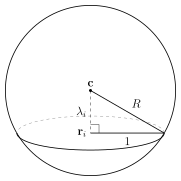
A plane \(\pi\) in 3-dimensional space is given by the vector equation \(\mathbf{r}\cdot\mathbf{n}=p,\) where \(\mathbf{n}\) is a unit vector and \(p\) is a non-negative real number. If \(\mathbf{x}\) is the position vector of a general point \(X\), find the equation of the normal to \(\pi\) through \(X\) and the perpendicular distance of \(X\) from \(\pi\). The unit circles \(C_{i},\) \(i=1,2,\) with centres \(\mathbf{r}_{i},\) lie in the planes \(\pi_{i}\) given by \(\mathbf{r}\cdot\mathbf{n}_{i}=p_{i},\) where the \(\mathbf{n}_{i}\) are unit vectors, and \(p_{i}\) are non-negative real numbers. Prove that there is a sphere whose surface contains both circles only if there is a real number \(\lambda\) such that \[ \mathbf{r}_{1}+\lambda\mathbf{n}_{1}=\mathbf{r}_{2}\pm\lambda\mathbf{n}_{2}. \] Hence, or otherwise, deduce the necessary conditions that \[ (\mathbf{r}_{1}-\mathbf{r}_{2})\cdot(\mathbf{n}_{1}\times\mathbf{n}_{2})=0 \] and that \[ (p_{1}-\mathbf{n}_{1}\cdot\mathbf{r}_{2})^{2}=(p_{2}-\mathbf{n}_{2}\cdot\mathbf{r}_{1})^{2}. \] Interpret each of these two conditions geometrically.
Solution: The equation of the normal to \(\pi\) through \(X\) is \(\mathbf{x} + \lambda \mathbf{n}\). The distance is \(|\mathbf{x}\cdot \mathbf{n}-p|\) We know that the centre of the sphere must lie above the centre of the circle following the normal, ie \(\mathbf{c} = \mathbf{r}_1+\lambda_1 \mathbf{n}_1 = \mathbf{r}_2+\lambda_2 \mathbf{n}_2\)
1995 Paper 3 Q9
A thin circular disc of mass \(m\), radius \(r\) and with its centre of mass at its centre \(C\) can rotate freely in a vertical plane about a fixed horizontal axis through a point \(O\) of its circumference. A particle \(P\), also of mass \(m,\) is attached to the circumference of the disc so that the angle \(OCP\) is \(2\alpha,\) where \(\alpha\leqslant\pi/2\).
- In the position of stable equilibrium \(OC\) makes an angle \(\beta\) with the vertical. Prove that \[ \tan\beta=\frac{\sin2\alpha}{2-\cos2\alpha}. \]
- The density of the disc at a point distant \(x\) from \(C\) is \(\rho x/r.\) Show that its moment of inertia about the horizontal axis through \(O\) is \(8mr^{2}/5\).
- The mid-point of \(CP\) is \(Q\). The disc is held at rest with \(OQ\) horizontal and \(C\) lower than \(P\) and it is then released. Show that the speed \(v\) with which \(C\) is moving when \(P\) passes vertically below \(O\) is given by \[ v^{2}=\frac{15gr\sin\alpha}{2(2+5\sin^{2}\alpha)}. \] Find the maximum value of \(v^{2}\) as \(\alpha\) is varied.
1995 Paper 3 Q10
A cannon is situated at the bottom of a plane inclined at angle \(\beta\) to the horizontal. A (small) cannon ball is fired from the cannon at an initial speed \(u.\) Ignoring air resistance, find the angle of firing which will maximise the distance up the plane travelled by the cannon ball and show that in this case the ball will land at a distance \[ \frac{u^{2}}{g(1+\sin\beta)} \] from the cannon.
1995 Paper 3 Q11
A ship is sailing due west at \(V\) knots while a plane, with an airspeed of \(kV\) knots, where \(k>\sqrt{2},\) patrols so that it is always to the north west of the ship. If the wind in the area is blowing from north to south at \(V\) knots and the pilot is instructed to return to the ship every thirty minutes, how long will her outward flight last? Assume that the maximum distance of the plane from the ship during the above patrol was \(d_{w}\) miles. If the air now becomes dead calm, and the pilot's orders are maintained, show that the ratio \(d_{w}/d_{c}\) of \(d_{w}\) to the new maximum distance, \(d_{c}\) miles, of the plane from the ship is \[ \frac{k^{2}-2}{2k(k^{2}-1)}\sqrt{4k^{2}-2}. \]
1995 Paper 3 Q12
The random variables \(X\) and \(Y\) are independently normally distributed with means 0 and variances 1. Show that the joint probability density function for \((X,Y)\) is \[ \mathrm{f}(x,y)=\frac{1}{2\pi}\mathrm{e}^{-\frac{1}{2}(x^{2}+y^{2})}\qquad-\infty < x < \infty,-\infty < y < \infty. \] If \((x,y)\) are the coordinates, referred to rectangular axes, of a point in the plane, explain what is meant by saying that this density is radially symmetrical. The random variables \(U\) and \(V\) have a joint probability density function which is radially symmetrical (in the above sense). By considering the straight line with equation \(U=kV,\) or otherwise, show that \[ \mathrm{P}\left(\frac{U}{V} < k\right)=2\mathrm{P}(U < kV,V > 0). \] Hence, or otherwise, show that the probability density function of \(U/V\) is \[ \mathrm{g}(k)=\frac{1}{\pi(1+k^{2})}\qquad-\infty < k < \infty. \]