Problems
Filters
2018 Paper 2 Q11
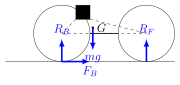
The axles of the wheels of a motorbike of mass \(m\) are a distance \(b\) apart. Its centre of mass is a horizontal distance of \(d\) from the front axle, where \(d < b\), and a vertical distance \(h\) above the road, which is horizontal and straight. The engine is connected to the rear wheel. The coefficient of friction between the ground and the rear wheel is \(\mu\), where \(\mu < b/h\), and the front wheel is smooth. You may assume that the sum of the moments of the forces acting on the motorbike about the centre of mass is zero. By taking moments about the centre of mass show that, as the acceleration of the motorbike increases from zero, the rear wheel will slip before the front wheel loses contact with the road if \[ \mu < \frac {b-d}h\,. \tag{*} \] If the inequality \((*)\) holds and the rear wheel does not slip, show that the maximum acceleration is \[ \frac{ \mu dg}{b-\mu h} \,. \] If the inequality \((*)\) does not hold, find the maximum acceleration given that the front wheel remains in contact with the road.
Solution:
2018 Paper 2 Q12
In a game, I toss a coin repeatedly. The probability, \(p\), that the coin shows Heads on any given toss is given by \[ p= \frac N{N+1} \,, \] where \(N\) is a positive integer. The outcomes of any two tosses are independent. The game has two versions. In each version, I can choose to stop playing after any number of tosses, in which case I win £\(H\), where \(H\) is the number of Heads I have tossed. However, the game may end before that, in which case I win nothing.
- In version 1, the game ends when the coin first shows Tails (if I haven't stopped playing before that). I decide from the start to toss the coin until a total of \(h\) Heads have been shown, unless the game ends before then. Find, in terms of \(h\) and \(p\), an expression for my expected winnings and show that I can maximise my expected winnings by choosing \(h=N\).
- In version 2, the game ends when the coin shows Tails on two consecutive tosses (if I haven't stopped playing before that). I decide from the start to toss the coin until a total of \(h\) Heads have been shown, unless the game ends before then. Show that my expected winnings are \[ \frac{ hN^h (N+2)^h}{(N+1)^{2h}} \,.\] In the case \(N=2\,\), use the approximation \(\log_3 2 \approx 0.63\) to show that the maximum value of my expected winnings is approximately £3.
Solution:
- Since we either win \(h\) or \(0\), to calculate the expected winnings we just need to calculate the probability that we get \(h\) consecutive heads, therefore: \begin{align*} && \mathbb{E}(\text{winnings}) &= E_h \\ &&&= h \cdot \left ( \frac{N}{N+1} \right)^h \\ && \frac{E_{h+1}}{E_h} &= \frac{h+1}{h }\left ( \frac{N}{N+1} \right) \end{align*} Therefore \(E_h\) is increasing if \(h \leq N\), so we can maximise our winnings by taking \(h = N\). (In fact, we could take \(h = N\) or \(h = N+1\), but arguably \(h = N\) is better as we have the same expected value but lower variance).
- We can have up to \(h\) tails appearing (if we imagine slots for tails of the form \(\underbrace{\_H\_H\_H\_\cdots\_H}_{h\text{ spaces and }h\, H}\) so, we have \begin{align*} && \mathbb{P}(\text{wins}) &= \sum_{t = 0}^h \mathbb{P}(\text{wins and } t\text{ tails}) \\ &&&= \sum_{t = 0}^h\binom{h}{t} \left ( \frac{N}{N+1} \right)^h\left ( \frac{1}{N+1} \right)^t \\ &&&= \left ( \frac{N}{N+1} \right)^h \sum_{t = 0}^h\binom{h}{t}\left ( \frac{1}{N+1} \right)^t \cdot 1^{h-t} \\ &&&= \left ( \frac{N}{N+1} \right)^h \left ( 1 + \left ( \frac{1}{N+1} \right) \right)^h \\ &&&= \left ( \frac{N}{N+1} \right)^h \left ( \frac{N+2}{N+1}\right)^h \\ &&&= \frac{N^h(N+2)^h}{(N+1)^{2h}} \\ \Rightarrow && \E(\text{winnings}) &= h \cdot \frac{N^h(N+2)^h}{(N+1)^{2h}} \end{align*} If \(N = 2\), we have \begin{align*} && \E(\text{winnings}) &= E_h \\ &&&= h \cdot \frac{2^h\cdot2^{2h}}{3^{2h}}\\ &&&= h \cdot \frac{2^{3h}}{3^{2h}} \\ \Rightarrow && \frac{E_{h+1}}{E_h} &= \frac{h+1}{h} \frac{8}{9} \\ \end{align*} Therefore to maximise the winnings we should take \(h = 8\), and the expected winnings will be: \begin{align*} && E_8 &= 8 \cdot \frac{2^{24}}{3^{16}} \\ \Rightarrow && \log_3 E_8 &= 27 \log_3 2 - 16 \\ &&&\approx 24 \cdot 0.63 - 16 \\ &&&\approx 17 - 16 \\ &&&\approx 1 \\ \Rightarrow && E_8 &\approx 3 \end{align*}
2018 Paper 2 Q13
Four children, \(A\), \(B\), \(C\) and \(D\), are playing a version of the game `pass the parcel'. They stand in a circle, so that \(ABCDA\) is the clockwise order. Each time a whistle is blown, the child holding the parcel is supposed to pass the parcel immediately exactly one place clockwise. In fact each child, independently of any other past event, passes the parcel clockwise with probability \(\frac{1}{4}\), passes it anticlockwise with probability \(\frac{1}{4}\) and fails to pass it at all with probability \(\frac{1}{2}\). At the start of the game, child \(A\) is holding the parcel. The probability that child \(A\) is holding the parcel just after the whistle has been blown for the \(n\)th time is \(A_n\), and \(B_n\), \(C_n\) and \(D_n\) are defined similarly.
- Find \(A_1\), \(B_1\), \(C_1\) and \(D_1\). Find also \(A_2\), \(B_2\), \(C_2\) and \(D_2\).
- By first considering \(B_{n+1}+D_{n+1}\), or otherwise, find \(B_n\) and \(D_n\). Find also expressions for \(A_n\) and \(C_n\) in terms of \(n\).
Solution:
- \(\,\) \begin{align*} && A_1 &= \frac12 \\ && B_1 &= \frac14 \\ && C_1 &= 0 \\ && D_1 &= \frac14 \end{align*} \begin{align*} && A_2 &= \frac12 \cdot \frac12 + 2 \cdot \frac14 \cdot \frac14 = \frac38 \\ && B_2 &= \frac14 \cdot \frac12 + \frac12 \cdot \frac14 = \frac14 \\ && C_2 &=2 \cdot \frac14 \cdot \frac14 =\frac18 \\ && D_2 &= B_2 = \frac14 \end{align*}
- \begin{align*} && A_{n+1} &= \frac12 A_n+ \frac14(B_n + D_n) \\ && B_{n+1} &= \frac12 B_n+ \frac14(A_n + C_n) \\ && C_{n+1} &= \frac12 C_n+ \frac14(D_n +B_n) \\ && D_{n+1} &= \frac12 D_n+ \frac14(C_n +A_n) \\ \\ \Rightarrow && B_{n+1}+D_{n+1} &= \frac12 (B_n+D_n) + \frac12(A_n+C_n) \\ &&&= \frac12 \\ \Rightarrow && B_{n+1}&=D_{n+1} = \frac14 \\ \\ && C_{n+1} &= \frac12C_n + \frac14 \cdot \frac12 \\ &&&= \frac12 C_n + \frac18\\ &&&= \frac12 C_{n-1} + \frac1{8} + \frac1{16} \\ &&&= \frac1{8} + \frac{1}{16} + \cdots + \frac{1}{8 \cdot 2^{n-1}} \\ &&&= \frac18 \left (1 + \frac12 + \cdots + \frac1{2^{n-1}} \right) \\ &&&= \frac18\left ( \frac{1-\frac1{2^n}}{1-\frac12} \right) \\ &&&= \frac18 \left (2 - \frac{1}{2^{n-1}} \right) \\ &&&= \frac14 - \frac{1}{2^{n-1}} \\ \Rightarrow && A_n &= \frac14 + \frac1{2^{n-1}} \end{align*}