Problems
Filters
2013 Paper 2 Q11
Three identical particles lie, not touching one another, in a straight line on a smooth horizontal surface. One particle is projected with speed \(u\) directly towards the other two which are at rest. The coefficient of restitution in all collisions is \(e\), where \(0 < e < 1\,\).
- Show that, after the second collision, the speeds of the particles are \(\frac12u(1-e)\), \(\frac14u (1-e^2)\) and \(\frac14u(1+e)^2\). Deduce that there will be a third collision whatever the value of \(e\).
- Show that there will be a fourth collision if and only if \(e\) is less than a particular value which you should determine.
Solution:
- First Collision:
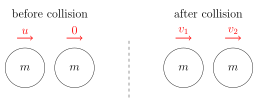
By NEL, \(v_2 = v_1 + eu\), so \begin{align*} \text{COM}: && mu &= mv_1 + m(v_1 + eu) \\ \Rightarrow && 2mv_1 &= mu(1-e) \\ \Rightarrow && v_1 &= \frac12 u(1-e) \\ && v_2 &= \frac12 u(1-e) + eu \\ &&&= \frac12 u(1+e) \end{align*} The second collision is identical to the first except replacing \(u\) with \(\frac12u(1+e)\), therefore after that collision: \begin{align*} && \text{first particle} &= \frac12 u(1-e) \\ && \text{second particle} &= \frac12 \left (\frac12 u(1+e) \right)(1-e) \\ &&&= \frac14 u(1-e^2) \\ && \text{third particle} &= \frac12 \left (\frac12 u(1+e) \right)(1+e) \\ &&&= \frac14 u(1+e)^2 \end{align*} After all these collisions, all particles are moving in the same direction (since they all have positive velocity), but the first particle is now travelling faster than the second particle (as \(\frac12(1-e) < 1\)). Therefore they will collide again.
- The third collision:
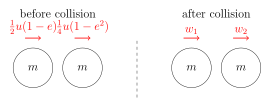
The speed of approach will be \(\frac12u(1-e) - \frac14u(1-e^2) = \frac14u(1-e)(2 - (1+e)) = \frac14 u(1-e)^2\), therefore by NEL, \(w_2 = w_1 + \frac14ue(1-e)^2\) \begin{align*} \text{COM}: && m\frac12u(1-e) + m \frac14u(1-e^2) &= mw_1 + m\left (w_1 + \frac14ue(1-e)^2 \right) \\ \Rightarrow && \frac14u(1-e)(2+(1+e)) &= 2w_1 + \frac14ue(1-e)^2 \\ \Rightarrow && 2w_1 &= \frac14u(1-e)(3+e)-\frac14ue(1-e)^2 \\ &&&= \frac14u(1-e)(3+e-e(1-e)) \\ &&&= \frac14u(1-e)(3+e^2) \\ \Rightarrow && w_1 &= \frac18 u(1-e)(3+e^2) \\ && w_2 &= \frac18 u(1-e)(3+e^2) + \frac14ue(1-e)^2 \\ &&&= \frac18u(1-e)(3+e^2+2e(1-e)) \\ &&&= \frac18u(1-e)(3+2e-e^2) \\ &&&= \frac18u(1-e)(1+e)(3-e) \\ \end{align*} A fourth collision is possible, iff \begin{align*} && \frac18u(1-e)(1+e)(3-e)&> \frac14 u(1+e)^2 \\ \Leftrightarrow && (1-e)(3-e)&> 2 (1+e) \\ \Leftrightarrow &&3-4e-e^2&> 2+2e \\ \Leftrightarrow &&1-5e-e^2&>0 \\ \Leftrightarrow && e &< 3-\sqrt{2} \end{align*}
2013 Paper 2 Q12
The random variable \(U\) has a Poisson distribution with parameter \(\lambda\). The random variables \(X\) and \(Y\) are defined as follows. \begin{align*} X&= \begin{cases} U & \text{ if \(U\) is 1, 3, 5, 7, \(\ldots\,\)} \\ 0 & \text{ otherwise} \end{cases} \\ Y&= \begin{cases} U & \text{ if \(U\) is 2, 4, 6, 8, \(\ldots\,\) } \\ 0 & \text{ otherwise} \end{cases} \end{align*}
- Find \(\E(X)\) and \(\E(Y)\) in terms of \(\lambda\), \(\alpha\) and \(\beta\), where \[ \alpha = 1+\frac{\lambda^2}{2!}+\frac{\lambda^4}{4!} +\cdots\, \text{ \ \ and \ \ } \beta = \frac{\lambda}{1!} + \frac{\lambda^3}{3!} + \frac{\lambda^5}{5!} +\cdots\,. \]
- Show that \[ \var(X) = \frac{\lambda\alpha+\lambda^2\beta}{\alpha+\beta} - \frac{\lambda^2\alpha^2}{(\alpha+\beta)^2} \] and obtain the corresponding expression for \(\var(Y)\). Are there any non-zero values of \(\lambda\) for which \( \var(X) + \var(Y) = \var(X+Y)\,\)?
Solution:
- \begin{align*} \mathbb{E}(X) &= \sum_{r=1}^\infty r \mathbb{P}(X = r) \\ &= \sum_{j=1}^{\infty} (2j-1)\mathbb{P}(U=2j-1) \\ &= \sum_{j=1}^{\infty}(2j-1) \frac{e^{-\lambda} \lambda^{2j-1}}{(2j-1)!} \\ &= \sum_{j=1}^{\infty} e^{-\lambda} \frac{\lambda^{2j-1}}{(2j-2)!} \\ &= \lambda e^{-\lambda} \sum_{j=1}^{\infty} \frac{\lambda^{2j-2}}{(2j-2)!} \\ &= \lambda e^{-\lambda} \alpha \end{align*} Since \(\mathbb{E}(X+Y) = \lambda, \mathbb{E}(Y) = \lambda(1-e^{-\lambda}\alpha) = \lambda(e^{-\lambda}(\alpha+\beta) - e^{-\lambda}\alpha) = \lambda e^{-\lambda} \beta\). Alternatively, as \(\beta + \alpha = e^{\lambda}\), \(\mathbb{E}(X) = \frac{\lambda \alpha}{\alpha+\beta}, \mathbb{E}(Y) = \frac{\lambda \beta}{\alpha+\beta}\)
- \begin{align*} \textrm{Var}(X) &= \mathbb{E}(X^2) - [\mathbb{E}(X) ]^2 \\ &= \sum_{odd} r^2 \mathbb{P}(U = r) - \left [ \mathbb{E}(X) \right]^2 \\ &= \sum_{odd} (r(r-1)+r)\frac{e^{-\lambda}\lambda^r}{r!} - \frac{\lambda^2 \alpha^2}{(\alpha+\beta)^2} \\ &= \sum_{odd} \frac{e^{-\lambda}\lambda^r}{(r-2)!}+\sum_{odd} \frac{e^{-\lambda}\lambda^r}{(r-1)!} - \frac{\lambda^2 \alpha^2}{(\alpha+\beta)^2} \\ &= e^{-\lambda}\lambda^2 \beta + e^{-\lambda}\lambda \alpha - \frac{\lambda^2 \alpha^2}{(\alpha+\beta)^2} \\ &= \frac{\lambda \alpha + \lambda^2 \beta}{\alpha+\beta}- \frac{\lambda^2 \alpha^2}{(\alpha+\beta)^2} \end{align*} Similarly, \begin{align*} \textrm{Var}(Y) &= \mathbb{E}(Y^2) - [\mathbb{E}(Y) ]^2 \\ &= \sum_{even} r^2 \mathbb{P}(U = r) - \left [ \mathbb{E}(Y) \right]^2 \\ &= \sum_{even} (r(r-1)+r)\frac{e^{-\lambda}\lambda^r}{r!} - \frac{\lambda^2 \beta^2}{(\alpha+\beta)^2} \\ &= e^{-\lambda}\lambda^2\alpha + e^{-\lambda}\lambda \beta - \frac{\lambda^2 \beta^2}{(\alpha+\beta)^2} \\ &= \frac{\lambda \beta + \lambda^2 \alpha}{\alpha+\beta}- \frac{\lambda^2 \beta^2}{(\alpha+\beta)^2} \end{align*} Since \(\textrm{Var}(X+Y) = \textrm{Var}(U) = \lambda\), we are interested in solving: \begin{align*} \lambda &= \frac{\lambda \alpha + \lambda^2 \beta}{\alpha+\beta}- \frac{\lambda^2 \alpha^2}{(\alpha+\beta)^2} + \frac{\lambda \beta + \lambda^2 \alpha}{\alpha+\beta}- \frac{\lambda^2 \beta^2}{(\alpha+\beta)^2} \\ &= \frac{\lambda(\alpha+\beta) + \lambda^2(\alpha+\beta)}{\alpha+\beta} - \frac{\lambda^2(\alpha^2+\beta^2)}{(\alpha+\beta)^2} \\ &= \lambda + \lambda^2 \frac{(\alpha+\beta)^2 - (\alpha^2+\beta^2)}{(\alpha+\beta)^2} \\ &= \lambda + \lambda^2 \frac{2\alpha\beta}{(\alpha+\beta)^2} \end{align*} which is clearly not possible if \(\lambda \neq 0\)
2013 Paper 2 Q13
A biased coin has probability \(p\) of showing a head and probability \(q\) of showing a tail, where \(p\ne0\), \(q\ne0\) and \(p\ne q\). When the coin is tossed repeatedly, runs occur. A straight run of length \(n\) is a sequence of \(n\) consecutive heads or \(n\) consecutive tails. An alternating run of length \(n\) is a sequence of length \(n\) alternating between heads and tails. An alternating run can start with either a head or a tail. Let \(S\) be the length of the longest straight run beginning with the first toss and let \(A\) be the length of the longest alternating run beginning with the first toss.
- Explain why \(\P(A=1)=p^2+q^2\) and find \(\P(S=1)\). Show that \(\P(S=1)<\P(A=1)\).
- Show that \(\P(S=2)= \P(A=2)\) and determine the relationship between \(\P(S=3)\) and \( \P(A=3)\).
- Show that, for \(n>1\), \(\P(S=2n)>\P(A=2n)\) and determine the corresponding relationship between \(\P(S=2n+1)\) and \(\P(A=2n+1)\). [You are advised not to use \(p+q=1\) in this part.]
Solution:
- The only way \(A = 1\) is if we get \(HH\) or \(TT\) which has probability \(p^2+q^2\). The only way we get \(S=1\) is if we have \(HT\) to \(TH\), ie \(2pq\). Since \((p-q)^2 = p^2 + q^2 - 2pq >0\) we must have \(\mathbb{P}(A=1) > \mathbb{P}(S=1)\).
- \(\,\) \begin{align*} \mathbb{P}(S=2) &= p^2q + q^2p \\ \mathbb{P}(A=2) &= pq^2 + qp^2 = \mathbb{P}(S=2) \\ \\ \mathbb{P}(S=3) &= p^3q + q^3p = pq(p^2+q^2) \\ \mathbb{P}(A=3) &= pqp^2 + qpq^2 = pq(p^2+q^2) = \mathbb{P}(S=3) \end{align*}
- For \(n > 1\) we must have \begin{align*} && \mathbb{P}(S = 2n) &= p^{2n}q + q^{2n}p \\ && \mathbb{P}(A=2n) &= (pq)^{n}q + (qp)^{n}p \\ &&&= p^nq^{n+1} + q^np^{n+1} \\ && \mathbb{P}(S = 2n) &> \mathbb{P}(A = 2n) \\ \Leftrightarrow && p^{2n}q + q^{2n}p & > p^nq^{n+1} + q^np^{n+1}\\ \Leftrightarrow && 0 & < p^{2n}q+q^{2n}p - p^nq^{n+1} -q^np^{n+1}\\ &&&= (p^n-q^n)(qp^n - pq^n) \end{align*} which is clearly true. \begin{align*} && \mathbb{P}(S=2n+1) &= p^{2n+1}q + q^{2n+1}p \\ && \mathbb{P}(A=2n+1) &= (pq)^{n}p^2 + (qp)^{n}q^2 \\ &&&= p^{n+2}q^n + q^{n+2}p^n \end{align*} The same factoring logic shows that \(\mathbb{P}(S = 2n+1) > \mathbb{P}(A=2n+1)\)