Problems
Filters
2017 Paper 1 Q11
A plane makes an acute angle \(\alpha\) with the horizontal. A box in the shape of a cube is fixed onto the plane in such a way that four of its edges are horizontal and two of its sides are vertical. A uniform rod of length \(2L\) and weight \(W\) rests with its lower end at \(A\) on the bottom of the box and its upper end at \(B\) on a side of the box, as shown in the diagram below. The vertical plane containing the rod is parallel to the vertical sides of the box and cuts the lowest edge of the box at \(O\). The rod makes an acute angle~\(\beta\) with the side of the box at \(B\). The coefficients of friction between the rod and the box at the two points of contact are both \(\tan \gamma\), where \(0 < \gamma < \frac12\pi\). %The frictional force on the rod at \(A\) acts toward \(O\), %and the frictional force on the rod at~\(B\) %acts away from \(O\). The rod is in limiting equilibrium, with the end at \(A\) on the point of slipping in the direction away from \(O\) and the end at \(B\) on the point of slipping towards \(O\). Given that \(\alpha < \beta\), show that \(\beta = \alpha + 2\gamma\). [\(Hint\): You may find it helpful to take moments about the midpoint of the rod.]
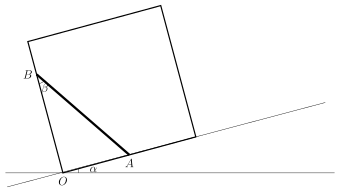
Solution:

2017 Paper 1 Q12
In a lottery, each of the \(N\) participants pays \(\pounds c\) to the organiser and picks a number from \(1\) to \(N\). The organiser picks at random the winning number from \(1\) to \(N\) and all those participants who picked this number receive an equal share of the prize, \(\pounds J\).
- The participants pick their numbers independently and with equal probability. Obtain an expression for the probability that no participant picks the winning number, and hence determine the organiser's expected profit. Use the approximation \[ \left( 1 - \frac{a}{N} \right)^N \approx \e^{-a} \tag{\(*\)} \] to show that if \(2Nc = J\) then the organiser will expect to make a loss. Note: \(\e > 2\).
- Instead of the numbers being equally popular, a fraction \(\gamma\) of the numbers are popular and the rest are unpopular. For each participant, the probability of picking any given popular number is \(\dfrac{a}{N}\) and the probability of picking any given unpopular number is \(\dfrac{b}{N}\,\). Find a relationship between \(a\), \(b\) and \(\gamma\). Show that, using the approximation \((*)\), the organiser's expected profit can be expressed in the form \[ A\e^{-a} + B\e^{-b} +C \,, \] where \(A\), \(B\) and \(C\) can be written in terms of \(J\), \(c\), \(N\) and \(\gamma\). In the case \(\gamma = \frac18\) and \(a=9b\), find \(a\) and \(b\). Show that, if \(2Nc = J\), then the organiser will expect to make a profit. Note: \(\e < 3\).
Solution:
- The probability no-one picks the winning number is \(\left ( 1 - \frac{1}{N}\right)^N \approx \frac1e\). \begin{align*} && \mathbb{E}(\text{profit}) &= Nc - (1-e^{-1})J \\ &&& < Nc -(1- \tfrac12 )J \\ &&& < Nc - \frac12 J \\ &&&= \frac{2Nc-J}{2} \end{align*} Therefore if \(J = 2Nc\) the expected profit is negative.
- \(\,\) \begin{align*} && 1 &= \sum_{\text{all numbers}} \mathbb{P}(\text{pick }i) \\ &&&= \sum_{\text{popular numbers}} \mathbb{P}(\text{pick }i)+\sum_{\text{unpopular numbers}} \mathbb{P}(\text{pick }i) \\ &&&=\gamma N \frac{a}{N} + (1-\gamma)N \frac{b}{N} \\ &&&= \gamma a + (1-\gamma)b \end{align*} \begin{align*} && \mathbb{P}(\text{no-one picks winning number}) &= \mathbb{P}(\text{no-one picks winning number} | \text{winning number is popular})\mathbb{P})(\text{winning number is popular}) + \\ &&&\quad + \mathbb{P}(\text{no-one picks} | \text{unpopular})\mathbb{P}(\text{unpopular}) \\ &&&= \left (1 - \frac{a}{N} \right)^N \gamma + \left (1 - \frac{b}{N} \right)^N (1-\gamma) \\ &&&\approx \gamma e^{-a} + (1-\gamma)e^{-b} \\ \\ && \mathbb{E}(\text{profit}) &= Nc - (1-\gamma e^{-a} - (1-\gamma)e^{-b})J \\ &&&= Nc-J+J\gamma e^{-a} +J(1-\gamma)e^{-b} \end{align*} If \(\gamma = \frac18\) and \(a=9b\), then \(1=\frac18 a + \frac78b = 2b \Rightarrow b = \frac12, a = \frac92\) and \begin{align*} && \mathbb{E}(\text{profit}) &= Nc-J +J\tfrac18e^{-9/2}+J\tfrac78e^{-1/2} \\ &&&= Nc-J+\tfrac18Je^{-1/2}(e^{-4}+7) \end{align*} If we can show \(e^{-1/2}\frac{e^{-4}+7}{8} > \frac12\) we'd be done, so \begin{align*} && e^{-1/2}\frac{e^{-4}+7}{8} &> \frac12 \\ \Leftrightarrow && e^{-4}+7 &>4e^{1/2} \\ \Leftrightarrow && 49+14e^{-4}+e^{-8} &>16e \\ \end{align*} But clearly the LHS \(>49\) and the RHS \(<48\) so we're done
2017 Paper 1 Q13
I have a sliced loaf which initially contains \(n\) slices of bread. Each time I finish setting a STEP question, I make myself a snack: either toast, using one slice of bread; or a sandwich, using two slices of bread. I make toast with probability \(p\) and I make a sandwich with probability \(q\), where \(p+q=1\), unless there is only one slice left in which case I must, of course, make toast. Let \(s_r\) (\(1 \le r \le n\)) be the probability that the \(r\)th slice of bread is the second of two slices used to make a sandwich and let \(t_r\) (\(1 \le r \le n\)) be the probability that the \(r\)th slice of bread is used to make toast. What is the value of \(s_1\)? Explain why the following equations hold: \begin{align*} \phantom{\hspace{2cm} (2\le r \le n-1)} t_r &= (s_{r-1}+ t_{r-1})\,p \hspace{2cm} (2\le r \le n-1)\,; \\ \phantom{\hspace{1.53cm} (2\le r \le n) } s_r &= 1- (s_{r-1} + t_{r-1}) \hspace{1.53cm} ( 2\le r \le n )\,. \end{align*} Hence, or otherwise, show that \(s_{r} = q(1-s_{r-1})\) for \(2\le r\le n-1\). Show further that \[ \phantom{\hspace{2.7cm} (1\le r\le n)\,,} s_r = \frac{q+(-q)^r}{1+q} \hspace{2.7cm} (1\le r\le n-1)\,, \, \hspace{0.14cm} \] and find the corresponding expression for \(t_r\). Find also expressions for \(s_n\) and \(t_n\) in terms of \(q\).
Solution: The \(1\)st slice of bread can only be the first slice in a sandwich or a slice of toast. Therefore \(s_1 = 0\) \begin{align*} && t_r &= \underbrace{s_{r-1}}_{r-1\text{th is the end of a sandwich}} \cdot \underbrace{p}_{\text{and we make toast}} + \underbrace{t_{r-1}}_{r-1\text{th is toast}} \cdot \underbrace{p}_{\text{and we make toast}} \\ &&&= (s_{r-1}+t_{r-1})p \\ \\ && s_r &= 1-\mathbb{P}(\text{previous slice is not the first of a sandwich}) \\ &&&= 1-(s_{r-1} + t_{r-1}) \\ \\ \Rightarrow && s_r &= 1 - \frac{t_r}{p} \\ \Rightarrow && t_r &= p - ps_r \\ \Rightarrow && s_r &= 1 - s_{r-1} - (p-ps_{r-1}) \\ &&&= 1 -p -(1-p)s_{r-1} \\ &&&= q(1-s_{r-1}) \end{align*} Therefore since \(s_r + qs_{r-1} = q\) we should look for a solution of the form \(s_r = A(-q)^r + B\). The particular solution will have \((1+q)B = q \Rightarrow B = \frac{q}{1+q}\), the initial condition will have \(s_1 = \frac{q}{1+q} +A(-q) = 0 \Rightarrow q = \frac{1}{1+q}\), so we must have \begin{align*} && s_r &= \frac{q+(-q)^r}{1+q}\\ \Rightarrow && t_r &= p(1-s_r) \\ &&&= p \frac{1+q-q-(-q)^r}{1+q} \\ &&&= \frac{(1-q)(1-(-q)^r)}{1+q} \\ && s_n &= 1-\frac{q+(-q)^{n-1}}{1+q} - \frac{p(1-(-q)^{n-1})}{1+q} \\ &&&= 1-\frac{1+(1-p)(-q)^{n-1}}{1+q}\\ &&&= 1-\frac{1-(-q)^n}{1+q}\\ &&&= \frac{q+(-q)^n}{1+q}\\ && t_n &=1-s_n \\ &&&=\frac{1-(-q)^n}{1+q} \end{align*}