Problems
Filters
2013 Paper 1 Q11
\(\,\)
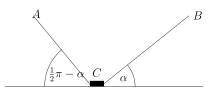
- In the case \(W> T\sin(\alpha+\beta)\), show that the block will remain at rest provided \[ W\sin\lambda \ge T\cos(\alpha+\beta- \lambda)\,, \] where \(\lambda\) is the acute angle such that \(\tan\lambda = \mu\).
- In the case \(W=T\tan\phi\), where \(2\phi =\alpha+\beta\), show that the block will start to move in a direction that makes an angle \(\phi\) with the horizontal.
Solution:
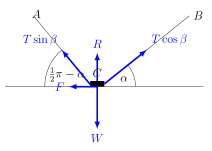
- Assuming the block is at rest we must have: \begin{align*} \text{N2}(\uparrow): && 0 &= T \sin \beta\cos \alpha + T \cos \beta \sin \alpha +R -W \\ \Rightarrow && W &> T \sin \beta\cos \alpha + T \cos \beta \sin \alpha \\ &&&= T\sin(\alpha+\beta) \\ \Rightarrow && R &= W-T\sin(\alpha+\beta)\\ \\ \text{N2}(\rightarrow): && 0 &= T \cos \beta \cos \alpha - T \sin \beta \sin \alpha - F \\ \Rightarrow && T \cos(\alpha+\beta) &= F \\ &&&\leq \mu (W-T\sin(\alpha+\beta)) \\ \Rightarrow && W \sin \lambda &\geq T \cos (\alpha+\beta)\cos \lambda +T \sin (\alpha+\beta) \sin \lambda \\ &&&= T\cos(\alpha+\beta-\lambda) \end{align*}
- If \(W = T\tan \phi\) where \(2\phi = \alpha + \beta\) then \begin{align*} \text{N2}(\uparrow): && ma_y &= T\sin(\alpha+\beta) - W \\ &&&= T \sin(\alpha+\beta) - T \tan \left ( \frac{\alpha+\beta}{2} \right ) \\ &&&= T \tan \left ( \frac{\alpha+\beta}{2} \right ) \left ( 2 \cos^2 \left ( \frac{\alpha+\beta}{2} \right ) -1\right) \\ &&&= T \tan \phi \cos \left ( \alpha+\beta\right ) \tag{notice this is positive so \(R=F=0\)} \\ \text{N2}(\rightarrow): && ma_x &= T \cos(\alpha+\beta) \\ \Rightarrow && \frac{a_y}{a_x} &= \tan \phi \end{align*} Therefore we are accelerating at an angle \(\phi\) to the horizontal
2013 Paper 1 Q12
Each day, I have to take \(k\) different types of medicine, one tablet of each. The tablets are identical in appearance. When I go on holiday for \(n\) days, I put \(n\) tablets of each type in a container and on each day of the holiday I select \(k\) tablets at random from the container.
- In the case \(k=3\), show that the probability that I will select one tablet of each type on the first day of a three-day holiday is \(\frac9{28}\). Write down the probability that I will be left with one tablet of each type on the last day (irrespective of the tablets I select on the first day).
- In the case \(k=3\), find the probability that I will select one tablet of each type on the first day of an \(n\)-day holiday.
- In the case \(k=2\), find the probability that I will select one tablet of each type on each day of an \(n\)-day holiday, and use Stirling's approximation \[ n!\approx \sqrt{2n\pi} \left(\frac n\e\right)^n \] to show that this probability is approximately \(2^{-n} \sqrt{n\pi\;}\).
Solution:
- The probability the first is different to the second is \(\frac68\), the probability the third is different to both of the first two is \(\frac37\) therefore the probability is \(\frac{6}{8} \cdot \frac37 = \frac9{28}\) Whatever pills we are left with on the last day is essentially the same random choice as we make on the first day, therefore \(\frac9{28}\)
- The probability the first is different to the second is \(\frac{2n}{3n-1}\), the probability the third is different to both of the first two is \(\frac{n}{3n-2}\) therefore the probability is \(\frac{2n^2}{(3n-1)(3n-2)}\). [We can also view this as \(\frac{(3n) \cdot (2n) \cdot n}{(3n) \cdot (3n-1) \cdot (3n-2)}\)]
- Suppose describe the pills as \(B\) and \(R\) and also number them, then we must have a sequence of the form: \[ B_1R_1 \, B_2R_2 \, B_3R_3 \, \cdots \, B_{n}R_n \] However, we can also rearrange the order of the \(B\) and \(R\) pills in \(n!\) ways each, and also the order of the pairs in \(2^n\) ways. There are \((2n)!\) orders we could have taken the pills out therefore the probability is \begin{align*} && P &= \frac{2^n (n!)^2}{(2n)!} = \frac{2^n}{\binom{2n}{n}} \\ &&&\approx \frac{2^n \cdot 2n \pi \left ( \frac{n}{e} \right)^{2n}}{\sqrt{2 \cdot 2n \cdot \pi} \left ( \frac{2n}{e} \right)^{2n}} \\ &&&= \frac{2^n \sqrt{n \pi} \cdot n^{2n} \cdot e^{-2n}}{2^{2n} \cdot n^{2n} \cdot e^{-2n}} \\ &&&= 2^{-n} \sqrt{n \pi} \end{align*} There is a nice way to think about this question using conditional probability. Suppose we are drawing out of an infinitely supply of \(R\) and \(B\) pills, then each day there is a \(\frac12\) chance of getting different pills. Therefore over \(n\) days there is a \(2^{-n}\) chance of getting different pills. Conditional on the balanced total we see that \begin{align*} && \mathbb{P}(\text{balanced every day} |\text{balanced total}) &= \frac{\mathbb{P}(\text{balanced every day})}{\mathbb{P}(\text{balanced total})} \end{align*} We have already seen the term that is balanced total is \(\frac{1}{2^{2n}}\binom{2n}{n}\), but we can also approximate the balanced total using a normal approximation. \(B(2n, \tfrac12) \approx N(n, \frac{n}{2})\) and so: \begin{align*} \mathbb{P}(X = n) &\approx \mathbb{P}\left (n-0.5 \leq \sqrt{\tfrac{n}{2}} Z + n \leq n+0.5 \right) \\ &= \mathbb{P}\left (- \frac1{\sqrt{2n}} \leq Z \leq \frac{1}{\sqrt{2n}} \right) \\ &= \int_{- \frac1{\sqrt{2n}}}^{\frac1{\sqrt{2n}}} \frac{1}{\sqrt{2\pi}} e^{-x^2/2} \d x \approx \frac{2}{\sqrt{2n}} \frac{1}{\sqrt{2\pi}} \\ &\approx \frac{1}{\sqrt{n\pi}} \end{align*}
2013 Paper 1 Q13
From the integers \(1, 2, \ldots , 52\), I choose seven (distinct) integers at random, all choices being equally likely. From these seven, I discard any pair that sum to 53. Let \(X\) be the random variable the value of which is the number of discarded pairs. Find the probability distribution of \(X\) and show that \(\E (X) = \frac 7 {17}\). Note: \(7\times 17 \times 47 =5593\).
Solution: There are \(\binom{26}3\binom{23}{1}2\) ways to obtain \(3\) pairs There are \(\binom{26}2 \binom{24}3 \cdot 2^3\) ways to obtain \(2\) pairs There are \(\binom{26}1 \binom{25}5 \cdot 2^5\) ways to obtain \(1\) pairs There are \(\binom{26}7 \cdot 2^7\) ways to obtain \(0\) pairs There are \(\binom{52}{7}\) ways to choose our integers, so \begin{align*} && \mathbb{P}(X = 3) &= \frac{\binom{26}{3} \cdot \binom{23}{1} \cdot 2}{\binom{52}{7}} \\ &&&= \frac{7! \cdot 26 \cdot 25 \cdot 24 \cdot 23 \cdot 2}{3! \cdot 52 \cdot 51 \cdot 50 \cdot 49 \cdot 48 \cdot 47 \cdot 46} \\ &&&= \frac{7 \cdot 6 \cdot 5 \cdot 4 }{51 \cdot 2\cdot 49 \cdot 2\cdot 47 \cdot 2} \\ &&&= \frac{ 5 }{17\cdot 7\cdot 47} = \frac{5}{5593} \\ \\ && \mathbb{P}(X = 2) &= \frac{\binom{26}2 \binom{24}3 \cdot 2^3}{\binom{52}{7}} \\ &&&= \frac{220}{5593} \\ \\ && \mathbb{P}(X = 1) &= \frac{\binom{26}1 \binom{25}5 \cdot 2^5}{\binom{52}{7}} \\ &&&= \frac{1848}{5593} \\ \\ && \mathbb{P}(X = 0) &= \frac{\binom{26}7 \cdot 2^7}{\binom{52}{7}} \\ &&&= \frac{3520}{5593} \\ \\ && \mathbb{E}(X) &= \frac{1848}{5593} + 2 \cdot \frac{220}{5593} + 3 \cdot \frac{5}{5593} \\ &&&= \frac{2303}{5593} = \frac{7}{17} \end{align*} Notice we can find the expected value directly: Let \(X_i\) be the random variable the \(i\)th number is discarded. Notice that \(\mathbb{E}(X) = \mathbb{E}\left (\frac12 \left (X_1 +X_2 +X_3 +X_4 +X_5 +X_6 +X_7\right) \right)\) and also notice that each \(X_i\) has the same distribution (although not independent!). Then \begin{align*} &&\mathbb{E}(X) &= \frac72 \mathbb{E}(X_i) \\ &&&= \frac72 \cdot \left (1 - \frac{50}{51} \cdot \frac{49}{50} \cdots \frac{45}{46} \right) = \frac74 \left ( 1 - \frac{45}{51}\right) \\ &&&= \frac72 \cdot \frac{6}{51} \\ &&&= \frac7{17} \end{align*}