Problems
Filters
2012 Paper 1 Q11
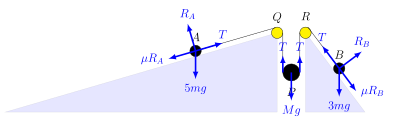
The diagram shows two particles, \(A\) of mass \(5m\) and \(B\) of mass \(3m\), connected by a light inextensible string which passes over two smooth, light, fixed pulleys, \(Q\) and \(R\), and under a smooth pulley \(P\) which has mass \(M\) and is free to move vertically. Particles \(A\) and \(B\) lie on fixed rough planes inclined to the horizontal at angles of \(\arctan \frac 7{24}\) and \(\arctan\frac43\) respectively. The segments \(AQ\) and \(RB\) of the string are parallel to their respective planes, and segments \(QP\) and \(PR\) are vertical. The coefficient of friction between each particle and its plane is \(\mu\).

- Given that the system is in equilibrium, with both \(A\) and \(B\) on the point of moving up their planes, determine the value of \(\mu\) and show that \(M = 6m\).
- In the case when \(M = 9m\), determine the initial accelerations of \(A\), \(B\) and \(P\) in terms of \(g\).
Solution:
2012 Paper 1 Q12
Fire extinguishers may become faulty at any time after manufacture and are tested annually on the anniversary of manufacture. The time \(T\) years after manufacture until a fire extinguisher becomes faulty is modelled by the continuous probability density function \[ f(t) = \begin{cases} \frac{2t}{(1+t^2)^2}& \text{for \(t\ge0\)}\,,\\[4mm] \ \ \ \ 0& \text{otherwise}. \end{cases} \] A faulty fire extinguisher will fail an annual test with probability \(p\), in which case it is destroyed immediately. A non-faulty fire extinguisher will always pass the test. All of the annual tests are independent. Show that the probability that a randomly chosen fire extinguisher will be destroyed exactly three years after its manufacture is \(p(5p^2-13p +9)/10\). Find the probability that a randomly chosen fire extinguisher that was destroyed exactly three years after its manufacture was faulty 18 months after its manufacture.
Solution: The probability it becomes faulty in each year is: \begin{align*} \mathbb{P}(\text{faulty in Y}1) &= \int_0^1 \frac{2t}{(1+t^2)^2} \, dt \\ &= \left [ -\frac{1}{(1+t^2)} \right]_0^1 \\ &= 1 - \frac{1}{2} = \frac{1}{2} \\ \mathbb{P}(\text{faulty in Y}2) &= \frac{1}{2} - \frac{1}{5} = \frac{3}{10} \\ \mathbb{P}(\text{faulty in Y}3) &= \frac{1}{5} - \frac{1}{10} = \frac{1}{10} \end{align*} The probability of failing for the first time after exactly \(3\) years is: \begin{align*} \mathbb{P}(\text{faulty in Y1, }PPF) &+ \mathbb{P}(\text{faulty in Y2, }PF) + + \mathbb{P}(\text{faulty in Y3, }F) \\ &= \frac12 (1-p)^2p + \frac3{10}(1-p)p + \frac1{10}p \\ &= \frac{p}{10} \l 5(1-p)^2 + 3(1-p) + 1 \r \\ &= \frac{p}{10} \l 5 - 10p + 5p^2 + 3 -3p +1 \r \\ &= \frac{p}{10} \l 9 - 13p + 5p^2 \r \end{align*} as required. The probability that a randomly chosen fire extinguisher that was destroyed exactly three years after its manufacture was faulty 18 months after its manufacture is: \begin{align*} \mathbb{P}(\text{faulty 18 months after} | \text{fails after 3 tries}) &= \frac{\mathbb{P}(\text{faulty 18 months after and fails after 3 tries})}{\mathbb{P}(\text{fails after exactly 3 tries})} \end{align*} We can compute \(\mathbb{P}(\text{faulty 18 months after and fails after 3 tries})\) by looking at \(2\) cases, fails between \(12\) months and \(18\) years, and between \(0\) years and \(1\) year. \begin{align*} \mathbb{P}(\text{faulty between 1y and 18m}) &= \int_{1}^{\frac32} \frac{2t}{(1+t^2)^2} \, dt \\ &= \left [ -\frac{1}{(1+t^2)} \right]_{1}^{\frac32} \\ &= \frac12 - \frac{4}{13} = \frac{5}{26} \\ \end{align*} So the probability is: \begin{align*} \mathbb{P} &= \frac{\frac{5}{26}(1-p)p + \frac12(1-p)^2p}{\frac{p}{10} \l 9 - 13p + 5p^2 \r} \\ &= \frac{\frac{25}{13}(1-p) + 5(1-p)^2}{9 - 13p + 5p^2} \\ &= \frac{5}{13} \frac{(1-p)\l 5 + 13(1-p) \r}{9 - 13p + 5p^2} \\ &= \frac{5}{13} \frac{(1-p)\l 18 - 13p \r}{9 - 13p + 5p^2} \\ \end{align*}
2012 Paper 1 Q13
I choose at random an integer in the range 10000 to 99999, all choices being equally likely. Given that my choice does not contain the digits 0, 6, 7, 8 or 9, show that the expected number of different digits in my choice is 3.3616.
Solution: We are choosing any \(5\) digit number from \(\{1,2,3,4,5\}\). There are \(5^5\) such numbers. \begin{align*} && \mathbb{E}(\text{different digits}) &= \frac1{5^5} \left (1 \cdot 5 + 2 \cdot \binom{5}{2}(2^5-2)+3 \cdot \binom{5}{3}(3^5-3 \cdot 2^5+3)+4 \cdot \binom{5}{4}(4^5 - 4 \cdot 3^5+6 \cdot 2^5-4) + 5 \cdot 5! \right) \\ &&&= \frac{2101}{625} = 3.3616 \end{align*}