Problems
Filters
2010 Paper 1 Q11
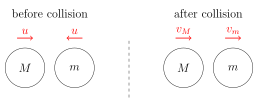
Two particles of masses \(m\) and \(M\), with \(M>m\), lie in a smooth circular groove on a horizontal plane. The coefficient of restitution between the particles is \(e\). The particles are initially projected round the groove with the same speed \(u\) but in opposite directions. Find the speeds of the particles after they collide for the first time and show that they will both change direction if \(2em> M-m\). After a further \(2n\) collisions, the speed of the particle of mass \(m\) is \(v\) and the speed of the particle of mass \(M\) is \(V\). Given that at each collision both particles change their directions of motion, explain why \[ mv-MV = u(M-m), \] and find \(v\) and \(V\) in terms of \(m\), \(M\), \(e\), \(u\) and \(n\).
Solution: All the forces in the circular groove will be perpendicular to the direction of motion. Therefore the particles will continue moving with constant speed at all times (aside from collisions). We can consider the collisions to occur as if along a tangent, (since they will be travelling perfectly perpendicular at the collisions).
2010 Paper 1 Q12
A discrete random variable \(X\) takes only positive integer values. Define \(\E(X)\) for this case, and show that \[\E(X) =\sum^{\infty}_{n=1}\P\left(X\ge n \right).\] I am collecting toy penguins from cereal boxes. Each box contains either one daddy penguin or one mummy penguin. The probability that a given box contains a daddy penguin is \(p\) and the probability that a given box contains a mummy penguin is \(q\), where \(p\ne0\), \(q\ne0\) and \(p+q=1\,\). Let \(X\) be the number of boxes that I need to open to get at least one of each kind of penguin. Show that \(\P(X\ge 4)= p^{3}+q^{3}\), and that \[ \E(X)=\frac{1}{pq}-1.\, \] Hence show that \(\E(X)\ge 3\,\).
Solution: \[ \E[X] := \sum_{n=1}^{\infty} n \mathbb{P}(X=n) \] \begin{align*} && \sum^{\infty}_{n=1}\mathbb{P}\left(X\ge n \right) &= \sum^{\infty}_{n=1}\sum_{k=n}^\infty \mathbb{P}(X=k) \\ &&&= \sum_{k=1}^\infty k \cdot \mathbb{P}(X=k) \\ &&&= \E[X] \end{align*} \begin{align*} &&\mathbb{P}(X \geq 4) &= \mathbb{P}(\text{first 3 are daddies}) +\mathbb{P}(\text{first 3 are mummies}) \\ &&&= p^3 + q^3 \\ \Rightarrow && \E[X] &= \sum_{n=1}^{\infty} \mathbb{P}\left(X\ge n \right) \\ &&&= 1+\sum_{n=2}^{\infty} \left ( p^{n-1} + q^{n-1}\right) \\ &&&= 1+\frac{p}{1-p} + \frac{q}{1-q} \\ &&&= 1+\frac{p}q + \frac{q}p \\ &&&= 1+\frac{p^2+q^2}{pq} \\ &&&= 1+\frac{(p+q)^2-2pq}{pq} \\ &&&= \frac{1}{pq} -1 \\ &&& \underbrace{\geq}_{AM-GM} \frac{1}{4}-1 = 3 \end{align*}
2010 Paper 1 Q13
The number of texts that George receives on his mobile phone can be modelled by a Poisson random variable with mean \(\lambda\) texts per hour. Given that the probability George waits between 1 and 2 hours in the morning before he receives his first text is \(p\), show that \[ p\e^{2\lambda}-\e^{\lambda}+1=0. \] Given that \(4p<1\), show that there are two positive values of \(\lambda\) that satisfy this equation. The number of texts that Mildred receives on each of her two mobile phones can be modelled by independent Poisson random variables with different means \(\lambda_{1}\) and \(\lambda_{2}\) texts per hour. Given that, for each phone, the probability that Mildred waits between 1 and 2 hours in the morning before she receives her first text is also \(p\), find an expression for \(\lambda_{1}+\lambda_{2}\) in terms of \(p\). Find the probability, in terms of \(p\), that she waits between 1 and 2 hours in the morning to receive her first text.
Solution: Let \(X_t\) be the number of texts he recieves before \(t\) hours. So \(X_t \sim P(t\lambda)\) \begin{align*} &&\mathbb{P}(X_1 = 0 \, \cap \, X_2 > 0) &= e^{-\lambda} \cdot \left ( 1-e^{-\lambda}\right) = p \\ \Rightarrow && e^{2\lambda}p &= e^{\lambda} - 1 \\ \Rightarrow && 0 &= pe^{2\lambda}-e^{\lambda} + 1 \\ \Rightarrow && e^{\lambda} &= \frac{1 \pm \sqrt{1-4p}}{2p} \end{align*} Which clearly has two positive roots if \(4p < 1\). We need to show both roots are \(>1\). So considering the smaller one we are looking at: \begin{align*} && \frac{1-\sqrt{1-4p}}{2p} & > 1 \\ \Leftrightarrow && 1-\sqrt{1-4p} &> 2p \\ \Leftrightarrow && 1-2p&> \sqrt{1-4p} \\ \Leftrightarrow && (1-2p)^2&> 1-4p \\ \Leftrightarrow && 1-4p+4p^2&> 1-4p \\ \end{align*} which is clearly true. We must have \(e^{\lambda_1}\cdot e^{\lambda_2} = \frac{1}{p}\), so \(\lambda_1 + \lambda_2 = -\ln p\) by considering the product of the roots in our quadratic. (Vieta). Therefore the probability she waits between 1 and 2 hours in the morning is \(e^{-(\lambda_1 + \lambda_2)} \cdot ( 1- e^{-(\lambda_1+\lambda_2)}) = p \cdot (1-p)\)