Problems
Filters
2003 Paper 1 Q11
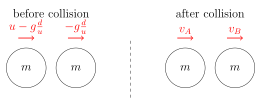
A smooth plane is inclined at an angle \(\alpha\) to the horizontal. \(A\) and \(B\) are two points a distance \(d\) apart on a line of greatest slope of the plane, with \(B\) higher than \(A\). A particle is projected up the plane from \(A\) towards \(B\) with initial speed \(u\), and simultaneously another particle is released from rest at \(B\,\). Show that they collide after a time \(\displaystyle {d /u}\,\). The coefficient of restitution between the two particles is \(e\) and both particles have mass \(m\,\). Show that the loss of kinetic energy in the collision is \(\frac14 {m u^2 \big( 1 - e^2 \big) }\,\).
Solution: We can `ignore' the fact that they are both accelerating, because the acceleration is the same for both object so it will "cancel" out. Therefore the time taken is the same as if the object has to travel distance \(d\) at speed \(u\), ie \(d/u\). \begin{align*} && u_A &= u - g \frac{d}{u} \\ && u_B &= -g\frac{d}{u} \end{align*}
2003 Paper 1 Q12
In a bag are \(n\) balls numbered 1, 2, \(\ldots\,\), \(n\,\). When a ball is taken out of the bag, each ball is equally likely to be taken.
- A ball is taken out of the bag. The number on the ball is noted and the ball is replaced in the bag. The process is repeated once. Explain why the expected value of the product of the numbers on the two balls is \[ \frac 1 {n^2} \sum_{r=1}^n\sum_{s=1}^n rs \] and simplify this expression.
- A ball is taken out of the bag. The number on the ball is noted and the ball is {\sl not} replaced in the bag. Another ball is taken out of the bag and the number on this ball is noted. Show that the expected value of the product of the two numbers is \[ \frac{(n+1)(3n+2)}{12}\;. \]
2003 Paper 1 Q13
If a football match ends in a draw, there may be a "penalty shoot-out". Initially the teams each take 5 shots at goal. If one team scores more times than the other, then that team wins. If the scores are level, the teams take shots alternately until one team scores and the other team does not score, both teams having taken the same number of shots. The team that scores wins. Two teams, Team A and Team B, take part in a penalty shoot-out. Their probabilities of scoring when they take a single shot are \(p_A\) and \(p_B\) respectively. Explain why the probability \(\alpha\) of neither side having won at the end of the initial \(10\)-shot period is given by $$\alpha =\sum_{i=0}^5\binom{5}{i}^2(1-p_A)^i(1-p_B)^i\,p_A^{5-i}p_B^{5-i}.$$ Show that the expected number of shots taken is \(\ds10+ \frac{2\alpha}\beta\;,\) where \(\beta=p_A+p_B-2p_Ap_B\,.\)
2003 Paper 1 Q14
Jane goes out with any of her friends who call, except that she never goes out with more than two friends in a day. The number of her friends who call on a given day follows a Poisson distribution with parameter \(2\). Show that the average number of friends she sees in a day is~\(2-4\e^{-2}\,\). Now Jane has a new friend who calls on any given day with probability \(p\). Her old friends call as before, independently of the new friend. She never goes out with more than two friends in a day. Find the average number of friends she now sees in a day.