Problems
Filters
1999 Paper 1 Q11
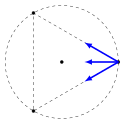
The force of attraction between two stars of masses \(m_{1}\) and \(m_{2}\) a distance \(r\) apart is \(\gamma m_{1}m_{2}/r^{2}\). The Starmakers of Kryton place three stars of equal mass \(m\) at the corners of an equilateral triangle of side \(a\). Show that it is possible for each star to revolve round the centre of mass of the system with angular velocity \((3\gamma m/a^{3})^{1/2}\). Find a corresponding result if the Starmakers place a fourth star, of mass \(\lambda m\), at the centre of mass of the system.
Solution: The net force on the planets will always be towards the centre of mass (by symmetry or similar arguments). Therefore it suffices to check whether we can find a speed where the planets follow uniform circular motion, ie \(F = mr \omega^2\). (But clearly this is possible, we just need to find the speed)

1999 Paper 1 Q12
- Prove that if \(x>0\) then \(x+x^{-1}\ge2.\;\) I have a pair of six-faced dice, each with faces numbered from 1 to 6. The probability of throwing \(i\) with the first die is \(q_{i}\) and the probability of throwing \(j\) with the second die is \(r_{j}\) (\(1\le i,j \le 6\)). The two dice are thrown independently and the sum noted. By considering the probabilities of throwing 2, 12 and 7, show the sums \(2, 3, \dots, 12\) are not equally likely.
- The first die described above is thrown twice and the two numbers on the die noted. Is it possible to find values of \(q_{j}\) so that the probability that the numbers are the same is less than \(1/36\)?
Solution:
- Notice that if \(x > 0\) we must have \begin{align*} && \left ( \sqrt{x} - \frac{1}{\sqrt{x}} \right)^2 &\geq 0 \\ \Leftrightarrow && x - 2 + x^{-1} & \geq 0 \\ \Leftrightarrow && x + x^{-1} & \geq 2 \end{align*} Let \(S\) be the sum, and assume all probabilities are equal \begin{align*} && \mathbb{P}(S = 2) &= q_1 r_1 \\ && \mathbb{P}(S = 12) &= q_6 r_6 \\ && \mathbb{P}(S = 7) &= \sum_{i=1}^6 q_i r_{7-i} \\ \Rightarrow && q_1r_1 &= q_6r_6 \\ \Rightarrow && q_1r_6+q_6r_1 &\leq q_1r_1 \\ \Rightarrow && \frac{r_6}{r_1} + \frac{q_6}{q_1} &\leq 1 \\ \Rightarrow && q_1r_6+q_6r_1 &\leq q_6r_6 \\ \Rightarrow && \frac{q_1}{q_6} + \frac{r_1}{r_6} &\leq 1 \\ \Rightarrow && \frac{r_6}{r_1} + \frac{q_6}{q_1}+\frac{q_1}{q_6} + \frac{r_1}{r_6} &\leq 2\\ \text{but} && \frac{r_6}{r_1} + \frac{q_6}{q_1}+\frac{q_1}{q_6} + \frac{r_1}{r_6} &\geq 4 \end{align*} Since we have a contradiction they cannot all be equal.
- We would like \(\displaystyle \sum q_i^2 \leq 1/36\) (subject to \(\displaystyle \sum q_i = 1\), clearly this cannot be true since: \begin{align*} && 1 &= \left ( \sum_{i=1}^6 q_i \right)^2 \\ &&&= \sum_{i=1}^6 q_i^2 + \sum_{i \neq j} 2q_i q_j \\ &&&\leq \sum_{i=1}^6 q_i^2 + 5\sum_{i=1}^6 q_i^2 \\ &&&=6 \sum_{i=1}^6 q_i^2 \\ \Rightarrow && \sum_{i=1}^6 q_i^2 &\geq 1/6 > 1/36 \end{align*} [For a weaker solution to the last part, notice that the largest value of \(q_i\) is \(\geq 1/6\) and therefore \(q_{max}^2 \geq 1/36\), but if equality holds then the other values must also be non-zero, and therefore the inequality cannot hold]
1999 Paper 1 Q13
Bar magnets are placed randomly end-to-end in a straight line. If adjacent magnets have ends of opposite polarities facing each other, they join together to form a single unit. If they have ends of the same polarity facing each other, they stand apart. Find the expectation and variance of the number of separate units in terms of the total number \(N\) of magnets.
Solution: There are \(N-1\) gaps between the magnets which are independently gaps or not gaps. Therefore the total number of gaps is \(X \sim Binomial(N-1, \frac12)\) and \begin{align*} \mathbb{E}(X) &= \frac{N-1}{2} \\ \textrm{Var}(X) &= \frac{N-1}{4} \end{align*}
1999 Paper 1 Q14
When I throw a dart at a target, the probability that it lands a distance \(X\) from the centre is a random variable with density function \[ \mathrm{f}(x)=\begin{cases} 2x & \text{ if }0\leqslant x\leqslant1;\\ 0 & \text{ otherwise.} \end{cases} \] I score points according to the position of the dart as follows: %
- Show that my expected score from one dart is 15/8.
- I play a game with the following rules. I start off with a total score 0, and each time~I throw a dart my score on that throw is added to my total. Then: \newline \hspace*{10mm} if my new total is greater than 3, I have lost and the game ends; \newline \hspace*{10mm} if my new total is 3, I have won and the game ends; \newline \hspace*{10mm} if my new total is less than 3, I throw again. Show that, if I have won such a game, the probability that I threw the dart three times is 343/2231.