Problems
Filters
1531 problems found
2025 Paper 3 Q4
- \(x_2\) and \(y_2\) are defined in terms of \(x_1\) and \(y_1\) by the equation $$\begin{pmatrix} x_2 \\ y_2 \end{pmatrix} = \begin{pmatrix} \frac{1}{\sqrt{2}} & -\frac{1}{\sqrt{2}} \\ \frac{1}{\sqrt{2}} & \frac{1}{\sqrt{2}} \end{pmatrix} \begin{pmatrix} x_1 \\ y_1 \end{pmatrix}$$ \(G_1\) is the graph with equation $$\frac{x^2}{9} + \frac{y^2}{4} = 1$$ and \(G_2\) is the graph with equation $$\frac{\left(\frac{x}{\sqrt{2}} + \frac{y}{\sqrt{2}}\right)^2}{9} + \frac{\left(-\frac{x}{\sqrt{2}} + \frac{y}{\sqrt{2}}\right)^2}{4} = 1$$ Show that, if \((x_1, y_1)\) is a point on \(G_1\), then \((x_2, y_2)\) is a point on \(G_2\). Show that \(G_2\) is an anti-clockwise rotation of \(G_1\) through \(45^\circ\) about the origin.
- The matrix $$\begin{pmatrix} -0.6 & 0.8 \\ 0.8 & 0.6 \end{pmatrix}$$ represents a reflection. Find the line of invariant points of this matrix.
- Sketch, on the same axes, the graphs with equations $$y = 2^x \text{ and } 0.8x + 0.6y = 2^{-0.6x+0.8y}$$
- Sketch, on the same axes, for \(0 \leq x \leq 2\pi\), the graphs with equations $$y = \sin x \text{ and } y = \sin(x - 2y)$$ You should determine the exact co-ordinates of the points on the graph with equation \(y = \sin(x - 2y)\) where the tangent is horizontal and those where it is vertical.
Solution:
- Suppose \begin{align*} && \begin{pmatrix} x_2 \\ y_2 \end{pmatrix} &= \begin{pmatrix} \frac{1}{\sqrt{2}} & -\frac{1}{\sqrt{2}} \\ \frac{1}{\sqrt{2}} & \frac{1}{\sqrt{2}} \end{pmatrix} \begin{pmatrix} x_1 \\ y_1 \end{pmatrix} \\ \Rightarrow && \binom{x_1}{y_1} &= \begin{pmatrix} \frac{1}{\sqrt{2}} & \frac{1}{\sqrt{2}} \\ -\frac{1}{\sqrt{2}} & \frac{1}{\sqrt{2}} \end{pmatrix} \binom{x_2}{y_2} \end{align*} Therefore if \(\frac{x_1^2}9+\frac{y_1^2}{4} = 1\) we must have \begin{align*} \frac{(\frac{x_2}{\sqrt{2}}+\frac{y_2}{\sqrt{2}})^2 }{9} + \frac{(-\frac{x_2}{\sqrt{2}}+\frac{y_2}{\sqrt{2}})^2}{4} = 1 \end{align*} but this is precisely the statement that \((x_1, y_1)\) is on \(G_1\) is equivalent to \((x_2,y_2)\) being on the \(G_2\). Since the point \((x_2,y_2)\) is a \(45^{\circ}\) rotation of \((x_1,y_1)\) anticlockwise about the origin, this means \(G_2\) is a \(45^{\circ}\) anticlockwise rotation of \(G_1\).
- \begin{align*} && \begin{pmatrix} -0.6 & 0.8 \\ 0.8 & 0.6 \end{pmatrix} \begin{pmatrix} x \\ y \end{pmatrix} &= \begin{pmatrix} x \\ y \end{pmatrix} \\ \Rightarrow && \begin{pmatrix} -0.6 x + 0.8y \\ 0.8x + 0.6y \end{pmatrix} &= \begin{pmatrix} x \\ y \end{pmatrix} \\ \Rightarrow && \begin{pmatrix} -1.6 x + 0.8y \\ 0.8x -0.4y \end{pmatrix} &= \begin{pmatrix} 0 \\ 0 \end{pmatrix} \\ \Rightarrow && y &=2 x \end{align*}

- Consider the transformation \(\begin{pmatrix} 1 & 2 \\ 0 & 1 \end{pmatrix}\) which is a shear, leaving the \(x\)-axis invariant. Then we must have:
Since the shear leaves lines of the form \(y = k\) invariant, the points where \(\frac{\d y}{\d x} = 0\) must also map to points where this is true, ie \((\tfrac{\pi}{2}, 1), (\tfrac{3\pi}{2}, -1)\) map to points \((\tfrac{\pi}{2}+2,1), (\tfrac{3\pi}{2} -2,-1)\) where the tangent is horizontal. The line \(x = c\) map back to lines \(\begin{pmatrix} 1 & -2 \\ 0 & 1\end{pmatrix} \begin{pmatrix} c \\ t\end{pmatrix} = \begin{pmatrix}c - 2t \\ t \end{pmatrix}\), ie \(y = -\frac12 x- \frac{c}{2}\). Therefore we are interested in points on the original curve where the gradient is \(-\frac12\), ie \((\frac{2\pi}{3}, \frac{\sqrt{3}}{2}), (\frac{4\pi}{3}, -\frac{\sqrt{3}}{2})\), these map to \((\frac{2\pi}{3}+\sqrt{3},\frac{\sqrt{3}}{2}), (\frac{4\pi}{3}-\sqrt{3}, -\frac{\sqrt{3}}{2})\)

2025 Paper 3 Q5
Three points, \(A\), \(B\) and \(C\), lie in a horizontal plane, but are not collinear. The point \(O\) lies above the plane. Let \(\overrightarrow{OA} = \mathbf{a}\), \(\overrightarrow{OB} = \mathbf{b}\) and \(\overrightarrow{OC} = \mathbf{c}\). \(P\) is a point with \(\overrightarrow{OP} = \alpha\mathbf{a} + \beta\mathbf{b} + \gamma\mathbf{c}\), where \(\alpha\), \(\beta\) and \(\gamma\) are all positive and \(\alpha + \beta + \gamma < 1\). Let \(k = 1 - (\alpha + \beta + \gamma)\).
- The point \(L\) is on \(OA\), the point \(X\) is on \(BC\) and \(LX\) passes through \(P\). Determine \(\overrightarrow{OX}\) in terms of \(\beta\), \(\gamma\), \(\mathbf{b}\) and \(\mathbf{c}\) and show that \(\overrightarrow{OL} = \frac{\alpha}{k+\alpha}\mathbf{a}\).
- Let \(M\) and \(Y\) be the unique pair of points on \(OB\) and \(CA\) respectively such that \(MY\) passes through \(P\), and let \(N\) and \(Z\) be the unique pair of points on \(OC\) and \(AB\) respectively such that \(NZ\) passes through \(P\). Show that the plane \(LMN\) is also horizontal if and only if \(OP\) intersects plane \(ABC\) at the point \(G\), where \(\overrightarrow{OG} = \frac{1}{3}(\mathbf{a} + \mathbf{b} + \mathbf{c})\). Where do points \(X\), \(Y\) and \(Z\) lie in this case?
- State what the condition \(\alpha + \beta + \gamma < 1\) tells you about the position of \(P\) relative to the tetrahedron \(OABC\).
2025 Paper 3 Q6
- Let \(a\), \(b\) and \(c\) be three non-zero complex numbers with the properties \(a + b + c = 0\) and \(a^2 + b^2 + c^2 = 0\). Show that \(a\), \(b\) and \(c\) cannot all be real. Show further that \(a\), \(b\) and \(c\) all have the same modulus.
- Show that it is not possible to find three non-zero complex numbers \(a\), \(b\) and \(c\) with the properties \(a + b + c = 0\) and \(a^3 + b^3 + c^3 = 0\).
- Show that if any four non-zero complex numbers \(a\), \(b\), \(c\) and \(d\) have the properties \(a + b + c + d = 0\) and \(a^3 + b^3 + c^3 + d^3 = 0\), then at least two of them must have the same modulus.
- Show, by taking \(c = 1\), \(d = -2\) and \(e = 3\) that it is possible to find five real numbers \(a\), \(b\), \(c\), \(d\) and \(e\) with distinct magnitudes and with the properties \(a + b + c + d + e = 0\) and \(a^3 + b^3 + c^3 + d^3 + e^3 = 0\).
Solution:
- If \(a,b,c\) were all real then \(a^2+b^2+c^2 = 0 \Rightarrow a,b,c = 0\) but they are non-zero. Therefore they cannot all be real. Since \((a+b+c)^2 = 0\) we must have \(ab+bc+ca = 0\). Therefore \(a,b,c\) must satisfy \(x^3 -abc = 0 \Rightarrow\) they all have the same modulus, since they are all cube roots of the same number.
- Notice that \(a^3+b^3+c^3 - 3abc = (a+b+c)(a^2+b^2+c^2 - ab-bc-ca) \Rightarrow abc = 0\) but therefore they cannot all be non-zero.
- Suppose \(a+b+c+d = 0\) then note that \(\displaystyle a^2+b^2+c^2+d^2 = (a+b+c+d)^2 - 2\sum_{sym} ab\) and \(\displaystyle a^3+b^3+c^3+d^3 = (a+b+c+d)^3 - 3(a+b+c+d)(ab+ac+ad+bc+bd+cd) + 3(abc+abd+acd+bcd) \Rightarrow abc+abd+acd+bcd = 0\). Therefore \(a,b,c,d\) are roots of a polynomial of the form \(x^4 -kx^2 + l = 0\), but this means they must come in pairs with the same modulus.
- Suppose \(c = 1, d = -2, e = 3\) so \(c+d+e = 2\) and \(c^3 + d^3 + e^3 = 1 - 8 + 27 = 20\), so we need to find \(a,b\) satisfying \(a+b = -2, a^2+b^2 = -20\), ie \(4 = (a+b)^2 = -20 + 2ab \Rightarrow ab = 12\), so we need the roots of \(x^2 +2x + 12= 0\) which clearly have different modulus.
2025 Paper 3 Q7
Let \(f(x) = \sqrt{x^2 + 1} - x\).
- Using a binomial series, or otherwise, show that, for large \(|x|\), \(\sqrt{x^2 + 1} \approx |x| + \frac{1}{2|x|}\). Sketch the graph \(y = f(x)\).
- Let \(g(x) = \tan^{-1} f(x)\) and, for \(x \neq 0\), let \(k(x) = \frac{1}{2}\tan^{-1}\frac{1}{x}\).
- Show that \(g(x) + g(-x) = \frac{1}{2}\pi\).
- Show that \(k(x) + k(-x) = 0\).
- Show that \(\tan k(x) = \tan g(x)\) for \(x > 0\).
- Sketch the graphs \(y = g(x)\) and \(y = k(x)\) on the same axes.
- Evaluate \(\int_0^1 k(x) \, dx\) and hence write down the value of \(\int_{-1}^0 g(x) \, dx\).
Solution:
- \begin{align*}
\sqrt{x^2+1} &= |x|\sqrt{1+\frac{1}{x^2}} \\
&=|x| \left (1 + \frac12 \frac{1}{x^2} + \cdots \right) & \text{if } \left (\frac{1}{x^2} < 1 \right) \\
&= |x| + \frac12 \frac{1}{|x|} + \cdots \\
&\approx |x| + \frac{1}{2|x|}
\end{align*}
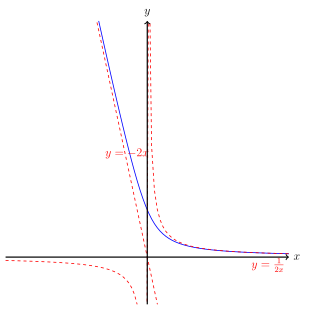
- \begin{align*} && \tan( g(x) + g(-x)) &= \tan \left ( \tan^{-1}(\sqrt{x^2+1}-x) + \tan^{-1}(\sqrt{x^2+1}+x) \right) \\ &&&= \frac{\sqrt{x^2+1}-x+\sqrt{x^2+1}+x}{1-1} \\ \Rightarrow && g(x) + g(-x) &\in \left \{\cdots, -\frac{\pi}{2}, \frac{\pi}{2}, \cdots \right\} \end{align*} But \(g(x), g(-x) > 0\) and \(g(x), g(-x) \in (-\frac{\pi}{2}, \frac{\pi}{2})\), therefore it must be \(\frac{\pi}{2}\).
- \begin{align*} && \tan(2(k(x) + k(-x))) &= \tan(\tan^{-1}x + \tan^{-1}(-x)) \\ &&&= 0 \\ \Rightarrow && k(x)+k(-x) &\in \left \{\cdots, -\frac{\pi}{2}, 0, \frac{\pi}{2}, \cdots \right\} \\ \end{align*} But \(k(x) \in (-\frac{\pi}{4}, \frac{\pi}{4})\), therefore \(k(x) + k(-x) = 0\).
- Let \(t = \tan k(x)\). \begin{align*} && \tan \left ( \tan^{-1} \frac{1}{x} \right) &= \frac{2 \tan\left ( \frac12 \tan^{-1} \frac1x \right)}{ 1-\tan^2\left ( \frac12 \tan^{-1} \frac1x \right)} \\ \Rightarrow && \frac1x &= \frac{2t}{1-t^2} \\ \Rightarrow && 1-t^2 &= 2tx \\ \Rightarrow && 0 &= t^2+2tx - 1 \\ \Rightarrow && 0 &= (t+x)^2 - 1-x^2 \\ \Rightarrow && t &= -x \pm \sqrt{1+x^2} \end{align*} Since \(t > 0\), \(t = \sqrt{1+x^2}-x = f(x) = \tan g(x)\)
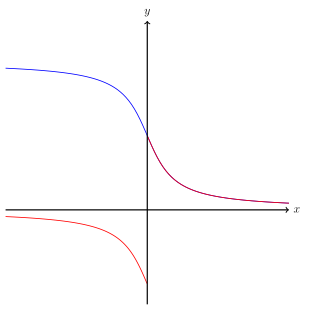
- \begin{align*} \int_0^1 k(x) \d x &= \int_0^1 \frac12 \tan^{-1} \left ( \frac1x \right) \d x \\ &= \left [ \frac{x}{2} \tan^{-1}\left ( \frac1x \right) \right]_0^1 - \int_0^1 \frac{x}{2} \frac{-1/x^2}{1+1/x^2} \d x \\ &= \left [ \frac{x}{2} \tan^{-1}\left ( \frac1x \right) \right]_0^1 + \frac14 \int_0^1 \frac{2x}{1+x^2} \d x \\ &= \frac12 \frac{\pi}{4} + \frac14 \ln(2) \\ &= \frac{\pi + \ln 4}{8}\end{align*} Therefore \(\displaystyle \int_{-1}^0 g(x) \d x = -\frac{\pi + \ln 4}{8}\)
2025 Paper 3 Q8
- Show that $$z^{m+1} - \frac{1}{z^{m+1}} = \left(z - \frac{1}{z}\right)\left(z^m + \frac{1}{z^m}\right) + \left(z^{m-1} - \frac{1}{z^{m-1}}\right)$$ Hence prove by induction that, for \(n \geq 1\), $$z^{2n} - \frac{1}{z^{2n}} = \left(z - \frac{1}{z}\right)\sum_{r=1}^n \left(z^{2r-1} + \frac{1}{z^{2r-1}}\right)$$ Find similarly \(z^{2n} - \frac{1}{z^{2n}}\) as a product of \((z + \frac{1}{z})\) and a sum.
- By choosing \(z = e^{i\theta}\), show that $$\sin 2n\theta = 2\sin\theta \sum_{r=1}^n \cos(2r-1)\theta$$
- Use this result, with \(n = 2\), to show that \(\cos\frac{2\pi}{5} = \cos\frac{\pi}{5} - \frac{1}{2}\).
- Use this result, with \(n = 7\), to show that \(\cos\frac{2\pi}{15} + \cos\frac{4\pi}{15} + \cos\frac{8\pi}{15} + \cos\frac{16\pi}{15} = \frac{1}{2}\).
- Show that \(\sin\frac{\pi}{14} - \sin\frac{3\pi}{14} + \sin\frac{5\pi}{14} = \frac{1}{2}\).
Solution:
- \begin{align*} RHS &= \left(z - \frac{1}{z}\right)\left(z^m + \frac{1}{z^m}\right) + \left(z^{m-1} - \frac{1}{z^{m-1}}\right) \\ &= z^{m+1} + \frac{1}{z^{m-1}} - z^{m-1} - \frac{1}{z^{m+1}} + z^{m-1} - \frac{1}{z^{m-1}} \\ &= z^{m+1} - \frac{1}{z^{m+1}} \\ &= LHS \end{align*}. Claim: For \(n \geq 1\), $$z^{2n} - \frac{1}{z^{2n}} = \left(z - \frac{1}{z}\right)\sum_{r=1}^n \left(z^{2r-1} + \frac{1}{z^{2r-1}}\right)$$ Proof: (By Induction) Base Case: (\(n=1\)). \begin{align*} LHS &= z^2 - \frac{1}{z^2} \\ &= (z-\frac1z)(z + \frac{1}{z}) \\ &= (z - \frac1z) \sum_{r=1}^1 \left ( z + \frac{1}{z} \right) \\ &= (z - \frac1z) \sum_{r=1}^1 \left ( z^{2r-1} + \frac{1}{z^{2r-1}} \right) \\ &= RHS \end{align*} as required. Inductive step: Suppose our result is true for some \(n=k\), then consider \(n = k+1\). \begin{align*} RHS &= \left(z - \frac{1}{z}\right)\sum_{r=1}^{k+1} \left(z^{2r-1} + \frac{1}{z^{2r-1}}\right) \\ &= \left(z - \frac{1}{z}\right)\sum_{r=1}^{k} \left(z^{2r-1} + \frac{1}{z^{2r-1}}\right) + \left(z - \frac{1}{z}\right)\left(z^{2k+1} + \frac{1}{z^{2k+1}}\right) \\ &= z^{2k} - \frac{1}{z^{2k}} + \left(z - \frac{1}{z}\right)\left(z^{2k+1} + \frac{1}{z^{2k+1}}\right) \\ &= z^{2k+2} - \frac{1}{z^{2k+2}} \\ &= LHS \end{align*}. Therefore if our result is true for \(n=k\) is true, it is true for \(n=k+1\). Since it is also true for \(n=1\) it is true for all \(n \geq 1\) but the principle of mathematical induction. Since \(\displaystyle z^{m+1} - \frac{1}{z^{m+1}} = \left(z + \frac{1}{z}\right)\left(z^m - \frac{1}{z^m}\right) + \left(z^{m-1} - \frac{1}{z^{m-1}}\right)\), we must have \(\displaystyle z^{2n}-\frac{1}{z^{2n}} = \left ( z + \frac{1}{z} \right) \sum_{r=1}^n \left (z^{2r-1}-\frac{1}{z^{2r-1}} \right)\)
- Since $$z^{2n} - \frac{1}{z^{2n}} = \left(z - \frac{1}{z}\right)\sum_{r=1}^n \left(z^{2r-1} + \frac{1}{z^{2r-1}}\right)$$ we have \begin{align*} && e^{2n\theta i} - e^{-2n\theta i} &= \left(e^{\theta i} - e^{-\theta i}\right)\sum_{r=1}^n \left(e^{(2r-1)\theta i} + e^{-(2r-1)\theta i}\right) \\ \Rightarrow && 2i \sin 2n \theta &= 2i \sin \theta \sum_{r=1}^n 2 \cos (2r-1) \theta \\ \Rightarrow && \sin 2n \theta &= 2\sin \theta \sum_{r=1}^n \cos (2r-1) \theta \end{align*}
- When \(n = 2, \theta = \frac{\pi}{5}\) we have: \begin{align*} &&\sin \frac{4\pi}{5} &= 2 \sin \frac{\pi}{5} (\cos \frac{\pi}{5} + \cos \frac{3\pi}{5}) \\ &&\sin \frac{\pi}{5} &= 2 \sin \frac{\pi}{5} (\cos \frac{\pi}{5} - \cos \frac{2\pi}{5}) \\ &&\frac12 &= \cos \frac{\pi}{5} - \cos \frac{2 \pi}{5} \\ \Rightarrow && \cos \frac{2\pi}{5} &= \cos \frac{\pi}{5} - \frac12 \end{align*}
- When \(n = 7, \theta = \frac{\pi}{15}\) we have: \begin{align*} && \sin \frac{14 \pi}{15} &= 2 \sin \frac{\pi}{15} \sum_{r=1}^7 \cos (2r-1) \frac{\pi}{15} \\ \Rightarrow && \frac12 &= \cos \frac{\pi}{15} + \cos \frac{3 \pi}{15} + \cos \frac{5 \pi}{15}+ \cos \frac{7 \pi}{15}+ \cos \frac{9 \pi}{15}+ \cos \frac{11 \pi}{15}+ \cos \frac{13 \pi}{15} \\ &&&= -\cos \frac{16\pi}{15} + \cos \frac{3 \pi}{15} + \cos \frac{5 \pi}{15}- \cos \frac{8 \pi}{15}+ \cos \frac{9 \pi}{15}- \cos \frac{4 \pi}{15}- \cos \frac{2\pi}{15} \\ &&&= - \left ( \cos \frac{2\pi}{15}+\cos \frac{4\pi}{15}+\cos \frac{8\pi}{15}+\cos \frac{16\pi}{15}\right) + \cos \frac{\pi}{5} + \cos \frac{\pi}{3} + \cos \frac{3 \pi}{5} \\ &&&= - \left ( \cos \frac{2\pi}{15}+\cos \frac{4\pi}{15}+\cos \frac{8\pi}{15}+\cos \frac{16\pi}{15}\right) + \frac12 + \frac12 \\ \Rightarrow && \frac12 &= cos \frac{2\pi}{15}+\cos \frac{4\pi}{15}+\cos \frac{8\pi}{15}+\cos \frac{16\pi}{15} \end{align*}
- By using \(z = e^{i \theta}\) we have that: \begin{align*} && z^{2n}-\frac{1}{z^{2n}} &= \left ( z + \frac{1}{z} \right) \sum_{r=1}^n \left (z^{2r-1}-\frac{1}{z^{2r-1}} \right ) \\ \Rightarrow && e^{2n \theta i} - e^{-2n \theta i} &= (e^{\theta i} + e^{-\theta i}) \sum_{r=1}^n (e^{(2r-1)\theta i} - e^{(2r-1) \theta i}) \\ \Rightarrow && 2i \sin 2n \theta &= 2 \cos \theta \sum_{r=1}^n 2i \sin(2r-1) \theta \\ \Rightarrow && \sin 2n \theta &= 2 \cos \theta \sum_{r=1}^n \sin(2r-1) \theta \end{align*} When \(n = 3, \theta = \frac{\pi}{14}\) we must have: \begin{align*} &&\sin \frac{3 \pi}{7} &= 2 \cos \frac{\pi}{14}( \sin \frac{\pi}{14}+\sin \frac{3\pi}{14}+\sin \frac{5\pi}{14}) \\ &&&= 2 \sin \left (\frac{\pi}{2} - \frac{\pi}{14} \right)( \sin \frac{\pi}{14}+\sin \frac{3\pi}{14}+\sin \frac{5\pi}{14}) \\ &&&= 2 \sin \frac{3\pi}{7} ( \sin \frac{\pi}{14}+\sin \frac{3\pi}{14}+\sin \frac{5\pi}{14}) \\ \Rightarrow && \frac12 &= \sin \frac{\pi}{14}+\sin \frac{3\pi}{14}+\sin \frac{5\pi}{14} \end{align*} as required.
2025 Paper 3 Q9
In this question, \(n \geq 2\).
- A solid, of uniform density, is formed by rotating through \(360°\) about the \(y\)-axis the region bounded by the part of the curve \(r^{n-1}y = r^n - x^n\) with \(0 \leq x \leq r\), and the \(x\)- and \(y\)-axes. Show that the \(y\)-coordinate of the centre of mass of this solid is \(\frac{nr}{2(n+1)}\).
- Show that the normal to the curve \(r^{n-1}y = r^n - x^n\) at the point \((rp, r(1-p^n))\), where \(0 < p < 1\), meets the \(y\)-axis at \((0, Y)\), where \(Y = r\left(1 - p^n - \frac{1}{np^{n-2}}\right)\). In the case \(n = 4\), show that the greatest value of \(Y\) is \(\frac{1}{4}r\).
- A solid is formed by rotating through \(360°\) about the \(y\)-axis the region bounded by the curves \(r^3y = r^4 - x^4\) and \(ry = -(r^2 - x^2)\), both for \(0 \leq x \leq r\). \(A\) and \(B\) are the points \((0, -r)\) and \((0, r)\), respectively, on the surface of the solid. Show that the solid can rest in equilibrium on a horizontal surface with the vector \(\overrightarrow{AB}\) at three different, non-zero, angles to the upward vertical. You should not attempt to find these angles.
Solution:
- By symmetry, the centre of mass will lie on the \(y\) axis. Notice that a single slice (when revolved around the \(y\)-axis) has volume \(y \cdot \pi \cdot ((x+ \delta x)^2 - x^2) = 2 \pi x y \delta x\), and COM at height \(\frac12 y\) so we can conclude: \[ \overline{y} \sum_{\delta x} 2 \pi x y \delta x = \sum_{\delta x} \pi xy^2 \delta x\] \begin{align*} && \overline{y} \int_0^r 2xy \d x &= \int_0^r y^2 x \d x \\ \Rightarrow && \overline{y} 2\int_0^r \left (r - \frac{x^n}{r^{n-1}} \right)x \d x &= \int_0^r \left (r - \frac{x^n}{r^{n-1}} \right)^2 x \d x \\ \Rightarrow && \overline{y} \left [r \frac{x^2}{2} - \frac{1}{r^{n-1}} \frac{x^{n+2}}{n+2} \right]_0^r &= \left [r^2 \frac{x^2}{2} - \frac{2}{r^{n-2}} \frac{x^{n+2}}{n+2} + \frac{1}{r^{2n-2}} \frac{x^{2n+2}}{2n+2} \right]_0^r \\ \Rightarrow && 2\overline{y} \left (\frac{r^3}{2} - \frac{r^3}{n+2} \right) &= \left (\frac12 r^4 - \frac{2}{n+2}r^4 + \frac{1}{2n+2}r^4 \right) \\ \Rightarrow && \overline{y}r^3 \frac{n}{(n+2)} &= r^4\frac{(n+1)(n+2)-2\cdot2\cdot(n+1)+(n+2)}{2(n+1)(n+2)} \\ \Rightarrow && \overline{y} \frac{n}{(n+2)} &= r \left ( \frac{n^2}{2(n+1)(n+2)} \right) \\ \Rightarrow && \overline{y} &= \frac{nr}{2(n+1)} \\ &&&= r \left (1 -p^n \right) \end{align*} as required.

- \begin{align*} && r^{n-1}y &= r^n - x^n \\ \frac{\d}{\d x}: && r^{n-1} \frac{\d y}{\d x} &= -n x^{n-1} \\ && \frac{\d y}{\d x} &= -np^{n-1} \end{align*} Therefor the normal has the equation: \begin{align*} && \frac{y-r(1-p^n)}{x-rp} &= \frac{1}{np^{n-1}} \\ \Rightarrow && Y &= \frac{-rp}{np^{n-1}} + r(1-p^n) \\ &&&= r \left (1 - p^n - \frac{1}{np^{n-2}} \right) \end{align*} If \(n = 4\) then \begin{align*} && Y &= r\left (1 - p^4 - \frac{1}{4p^{2}} \right) \\ \Rightarrow && \frac{\d Y}{\d p} &= r \left (-4p^3 + \frac{1}{2p^3} \right) \end{align*} Therefore there is a stationary point if \(p^6 = \frac18 \Rightarrow p =2^{-1/2}\). Clearly this will be a maximum (sketch or second derivative) therefore, \(Y = r(1 - \frac14 - \frac{2}{4}) = \frac14 r\)
- The centre of mass of this shape can be found using this table: \begin{array}{|c|c|c|} \hline \text{} & \overline{y} & \text{mass} \\ \hline r^3y = r^4 - x^4 & \frac{2r}{5} & \frac{4\pi r^3}{6} = \frac23 \pi r^3\\ ry = -(r^2 - x^2) & -\frac{r}{3}& \frac{2 \pi r^3}{4}=\frac12\pi r^3 \\ \text{combined} & \frac{(\frac25 \cdot \frac23-\frac13 \cdot \frac12)r^4}{\frac76 r^3} = \frac3{35}r & \frac76 \pi r^3\\ \hline \end{array} Normals to the surface through points on the upper surface will meet the \(y\)-axis between \((-\infty, \frac14 r)\), and since \(p = 0 \to -\infty\) and \(p = 1 \to -\frac14 r\), so normals will pass through \((0, \frac3{35}r)\) from two different points. Normals to the surface through points on the lower surface will go through \(-r(1 - p^2 - \frac12) =- r(\frac12 -p^2)\) which ranges monotonically from \(\frac12 r \to -\frac12 r\) so there will be one point where the normal goes through \(\frac3{35}r\). Therefore there are three angles where the vector \(\overrightarrow{AB}\) is not vertical but the normal to the surfaces runs through the centre of mass (ie the the solid can rest in equilibrium)
2025 Paper 3 Q10
A plank \(AB\) of length \(L\) initially lies horizontally at rest along the \(x\)-axis on a flat surface, with \(A\) at the origin. Point \(C\) on the plank is such that \(AC\) has length \(sL\), where \(0 < s < 1\). End \(A\) is then raised vertically along the \(y\)-axis so that its height above the horizontal surface at time \(t\) is \(h(t)\), while end \(B\) remains in contact with the flat surface and on the \(x\)-axis. The function \(h(t)\) satisfies the differential equation $$\frac{d^2h}{dt^2} = -\omega^2 h, \text{ with } h(0) = 0 \text{ and } \frac{dh}{dt} = \omega L \text{ at } t = 0$$ where \(\omega\) is a positive constant. A particle \(P\) of mass \(m\) remains in contact with the plank at point \(C\).
- Show that the \(x\)-coordinate of \(P\) is \(sL\cos\omega t\), and find a similar expression for its \(y\)-coordinate.
- Find expressions for the \(x\)- and \(y\)-components of the acceleration of the particle.
- \(N\) and \(F\) are the upward normal and frictional components, respectively, of the force of the plank on the particle. Show that $$N = mg(1 - k\sin\omega t)\cos\omega t$$ and that $$F = mgsk\frac{\omega^2}{g}\tan\omega t$$ where \(k = \frac{L\omega^2}{g}\).
- The coefficient of friction between the particle and the plank is \(\tan\alpha\), where \(\alpha\) is an acute angle.
Show that the particle will not slip initially, provided \(sk < \tan\alpha\).
Show further that, in this case, the particle will slip
- while \(N\) is still positive,
- when the plank makes an angle less than \(\alpha\) to the horizontal.
Solution:
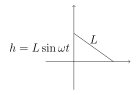
- Since we have \(h'' + \omega^2 h = 0\) we must have that \(h(t) = A \cos \omega t + B \sin \omega t\). The initial conditions tell us that \(A = 0\) and \(B = L\), so \(h(t) = L \sin \omega t\).
Therefore we can see the angle at \(B\) is \(\omega t\) and so \(P\) has \(y\)-coordinate \((1-s)L \sin \omega t\) and \(x\)-coordinate \(sL \cos \omega t\)
- If the position is \(\binom{sL \cos \omega t}{(1-s) L \sin \omega t}\) then the acceleration is \(-\omega^2 \binom{sL \cos \omega t}{(1-s) L \sin \omega t}\)
- \begin{align*} \text{N2}(\rightarrow): && - F\cos \omega t + N \sin \omega t &= -m\omega^2 sL \cos \omega t\\ \text{N2}(\uparrow): && -mg + F\sin \omega t + N \cos \omega t &= -m\omega^2 (1-s) L \sin \omega t \\ \Rightarrow && \begin{pmatrix} \cos \omega t & -\sin \omega t \\ \sin \omega t & \cos \omega t \end{pmatrix} \begin{pmatrix} F \\ N \end{pmatrix} &= \begin{pmatrix} m\omega^2 s L \cos \omega t \\ mg - m\omega^2(1-s)L \sin \omega t \end{pmatrix} \\ \Rightarrow && \begin{pmatrix}F \\ N \end{pmatrix} &= \begin{pmatrix} \cos \omega t & \sin \omega t \\ -\sin \omega t & \cos \omega t \end{pmatrix} \begin{pmatrix} m\omega^2 s L \cos \omega t \\ mg - m\omega^2(1-s)L \sin \omega t \end{pmatrix} \\ \Rightarrow && N &= m \omega^2 s L (-\sin \omega t \cos \omega t) + mg \cos \omega t - m \omega^2 (1-s)L \sin \omega t \cos \omega t \\ &&&=mg \cos \omega t - m \omega^2 L \sin \omega t \cos \omega t \\ &&&= mg \cos \omega t \left (1 - \frac{L \omega^2}{g} \sin \omega t \right) \\ &&&= mg (1 - k \sin \omega t) \cos \omega t \\ \Rightarrow && F &= m \omega^2 s L \cos^2 \omega t + mg \sin \omega t - m \omega^2 (1-s) L \sin ^2 \omega t \\ &&&= m \omega^2 s L + mg \sin \omega t - m \omega^2 L \sin^2 \omega t \\ &&&= mg \frac{\omega^2 L}{g} s + mg(1-\frac{\omega^2 L}{g} \sin \omega t)\sin \omega t \\ &&&= mg sk + mg(1-k \sin \omega t) \cos \omega t \tan \omega t \\ &&&= mgsk + N \tan \omega t \end{align*}
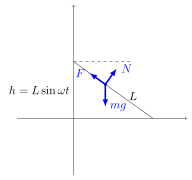
- The particle will not slip if \(F < \tan \alpha N\). When \(t = 0\), \(N = mg, F = mgsk\), but clearly \(sk < \tan \alpha \Rightarrow mgsk = F < \tan \alpha mg = \tan \alpha N\). The particle will slip when: \(F > \tan \alpha N\), but we have \(F = mgsk + N \tan \omega t\). Clearly when \(\omega t = \alpha\) we have reached a point where \(F > \tan \alpha N\). Therefore we must slip before we reach this point, ie at a point where the plank makes an angle of less than \(\alpha\) to the horizontal. Notice also that \(N\) changes sign when \(1-k \sin \omega t = 0\), however, to do this \(N\) must become very small, smaller than \(mgsk\), therefore we must slip before this point too. Since we slip before either condition occurs, we must be in a position when \(N\) is positive AND the plank still makes a shallow angle.
2025 Paper 3 Q11
- Let \(\lambda > 0\). The independent random variables \(X_1, X_2, \ldots, X_n\) all have probability density function $$f(t) = \begin{cases} \lambda e^{-\lambda t} & t \geq 0 \\ 0 & t < 0 \end{cases}$$ and cumulative distribution function \(F(x)\). The value of random variable \(Y\) is the largest of the values \(X_1, X_2, \ldots, X_n\). Show that the cumulative distribution function of \(Y\) is given, for \(y \geq 0\), by $$G(y) = (1 - e^{-\lambda y})^n$$
- The values \(L(\alpha)\) and \(U(\alpha)\), where \(0 < \alpha \leq \frac{1}{2}\), are such that $$P(Y < L(\alpha)) = \alpha \text{ and } P(Y > U(\alpha)) = \alpha$$ Show that $$L(\alpha) = -\frac{1}{\lambda}\ln(1 - \alpha^{1/n})$$ and write down a similar expression for \(U(\alpha)\).
- Use the approximation \(e^t \approx 1 + t\), for \(|t|\) small, to show that, for sufficiently large \(n\), $$\lambda L(\alpha) \approx \ln(n) - \ln\left(\ln\left(\frac{1}{\alpha}\right)\right)$$
- Hence show that the median of \(Y\) tends to infinity as \(n\) increases, but that the width of the interval \(U(\alpha) - L(\alpha)\) tends to a value which is independent of \(n\).
- You are given that, for \(|t|\) small, \(\ln(1 + t) \approx t\) and that \(e^3 \approx 20\). Show that, for sufficiently large \(n\), there is an interval of width approximately \(4\lambda^{-1}\) in which \(Y\) lies with probability \(0.9\).
Solution:
- Note that \(\displaystyle F(y) = \mathbb{P}(X_i < y) = \int_0^y \lambda e^{-\lambda t} \d t = 1-e^{-\lambda y}\). Notice also that \begin{align*} G(y) &= \mathbb{P}(Y < y) \\ &= \mathbb{P}(\max_i(X_i) < y) \\ &= \mathbb{P}(X_i < y \text{ for all }i) \\ &= \prod_{i=1}^n \mathbb{P}(X_i < y) \\ &= \prod_{i=1}^n (1-e^{-\lambda y})\\ &= (1-e^{-\lambda y})^n \end{align*} as required.
- \begin{align*} && \mathbb{P}(Y < L(\alpha)) &= \alpha \\ \Rightarrow && (1-e^{-\lambda L(\alpha)})^n &= \alpha \\ \Rightarrow && 1-e^{-\lambda L(\alpha)} &= \alpha^{\tfrac1n} \\ \Rightarrow && L(\alpha) &= -\frac{1}{\lambda}\ln \left (1-\alpha^{\tfrac1n} \right) \end{align*} Notice also: \begin{align*} && \mathbb{P}(Y > U(\alpha)) &= \alpha \\ \Rightarrow && 1 - (1-e^{-\lambda U(\alpha)})^n &= \alpha \\ \Rightarrow && U(\alpha) &= -\frac{1}{\lambda}\ln \left ( 1-(1-\alpha)^{\tfrac1n} \right) \end{align*}
- \begin{align*} \lambda L(\alpha) &= -\ln \left (1-\alpha^{\tfrac1n} \right) \\ &= -\ln \left (1-e^{\tfrac1n \ln \alpha} \right) \\ &\approx - \ln \left ( 1 - 1 - \frac1n \ln \alpha\right) \tag{\(e^t \approx 1 + t\)} \\ &= -\ln \left ( \frac{1}{n} \ln \frac{1}\alpha \right) \\ &= - \ln \frac{1}{n} - \ln \left ( \ln \frac{1}{\alpha} \right )\\ &= \ln n - \ln \left ( \ln \left ( \frac{1}{\alpha} \right ) \right) \end{align*} since if \(n\) is large, \(\frac{\ln \alpha}{n}\) is small.
- The median is the value where \(\mathbb{P}(Y < M) = \frac12\), or in other words \(L(\frac12)\), but this is \(\approx \frac{\ln n - \ln (\ln 2)}{\lambda} \to \infty\). \begin{align*} && \lambda U(\alpha) &\approx \ln n - \ln \left ( \ln \left ( \frac{1}{1-\alpha} \right ) \right) \\ \Rightarrow && \lambda(U(\alpha) - L(\alpha)) &\approx -\ln \left ( \ln \left ( \frac{1}{1-\alpha} \right ) \right)+ \ln \left ( \ln \left ( \frac{1}{\alpha} \right ) \right) \\ \Rightarrow && U(\alpha) - L(\alpha) &\to \frac{1}{\lambda} \left ( \ln \left ( \ln \left ( \frac{1}{\alpha} \right ) \right)-\ln \left ( \ln \left ( \frac{1}{1-\alpha} \right ) \right ) \right) \end{align*} which doesn't depend on \(n\).
- Suppose \(\alpha = \frac{1}{20}\) then \begin{align*} U(\alpha) - L(\alpha) &\approx \frac{1}{\lambda} \left (\ln \ln 20 - \ln \ln \frac{20}{19} \right) \\ &= \lambda^{-1} \left (\ln \ln 20 - \ln \ln (1 + \frac{1}{19}) \right) \\ &\approx \lambda^{-1} \left (\ln 3 - \ln \frac{1}{19} \right) \tag{\(\ln(1+t) \approx t\)} \\ &\approx \lambda^{-1} \ln 3 \cdot 19 \\ &\approx \lambda^{-1} (1 + 3) \\ &\approx 4\lambda^{-1} \end{align*} [Note that \(\ln \ln 20 - \ln \ln \frac{20}{19} = 4.0673\ldots\)]
2025 Paper 3 Q12
- Show that, for any functions \(f\) and \(g\), and for any \(m \geq 0\), $$\sum_{r=1}^{m+1} f(r)\sum_{s=r-1}^m g(s) = \sum_{s=0}^m g(s)\sum_{r=1}^{s+1} f(r)$$
- The random variables \(X_0, X_1, X_2, \ldots\) are defined as follows:
- \(X_0\) takes the value \(0\) with probability \(1\);
- \(X_{n+1}\) takes the values \(0, 1, \ldots, X_n + 1\) with equal probability, for \(n = 0, 1, \ldots\)
- Write down \(E(X_1)\). Find \(P(X_2 = 0)\) and \(P(X_2 = 1)\) and show that \(P(X_2 = 2) = \frac{1}{6}\). Hence calculate \(E(X_2)\).
- For \(n \geq 1\), show that $$P(X_n = 0) = \sum_{s=0}^{n-1} \frac{P(X_{n-1} = s)}{s+2}$$ and find a similar expression for \(P(X_n = r)\), for \(r = 1, 2, \ldots, n\).
- Hence show that \(E(X_n) = \frac{1}{2}(1 + E(X_{n-1}))\). Find an expression for \(E(X_n)\) in terms of \(n\), for \(n = 1, 2, \ldots\)
Solution:
- \begin{align*} \sum_{r=1}^{m+1} \left (f(r) \sum_{s=r-1}^m g(s) \right) &= \sum_{r=1}^{m+1} \sum_{s=r-1}^m f(r)g(s) \\ &= \sum_{(r,s) \in \{(r,s) : 1 \leq r \leq m+1, 0 \leq s \leq m, s \geq r-1\}} f(r)g(s) \\ &= \sum_{(r,s) \in \{(r,s) : 0 \leq s \leq m, 1 \leq r \leq m+1, r \leq s+1\}} f(r)g(s) \\ &= \sum_{s=0}^m \sum_{r=1}^{s+1} f(r)g(s) \\ &= \sum_{s=0}^m \left ( g(s) \sum_{r=1}^{s+1} f(r) \right) \end{align*}
- \(X_1\) takes the values \(0, 1\) with equal probabilities (since \(X_0 = 0\)). Therefore \(\mathbb{E}(X_1) = \frac12\).
- \begin{align*} \mathbb{P}(X_2 = 0) &= \mathbb{P}(X_2 = 0 | X_1 = 0) \mathbb{P}(X_1 = 0) + \mathbb{P}(X_2 = 0 | X_1 = 1) \mathbb{P}(X_1 = 1) \\ &= \frac12 \cdot \frac12 + \frac13 \cdot \frac12 \\ &= \frac5{12} \\ \\ \mathbb{P}(X_2 = 1) &= \mathbb{P}(X_2 = 1 | X_1 = 0) \mathbb{P}(X_1 = 0) + \mathbb{P}(X_2 = 1 | X_1 = 1) \mathbb{P}(X_1 = 1) \\ &= \frac12 \cdot \frac12 + \frac13 \cdot \frac12 \\ &= \frac5{12} \\ \\ \mathbb{P}(X_2 = 3) &= 1 - \mathbb{P}(X_2 = 0) - \mathbb{P}(X_2 = 1) \\ &= 1 - \frac{10}{12} = \frac16 \\ \\ \mathbb{E}(X_2) &= \frac{5}{12} + 2\cdot \frac{1}{6} \\ &= \frac34 \end{align*}
- \begin{align*} \mathbb{P}(X_n = 0) &= \sum_{s=0}^{n-1} \mathbb{P}(X_n = 0 | X_{n-1} = s)\mathbb{P}(X_{n-1} = s) \\ &= \sum_{s=0}^{n-1} \frac{1}{s+2}\mathbb{P}(X_{n-1} = s) \\ \end{align*} as required. (Where \(\mathbb{P}(X_n = 0 | X_{n-1} = s) = \frac{1}{s+2}\) since if \(X_{n-1} = s\) there are \(0, 1, \ldots, s + 1\) values \(X_n\) can take with equal chance (ie \(s+2\) different values). \begin{align*} \mathbb{P}(X_n = r) &= \sum_{s=0}^{n-1} \mathbb{P}(X_n = r | X_{n-1} = s)\mathbb{P}(X_{n-1} = s) \\ &= \sum_{s=r-1}^{n-1} \frac{\mathbb{P}(X_{n-1}=s)}{s+2} \end{align*}
- \begin{align*} \mathbb{E}(X_n) &= \sum_{r=1}^{n} r \cdot \mathbb{P}(X_n = r) \\ &= \sum_{r=1}^{n} r \cdot \sum_{s=r-1}^{n-1} \frac{\mathbb{P}(X_{n-1}=s)}{s+2} \\ &= \sum_{s=0}^{n-1} \frac{\mathbb{P}(X_{n-1}=s)}{s+2} \sum_{r=1}^{s+1} r \\ &= \sum_{s=0}^{n-1} \frac{\mathbb{P}(X_{n-1}=s)}{s+2} \frac{(s+1)(s+2)}{2} \\ &= \frac12 \sum_{s=0}^{n-1} (s+1)\mathbb{P}(X_{n-1}=s) \\ &= \frac12 \sum_{s=0}^{n-1} s\mathbb{P}(X_{n-1}=s) + \frac12 \sum_{s=0}^{n-1} \mathbb{P}(X_{n-1}=s) \\\\ &= \frac12 \left ( \mathbb{E}(X_{n-1}) + 1 \right) \end{align*} Suppose \(\mathbb{E}(X_n) = 1-2^{-n}\), then notice that this expression matches for \(n = 0, 1, 2\) and also: \(\frac12(1 - 2^{-n} + 1) = 1-2^{-n-1}\) satisfies the recusive formula. Therefore by induction (or similar) we can show that \(\mathbb{E}(X_n) = 1- 2^{-n}\).
2024 Paper 2 Q1
In the equality \[ 4 + 5 + 6 + 7 + 8 = 9 + 10 + 11, \] the sum of the five consecutive integers from 4 upwards is equal to the sum of the next three consecutive integers. Throughout this question, the variables \(n\), \(k\) and \(c\) represent positive integers.
- Show that the sum of the \(n + k\) consecutive integers from \(c\) upwards is equal to the sum of the next \(n\) consecutive integers if and only if \[ 2n^2 + k = 2ck + k^2. \]
- Find the set of possible values of \(n\), and the corresponding values of \(c\), in each of the cases
- \(k = 1\)
- \(k = 2\).
- Show that there are no solutions for \(c\) and \(n\) if \(k = 4\).
- Consider now the case where \(c = 1\).
- Find two possible values of \(k\) and the corresponding values of \(n\).
- Show, given a possible value \(N\) of \(n\), and the corresponding value \(K\) of \(k\), that \[ N' = 3N + 2K + 1 \] will also be a possible value of \(n\), with \[ K' = 4N + 3K + 1 \] as the corresponding value of \(k\).
- Find two further possible values of \(k\) and the corresponding values of \(n\).
Solution:
- Suppose the sum of the \(n + k\) consecutive integers from \(c\) upwards is equal to the sum of the next \(n\) consecutive integers then \begin{align*} && \sum_{i=c}^{i=c+n+k-1} i &= \sum_{i=c+n+k}^{c+2n+k-1} i \\ \Leftrightarrow && \frac{(c+n+k-1)(c+n+k)}{2} - \frac{(c-1)c}{2} &= \frac{(c+2n+k-1)(c+2n+k)}{2} - \frac{(c+n+k-1)(c+n+k)}{2} \\ \Leftrightarrow && 2(c+n+k-1)(c+n+k) &= (c+2n+k-1)(c+2n+k) + c(c-1) \\ \Leftrightarrow && 2c^2+4cn+4ck+2n^2+4kn+2k^2-2c-2n-2k&=2c^2+4cn+2ck+4n^2+4nk+k^2-2c-2n-k \\ \Leftrightarrow && 2ck+k^2&=2n^2+k \\ \end{align*}
- If \(k=1\) then \begin{align*} && 2n^2 + 1 &= 2c + 1 \\ \Rightarrow && c &= n^2 \end{align*} So \(n\) can take any value and \(c = n^2\)
- If \(k=2\) then \begin{align*} && 2n^2+2&= 4c+4 \\ \Rightarrow && n^2-1 &=2c \end{align*} So \(n\) must be odd, and \(c = \frac12(n^2-1)\)
- Suppose \(k=4\) then \(2n^2+4 = 8c+16\) or \(n^2-6 = 4c\) but then the left hand side is \(2, 3 \pmod{4}\) which is a contradiction.
- Suppose \(c =1\)
- Since \(2n^2+k = 2k + k^2\) or \(2n^2 = k^2+k\) we can have \(k = 1, n = 1\) or \(k = 8, n = 6\)
- Suppose \(2N^2 = K^2 + K\) then consider \begin{align*} && 2(N')^2 &= 2(3N+2K+1)^2 \\ &&&= 2(9N^2+4K^2+1+12NK+6N+4K) \\ &&&= 18N^2+8K^2+24NK+12N+8K+2 \\ && (K')^2+K' &= (4N+3K+1)^2 + (4N+3K+1) \\ &&&= 16N^2 + 9K^2+1+24NK+12N+9K+1 \\ &&&= 16N^2+9K^2+24NK+12N+9K+2 \\ \Rightarrow && 2(N')^2-(K')^2-K' &= 2N^2-K^2-K \\ &&&= 0 \end{align*} as required.
- So consider \((k,n) = (1,1), (8,6), (49, 35), (288,204)\)
2024 Paper 2 Q2
In this question, you need not consider issues of convergence.
- Find the binomial series expansion of \((8 + x^3)^{-1}\), valid for \(|x| < 2\). Hence show that, for each integer \(m \geqslant 0\), \[ \int_0^1 \frac{x^m}{8 + x^3}\,\mathrm{d}x = \sum_{k=0}^{\infty} \left( \frac{(-1)^k}{2^{3(k+1)}} \cdot \frac{1}{3k + m + 1} \right). \]
- Show that \[ \sum_{k=0}^{\infty} \frac{(-1)^k}{2^{3(k+1)}} \left( \frac{1}{3k+3} - \frac{2}{3k+2} + \frac{4}{3k+1} \right) = \int_0^1 \frac{1}{x+2}\,\mathrm{d}x\,, \] and evaluate the integral.
- Show that \[ \sum_{k=0}^{\infty} \frac{(-1)^k}{2^{3(k+1)}} \left( \frac{72(2k+1)}{(3k+1)(3k+2)} \right) = \pi\sqrt{a} - \ln b\,, \] where \(a\) and \(b\) are integers which you should determine.
Solution:
- Note that \(\,\) \begin{align*} && (8+x^3)^{-1} &= \tfrac18(1 + \tfrac18x^3)^{-1} \\ &&&= \tfrac18( 1 - \left (\tfrac{x}{2} \right)^3 + \left (\tfrac{x}{2} \right)^6 -\left (\tfrac{x}{2} \right)^9 + \cdots ) \end{align*} So \begin{align*} && \int_0^1 \frac{x^m}{8+x^3} \d x &= \int_0^1 x^m \sum_{k=0}^{\infty} \frac{1}{2^3} \left ( - \frac{x}{2} \right)^{3k} \d x \\ &&&= \sum_{k=0}^{\infty} (-1)^k \frac{1}{2^{3(k+1)}} \int_0^1 x^{m+3k} \d x \\ &&&= \sum_{k=0}^{\infty} \frac{(-1)^k}{2^{3(k+1)}} \frac{1}{3k+m+1} \\ \end{align*}
- Notice that \begin{align*} && S &= \sum_{k=0}^{\infty} \frac{(-1)^k}{2^{3(k+1)}} \left( \frac{1}{3k+3} - \frac{2}{3k+2} + \frac{4}{3k+1} \right) \\ &&&= \int_0^1 \frac{x^2}{8+x^3} \d x - 2\int_0^1 \frac{x^1}{8+x^3}+4\int_0^1 \frac{x^0}{8+x^3} \d x \\ &&&= \int_0^1 \frac{x^2-2x+4}{x^3+8} \d x \\ &&&= \int_0^1 \frac{1}{x+2} \d x = \left[ \ln(x+2)\right]_0^1 \\ &&&= \ln 3 - \ln 2 = \ln \tfrac32 \end{align*}
- Firstly, note that \begin{align*} && \frac{2k+1}{(3k+1)(3k+2)} &= \frac13 \left ( \frac{1}{3k+1} +\frac{1}{3k+2} \right) \end{align*} so \begin{align*} && S_2 &= \sum_{k=0}^{\infty} \frac{(-1)^k}{2^{3(k+1)}} \left( \frac{72(2k+1)}{(3k+1)(3k+2)} \right) \\ &&&= \sum_{k=0}^{\infty} \frac{(-1)^k}{2^{3(k+1)}} 24 \left ( \frac{1}{3k+1} +\frac{1}{3k+2} \right) \\ &&&= 24 \left [ \int_0^1 \frac{x^0}{8+x^3} \d x + \int_0^1 \frac{x^1}{8+x^3} \d x \right] \\ &&&= 24 \left [ \int_0^1 \frac{1+x}{(x+2)(x^2-2x+4)} \d x \right] \\ &&&= 24 \left [ \int_0^1 \frac{x+8}{12(x^2-2x+4)}-\frac{1}{12(x+2)} \d x \right] \\ &&&= 2\left [ \int_0^1 \frac{x+8}{x^2-2x+4}-\frac{1}{x+2} \d x \right] \\ &&&= 2\left [ \int_0^1 \frac{x-1}{x^2-2x+4}+ \frac{9}{(x-1)^2+3}-\frac{1}{x+2} \d x \right] \\ &&&=2 \left [ \int_0^1 \frac12\ln(x^2-2x+4)+3\sqrt{3}\arctan \frac{x-1}{\sqrt{3}} -\ln(x+2) \right]_0^1 \\ &&&=2 \left ( \frac12 \ln3+3\sqrt3 \arctan 0 - \ln 3 \right) - 2\left (\frac12 \ln 4-3\sqrt3 \arctan \frac{1}{\sqrt3} - \ln 2 \right) \\ &&&=\sqrt3 \pi - \ln3 \end{align*}
2024 Paper 2 Q3
The unit circle is the circle with radius 1 and centre the origin, \(O\). \(N\) and \(P\) are distinct points on the unit circle. \(N\) has coordinates \((-1, 0)\), and \(P\) has coordinates \((\cos\theta, \sin\theta)\), where \(-\pi < \theta < \pi\). The line \(NP\) intersects the \(y\)-axis at \(Q\), which has coordinates \((0, q)\).
- Show that \(q = \tan\frac{1}{2}\theta\).
- In this part, \(q \neq 1\).
- Let \(\mathrm{f}_1(q) = \dfrac{1+q}{1-q}\). Show that \(\mathrm{f}_1(q) = \tan\frac{1}{2}\!\left(\theta + \frac{1}{2}\pi\right)\).
- Let \(Q_1\) be the point with coordinates \((0, \mathrm{f}_1(q))\) and \(P_1\) be the point of intersection (other than \(N\)) of the line \(NQ_1\) and the unit circle. Describe geometrically the relationship between \(P\) and \(P_1\).
- \(P_2\) is the image of \(P\) under an anti-clockwise rotation about \(O\) through angle \(\frac{1}{3}\pi\). The line \(NP_2\) intersects the \(y\)-axis at the point \(Q_2\) with co-ordinates \((0, \mathrm{f}_2(q))\). Find \(\mathrm{f}_2(q)\) in terms of \(q\), for \(q \neq \sqrt{3}\).
- In this part, \(q \neq -1\). Let \(\mathrm{f}_3(q) = \dfrac{1-q}{1+q}\), let \(Q_3\) be the point with coordinates \((0, \mathrm{f}_3(q))\) and let \(P_3\) be the point of intersection (other than \(N\)) of the line \(NQ_3\) and the unit circle. Describe geometrically the relationship between \(P\) and \(P_3\).
- In this part, \(0 < q < 1\). Let \(\mathrm{f}_4(q) = \mathrm{f}_2^{-1}\!\Big(\mathrm{f}_3\!\big(\mathrm{f}_2(q)\big)\Big)\), let \(Q_4\) be the point with coordinates \((0, \mathrm{f}_4(q))\) and let \(P_4\) be the point of intersection (other than \(N\)) of the line \(NQ_4\) and the unit circle. Describe geometrically the relationship between \(P\) and \(P_4\).
Solution:
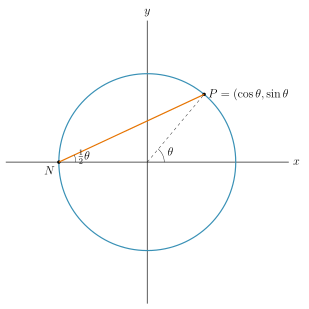
- \(\,\) \begin{align*} && \frac{y-0}{x-(-1)} &= \frac{\sin \theta }{\cos \theta + 1} \\ \Rightarrow && y_0 &= \frac{\sin \theta}{\cos \theta + 1} \\ &&&= \frac{\frac{2t}{1+t^2}}{\frac{1-t^2}{1+t^2}+1} \\ &&&= t = \tan \tfrac{\theta}{2} \end{align*} Alternatively, it is straightforward to see from the angles.
- \(f_1(q) = \frac{1+q}{1-q}\) so \begin{align*} && f_1(\tan\tfrac12\theta) &= \frac{1+\tan\tfrac12\theta}{1-\tan\tfrac12\theta} \\ &&&= \frac{\cos \tfrac12 \theta + \sin \tfrac12 \theta}{\cos \tfrac12 \theta - \sin \tfrac12 \theta} \\ &&&= \frac{\sin(\tfrac14 \pi + \tfrac12 \theta)}{\cos(\tfrac14 \pi + \tfrac12 \theta)} \\ &&&= \tan \tfrac12(\theta + \tfrac{\pi}{2}) \end{align*}
- \(Q_1\) is the point \((0, f_1(q))\) so \(P_1\) will be the point \((\cos (\theta + \tfrac{\pi}{2}), \sin (\theta + \tfrac{\pi}{2}))\) which is a rotation anticlockwise by \(\frac{\pi}{2}\)
- \(P_2 = (\cos(\theta + \tfrac{\pi}{3}), \sin( \theta + \tfrac{\pi}{3})\) and so \(f_2(q) = \tan (\tfrac12(\theta + \tfrac{\pi}{3}))\) so \begin{align*} && f_2(q) &= \tan (\tfrac12(\theta + \tfrac{\pi}{3})) \\ &&&= \frac{q + \tan \frac{\pi}{3}}{1 - \tan \frac{\pi}{3} \cdot q} \\ &&&= \frac{q + \frac{1}{\sqrt3}}{1 - \frac{q}{\sqrt{3}}} \\ &&&= \frac{\sqrt3 q + 1}{\sqrt3-q} \end{align*}
- Since \(q \to -q\) reflects \((0,q)\) in the \(x\)-axis, \(f_3(q) = f_1(-q)\) so \(P_3\) is the reflection of \(P_1\) so it's rotation by \(\frac{\pi}{2}\) followed by reflection in the \(x\)-axis, which is reflection in \(y=x\). [ie \(\theta \to -\theta + \frac{\pi}{2} \to \frac{\pi}{2}-\theta\)]
- We are rotating by \(\frac{\pi}{3}\) then reflecting in \(y=x\) and then rotating by \(-\frac{\pi}{3}\), ie \(\theta \to \theta + \frac{\pi}{3} \to \frac{\pi}{6}-\theta \to -\theta -\frac{\pi}{6} \)
2024 Paper 2 Q4
In this question, if \(O\), \(C\) and \(D\) are non-collinear points in three dimensional space, we will call the non-zero vector \(\mathbf{v}\) a \emph{bisecting vector} for angle \(COD\) if \(\mathbf{v}\) lies in the plane \(COD\), the angle between \(\mathbf{v}\) and \(\overrightarrow{OC}\) is equal to the angle between \(\mathbf{v}\) and \(\overrightarrow{OD}\), and both angles are less than \(90^\circ\).
- Let \(O\), \(X\) and \(Y\) be non-collinear points in three-dimensional space, and define \(\mathbf{x} = \overrightarrow{OX}\) and \(\mathbf{y} = \overrightarrow{OY}\).
Let \(\mathbf{b} = |\mathbf{x}|\mathbf{y} + |\mathbf{y}|\mathbf{x}\).
- Show that \(\mathbf{b}\) is a bisecting vector for angle \(XOY\). Explain, using a diagram, why any other bisecting vector for angle \(XOY\) is a positive multiple of \(\mathbf{b}\).
- Find the value of \(\lambda\) such that the point \(B\), defined by \(\overrightarrow{OB} = \lambda\mathbf{b}\), lies on the line \(XY\). Find also the ratio in which the point \(B\) divides \(XY\).
- Show, in the case when \(OB\) is perpendicular to \(XY\), that the triangle \(XOY\) is isosceles.
- Let \(O\), \(P\), \(Q\) and \(R\) be points in three-dimensional space, no three of which are collinear. A bisecting vector is chosen for each of the angles \(POQ\), \(QOR\) and \(ROP\). Show that the three angles between them are either all acute, all obtuse or all right angles.
2024 Paper 2 Q5
- The functions \(\mathrm{f}_1\) and \(\mathrm{F}_1\), each with domain \(\mathbb{Z}\), are defined by \[ \mathrm{f}_1(n) = n^2 + 6n + 11, \] \[ \mathrm{F}_1(n) = n^2 + 2. \] Show that \(\mathrm{F}_1\) has the same range as \(\mathrm{f}_1\).
- The function \(\mathrm{g}_1\), with domain \(\mathbb{Z}\), is defined by \[ \mathrm{g}_1(n) = n^2 - 2n + 5. \] Show that the ranges of \(\mathrm{f}_1\) and \(\mathrm{g}_1\) have empty intersection.
- The functions \(\mathrm{f}_2\) and \(\mathrm{g}_2\), each with domain \(\mathbb{Z}\), are defined by \[ \mathrm{f}_2(n) = n^2 - 2n - 6, \] \[ \mathrm{g}_2(n) = n^2 - 4n + 2. \] Find any integers that lie in the intersection of the ranges of the two functions.
- Show that \(p^2 + pq + q^2 \geqslant 0\) for all real \(p\) and \(q\). The functions \(\mathrm{f}_3\) and \(\mathrm{g}_3\), each with domain \(\mathbb{Z}\), are defined by \[ \mathrm{f}_3(n) = n^3 - 3n^2 + 7n, \] \[ \mathrm{g}_3(n) = n^3 + 4n - 6. \] Find any integers that lie in the intersection of the ranges of the two functions.
Solution:
- \(\,\) \begin{align*} && f_1(n) &= n^2 + 6n + 11 \\ &&&= (n+3)^2 + 2 \\ &&&=F_1(n+3) \end{align*} Since \(n \mapsto n+3\) is a bijection on \(\mathbb{Z}\) both functions must have exactly the same range.
- \(g_1(n) = n^2-2n+5 = (n-1)^2 + 4\). Since squares are always \(0, 1 \pmod{4}\) it's impossible for \(f_1\) and \(g_1\) to take the same value therefore the ranges have empty intersection.
- \(\,\) \begin{align*} && f_2(n) &= n^2-2n - 6 \\ &&&= (n-1)^2-7 \\ && g_2(n) &= n^2-4n+2 \\ &&&= (n-2)^2 - 2 \end{align*} so suppose \(x^2 - 7 = y^2 - 2\) then \begin{align*} && x^2 - 7 &= y^2 -2 \\ \Rightarrow && 5 &= y^2 - x^2 \\ &&&= (y-x)(y+x) \end{align*} So we have cases: \(y-x = -5, y + x = -1 \Rightarrow y = -3\) and the output is \(7\) \(y-x=-1, y+x = -5 \Rightarrow y = -3\) same output \(y-x=1, y+x = 5 \Rightarrow y = 3\) same output \(y-x=5, y-x = 1 \Rightarrow y = 3\) same ouput.
- \begin{align*} && 0 &\leq \frac12(p^2+q^2)+\frac12(p+q)^2 \\ &&&= p^2 + q^2 + pq \end{align*} Looking at \(f_3\) we see \begin{align*} && f_3(n) &= n^3 - 3n^2 + 7n \\ &&&= (n-1)^3 -3n + 7n +1 \\ &&&= (n-1)^3 +4(n-1) -3 \\ &&&= g_3(n-1) + 3 \end{align*} So suppose we have two values which are equal, ie \begin{align*} && x^3 + 4x -3 &= y^3 +4y -6 \\ \Rightarrow && 3 &= y^3-x^3+4y-4x \\ &&&= (y-x)(y^2+xy+x^2+4) \end{align*} Since \(x^2+xy+y^2 \geq 0\) then the right hand factor is always a positive integer bigger than \(3\) and in particular there will be no solutions and hence no integers in the intersection of the ranges.
2024 Paper 2 Q6
In this question, you need not consider issues of convergence.
- The sequence \(T_n\), for \(n = 0, 1, 2, \ldots\), is defined by \(T_0 = 1\) and, for \(n \geqslant 1\), by \[ T_n = \frac{2n-1}{2n}\,T_{n-1}. \] Prove by induction that \[ T_n = \frac{1}{2^{2n}}\binom{2n}{n}, \] for \(n = 0, 1, 2, \ldots\). [Note that \(\dbinom{0}{0} = 1\).]
- Show that in the binomial series for \((1-x)^{-\frac{1}{2}}\), \[ (1-x)^{-\frac{1}{2}} = \sum_{r=0}^{\infty} a_r x^r, \] successive coefficients are related by \[ a_r = \frac{2r-1}{2r}\,a_{r-1} \] for \(r = 1, 2, \ldots\)\,. Hence prove that \(a_r = T_r\) for all \(r = 0, 1, 2, \ldots\)\,.
- Let \(b_r\) be the coefficient of \(x^r\) in the binomial series for \((1-x)^{-\frac{3}{2}}\), so that \[ (1-x)^{-\frac{3}{2}} = \sum_{r=0}^{\infty} b_r x^r. \] By considering \(\dfrac{b_r}{a_r}\), find an expression involving a binomial coefficient for \(b_r\), for \(r = 0, 1, 2, \ldots\)\,.
- By considering the product of the binomial series for \((1-x)^{-\frac{1}{2}}\) and \((1-x)^{-1}\), prove that \[ \frac{(2n+1)}{2^{2n}}\binom{2n}{n} = \sum_{r=0}^{n} \frac{1}{2^{2r}}\binom{2r}{r}, \] for \(n = 1, 2, \ldots\)\,.
Solution:
- Claim: \(\displaystyle T_n = \frac{1}{2^{2n}}\binom{2n}{n}\) Proof: (By Induction) Base case: \(n=0\). Note that \(T_0 = 1\) and \(\frac{1}{2^0}\binom{0}{0} = 1\) so the base case is true. Assume true for some \(n=k\), ie \(T_k = \frac{1}{2^{2k}} \binom{2k}{k}\) so \begin{align*} && T_{k+1} &= \frac{2(k+1)-1}{2(k+1)} \frac{1}{2^{2k}} \binom{2k}{k} \\ &&&= \frac{2k+1}{k+1} \frac{1}{2^{2k+1}} \frac{(2k)!}{k!k!} \\ &&&= \frac{2(k+1)(2k+1)}{(k+1)(k+1)} \frac{1}{2^{2(k+1)}} \frac{(2k)!}{k!k!} \\ &&&= \frac{1}{2^{2(k+1)}} \frac{(2k+2)!}{(k+1)!(k+1)!} \\ &&&= \frac{1}{2^{2(k+1)}} \binom{2(k+1)}{k+1} \end{align*} and therefore it's true for all \(n\).
- Notice that \((1-x)^{-\frac12} = 1 + (-\tfrac12)(-x) + \frac{(-\frac12)(-\frac32)}{2!}(-x)^2+\cdots\) in particular \(a_r = \frac{(-\frac12 - r)}{r}(-1)a_{r-1} = \frac{2r-1}{2r}a_{r-1}\). Since \(a_0 = 1\) we have \(a_r = T_r\) for all \(r\).
- Notice that \begin{align*} && (1-x)^{-\frac32} &= \sum_{r=0}^\infty b_r x^r \\ &&&= \sum_{r=0}^\infty \frac{(-\frac32)\cdot(-\frac32-1)\cdots (-\frac32-(r-1))}{r!}(-x)^r \\ &&&= \sum_{r=0}^\infty \frac{(-\frac12-1)\cdot(-\frac12-2)\cdots (-\frac12-r)}{r!}(-x)^r \\ \end{align*} Therefore \(\frac{b_r}{a_r} = \frac{r+\frac12}{\frac12} = 2r+1\) so \(b_r = \frac{2r+1}{2^{2r}} \binom{2r}{r}\)
- Notice that \begin{align*} && (1-x)^{-\frac32} &= (1-x)^{-\frac12}(1-x)^{-1} \\ &&&= (1 + x+ x^2 + \cdots) \sum_{r=0}^{\infty} a_r x^r \\ &&&= \sum_{i=0}^{\infty} \sum_{k=0}^n a_r x^i \end{align*} So we must have \(b_r = \sum_{i=0}^ra_i\) which is the required result