Problems
Filters
1987 Paper 2 Q12
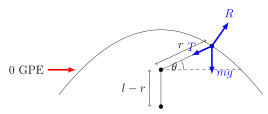
A long, inextensible string passes through a small fixed ring. One end of the string is attached to a particle of mass \(m,\) which hangs freely. The other end is attached to a bead also of mass \(m\) which is threaded on a smooth rigid wire fixed in the same vertical plane as the ring. The curve of the wire is such that the system can be in static equilibrium for all positions of the bead. The shortest distance between the wire and the ring is \(d(>0).\) Using plane polar coordinates centred on the ring, find the equation of the curve. The bead is set in motion. Assuming that the string remains taut, show that the speed of the bead when it is a distance \(r\) from the ring is \[ \left(\frac{r}{2r-d}\right)^{\frac{1}{2}}v, \] where \(v\) is the speed of the bead when \(r=d.\)
Solution:
1987 Paper 2 Q13
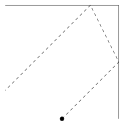
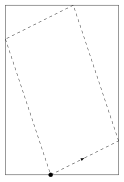
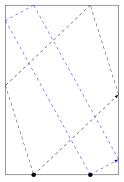
Ice snooker is played on a rectangular horizontal table, of length \(L\) and width \(B\), on which a small disc (the puck) slides without friction. The table is bounded by smooth vertical walls (the cushions) and the coefficient of restitution between the puck and any cushion is \(e\). If the puck is hit so that it bounces off two adjacent cushions, show that its final path (after two bounces) is parallel to its original path. The puck rests against the cushion at a point which divides the side of length \(L\) in the ratio \(z:1\). Show that it is possible, whatever \(z\), to hit the puck so that it bounces off the three other cushions in succession clockwise and returns to the spot at which it started. By considering these paths as \(z\) varies, explain briefly why there are two different ways in which, starting at any point away from the cushions, it is possible to perform a shot in which the puck bounces off all four cushions in succession clockwise and returns to its starting point.
Solution:
1987 Paper 2 Q14
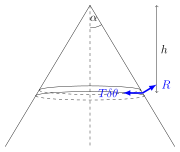
A thin uniform elastic band of mass \(m,\) length \(l\) and modulus of elasticity \(\lambda\) is pushed on to a smooth circular cone of vertex angle \(2\alpha,\) in such a way that all elements of the band are the same distance from the vertex. It is then released from rest. Let \(x(t)\) be the length of the band at time \(t\) after release, and let \(t_{0}\) be the time at which the band becomes slack. Assuming that a small element of the band which subtends an angle \(\delta\theta\) at the axis of the cone experiences a force, due to the tension \(T\) in the band, of magnitude \(T\delta\theta\) directed towards the axis, and ignoring the effects of gravity, show that \[ \frac{\mathrm{d}^{2}x}{\mathrm{d}t^{2}}+\frac{4\pi^{2}\lambda}{ml}(x-l)\sin^{2}\alpha=0,\qquad(0< t< t_{0}). \] Find the value of \(t_{0}.\)
Solution:
1987 Paper 2 Q15
A train of length \(l_{1}\) and a lorry of length \(l_{2}\) are heading for a level crossing at speeds \(u_{1}\) and \(u_{2}\) respectively. Initially the front of the train and the front of the lorry are at distances \(d_{1}\) and \(d_{2}\) from the crossing. Find conditions on \(u_{1}\) and \(u_{2}\) under which a collision will occur. On a diagram with \(u_{1}\) and \(u_{2}\) measured along the \(x\) and \(y\) axes respectively, shade in the region which represents collision. Hence show that if \(u_{1}\) and \(u_{2}\) are two independent random variables, both uniformly distributed on \((0,V)\), then the probability of a collision in the case when initially the back of the train is nearer to the crossing than the front of the lorry is \[ \frac{l_{1}l_{2}+l_{2}d_{1}+l_{1}d_{2}}{2d_{2}\left(l_{2}+d_{2}\right)}. \] Find the probability of a collision in each of the other two possible cases.
1987 Paper 2 Q16
My two friends, who shall remain nameless, but whom I shall refer to as \(P\) and \(Q\), both told me this afternoon that there is a body in my fridge. I'm not sure what to make of this, because \(P\) tells the truth with a probability of only \(p\), while \(Q\) (independently) tells the truth with probability \(q\). I haven't looked in the fridge for some time, so if you had asked me this morning, I would have said that there was just as likely to be a body in it as not. Clearly, in view of what \(P\) and \(Q\) told me, I must revise this estimate. Explain carefully why my new estimate of the probability of there being a body in the fridge should be \[ \frac{pq}{1-p-q+2pq}. \] I have now been to look in the fridge, and there is indeed a body in it; perhaps more than one. It seems to me that only my enemy \(A\), or my enemy \(B\), or (with a bit of luck) both \(A\) and \(B\) could be in my fridge, and this morning I would have judged these three possibilities to be equally likely. But tonight I asked \(P\) and \(Q\) separately whether or not \(A\) was in the fridge, and they each said that he was. What should be my new estimate of the probability that both \(A\) and \(B\) are in my fridge? Of course, I tell the truth always.
Solution: \begin{align*} \mathbb{P}(\text{body in fridge} | \text{P and Q say so}) &= \frac{\mathbb{P}(\text{body in fridge and P and Q say so})}{\mathbb{P}(\text{P and Q say so})} \\ &= \frac{\frac12 pq}{\mathbb{P}(\text{body in fridge and P and Q say so})+\mathbb{P}(\text{no body in fridge and P and Q say so})} \\ &= \frac{\frac12 pq}{\frac12 pq + \frac12(1-p)(1-q)} \\ &= \frac{pq}{pq + 1-p-q+pq} \\ &= \frac{pq}{1-p-q+2pq} \end{align*} \begin{align*} \mathbb{P}(\text{A and B in fridge} | \text{P and Q say A is in fridge}) &= \frac{\mathbb{P}(\text{A and B in fridge and P and Q say A is in fridge}) }{\mathbb{P}( \text{P and Q say A is in fridge}) } \\ &= \frac{\frac13pq}{\frac13pq+\frac13pq+\frac13(1-p)(1-q)} \\ &= \frac{pq}{1-p-q+3pq} \end{align*}
1987 Paper 3 Q1
Find the set of positive integers \(n\) for which \(n\) does not divide \((n-1)!.\) Justify your answer. [Note that small values of \(n\) may require special consideration.]
Solution: Claim: \(n \not \mid (n-1)!\) if and only if \(n\) is prime or \(4\) Proof: \((\Leftarrow)\)
- \(4 \not \mid 3! = 6\).
- If \(p\) is prime, then \(p \not \mid k\) for \(k < n\), therefore \(p \not \mid (n-1)!\)
1987 Paper 3 Q2
Let \({\displaystyle I_{m,n}=\int\cos^{m}x\sin nx\,\mathrm{d}x,}\) where \(m\) and \(n\) are non-negative integers. Prove that for \(m,n\geqslant1,\) \[ (m+n)I_{m,n}=-\cos^{m}x\cos nx+mI_{m-1,n-1}. \]
- Show that \({\displaystyle \int_{0}^{\pi}\cos^{m}x\sin nx\,\mathrm{d}x=0}\) whenever \(m,n\) are both even or both odd.
- Evaluate \({\displaystyle \int_{0}^{\frac{\pi}{2}}\sin^{2}x\sin3x\,\mathrm{d}x.}\)
Solution: Let \({\displaystyle I_{m,n}=\int\cos^{m}x\sin nx\,\mathrm{d}x,}\) Then \begin{align*} && I_{m,n} &= \int\cos^{m}x\sin nx\,\mathrm{d}x \\ &&&= \left [ -\frac1n \cos^m x \cos n x \right] - \frac{m}{n} \int \sin^{m-1} x \cos x \cos n x \d x \\ &&&= \left [ -\frac1n \cos^m x \cos n x \right] + \frac{m}{n} \int \sin^{m-1} x (\cos (n-1)x -\sin x \sin nx) \d x\\ &&&= \left [ -\frac1n \cos^m x \cos n x \right] + \frac{m}{n} \int \sin^{m-1} x \cos (n-1)x \d x-\frac{m}{n} I_{m,n} \\ &&&= \left [ -\frac1n \cos^m x \cos n x \right] + \frac{m}{n} I_{m-1,n-1} -\frac{m}{n} I_{m,n} \\ \Rightarrow && nI_{m,n} &= -\cos^m x \cos n x + mI_{m-1,n-1} -mI_{m,n}\\ \Rightarrow && (m+n)I_{m,n} &= -\cos^m x \cos n x + mI_{m-1,n-1} \end{align*}
- Note that \(I_{2m,0} = 0\) (the integrand is 0) and \(I_{0, 2m} = 0\) (symmetry for our limits). \(\displaystyle \left [-\cos^m x \cos n x \right]_0^\pi = \l - (-1)^m (-1)^n \r - \l -1 \r = 1 - (-1)^{m+n} = 0\) since \(m+n\) is even. Therefore all reductions are \(I_{m,n} = \frac{I_{m-1,n-1}}{m+n}\) terminating at \(0\), so all values are zero
- \begin{align*} \int_{0}^{\frac{\pi}{2}}\sin^{2}x\sin3x\,\mathrm{d}x &= \int_{0}^{\frac{\pi}{2}}(1-\cos^2x)\sin3x\,\mathrm{d}x \\ &= I_{0,3} - I_{2,3} \\ &= \frac13 - \frac15 \l \left [-\cos^2 x \cos 3 x \right]_0^{\pi/2} + 2 \cdot I_{1,2} \r \\ &= \frac13 - \frac15 \l 1 + \frac23 \l \left [-\cos x \cos 2 x \right]_0^{\pi/2} + 1\cdot I_{0,1} \r \r \\ &= \frac13 - \frac15 -\frac2{15} - \frac2{15} \\ &= \frac{5}{15} - \frac{3}{15} - \frac{4}{15} \\ &= -\frac2{15} \end{align*}
1987 Paper 3 Q3
- If \(z=x+\mathrm{i}y,\) with \(x,y\) real, show that \[ \left|x\right|\cos\alpha+\left|y\right|\sin\alpha\leqslant\left|z\right|\leqslant\left|x\right|+\left|y\right| \] for all real \(\alpha.\)
- By considering \((5-\mathrm{i})^{4}(1+\mathrm{i}),\) show that \[ \frac{\pi}{4}=4\tan^{-1}\left(\frac{1}{5}\right)-\tan^{-1}\left(\frac{1}{239}\right). \] Prove similarly that \[ \frac{\pi}{4}=3\tan^{-1}\left(\frac{1}{4}\right)+\tan^{-1}\left(\frac{1}{20}\right)+\tan^{-1}\left(\frac{1}{1985}\right). \]
Solution:
- If \(z=x+iy\) then \(|z|^2 = x^2 + y^2 \leq x^2 + y^2 + 2|x||y| \leq (|x|+|y|)^2\). The LHS is Cauchy-Schwarz with the vectors \(\begin{pmatrix} |x| \\ |y| \end{pmatrix}\) and \(\begin{pmatrix} \cos \alpha \\ \sin \alpha \end{pmatrix}\), although that's not in the spirit of the question. Consider \(e^{i \alpha}z = (\cos \alpha x - \sin \alpha y) + i(\sin \alpha x + \cos \alpha y)\) then \(\left | \textrm{Re}(e^{i \alpha} z) \right | \leq |z|\) for all values of \(\alpha\) and in particular we can choose \(\alpha\) to match the signs of the \(x\) and \(y\) to prove the result in question.
- Consider \((5-\mathrm{i})^{4}(1+\mathrm{i})\), then \begin{align*} \arg \l (5-\mathrm{i})^{4}(1+\mathrm{i}) \r &= \arg (5-i)^4 + \arg (1+i) \\ &= 4 \arg (5-i) + \arg (1+i) \\ &= -4 \tan^{-1} \frac{1}{5} + \tan^{-1} 1 \\ \\ &= \arg ( (24 - 10i)^2 (1+i)) \\ &= \arg (4 (12 - 5i)^2(1+i)) \\ &= \arg ((119 - 120i)(1+i)) \\ &= \arg (239 - i) \\ &= -\tan^{-1} \frac{1}{239} \end{align*} Therefore \(\displaystyle \frac{\pi}{4} =4 \tan^{-1} \frac{1}{5}- \tan^{-1} \frac{1}{239}\) Consider \((4-i)^3(1+i)(20-i)\) then \begin{align*} \arg \l(4-i)^3(1+i)(20-i) \r &= -3 \tan^{-1} \frac14 + \tan^{-1} 1 -\tan^{-1} \frac1{20} \\ \\ &= \arg \l(15-8i)(4-i)(1+i)(20-i) \r \\ &= \arg \l (52 - 47i)(1+i)(20-i) \r \\ &= \arg \l (99 + 5i)(20-i) \r \\ &= \arg (1985+i) \\ &= \tan^{-1} \frac1{1985} \end{align*} Therefore \(\displaystyle \frac{\pi}{4}=3\tan^{-1}\frac{1}{4}+\tan^{-1}\frac{1}{20}+\tan^{-1}\frac{1}{1985}\)
1987 Paper 3 Q4

Solution: The initial volume of water in \(A\) is: \begin{align*} \pi \int_0^4 x^2 \, \d y &= \pi \int_0^4 y \d y \\ &= \pi [ \frac{y^2}{2}]_0^4 \\ &= 8\pi \end{align*} We assume that no water is in the tube as it is `thin'. Therefore we must have: \begin{align*} && 8\pi &= \pi \int_0^{h-1} x^2 \d y +\pi \int_0^{h} x^2 \d y \\ &&&= \pi \int_0^{h-1} y \d y +\pi \int_0^{h} \l \sinh \frac{x}{2}\r^2 \d y \\ &&&= \pi \left [\frac{y^2}{2} \right]_0^{h-1} + \pi \int_0^h \frac{-1+\cosh y}{2}\d y \\ &&&= \pi \frac{(h-1)^2}{2} + \pi \left [ -\frac{y}{2} +\frac{\sinh y}{2}\right]_0^h \\ &&&= \pi \frac{(h-1)^2}{2} -\pi \frac{h}{2} + \pi \frac{\sinh h}{2} \\ \Rightarrow && 0 &= h^2-2h+1-h+\sinh h -16 \\ &&&= h^2 -3h+\sinh h - 15 \\ \Rightarrow && 15 &= h^2 -3h+\sinh h \end{align*}
1987 Paper 3 Q5
A secret message consists of the numbers \(1,3,7,23,24,37,39,43,43,43,45,47\) arranged in some order as \(a_{1},a_{2},\ldots,a_{12}.\) The message is encoded as \(b_{1},b_{2},\ldots,b_{12}\) with \(0\leqslant b_{j}\leqslant49\) and \begin{alignat*}{1} b_{2j} & \equiv a_{2j}+n_{0}+j\pmod{50},\\ b_{2j+1} & \equiv a_{2j+1}+n_{1}+j\pmod{50}, \end{alignat*} for some integers \(n_{0}\) and \(n_{1}.\) If the coded message is \(35,27,2,36,15,35,8,40,40,37,24,48,\) find the original message, explaining your method carefully.
Solution: Considering the odd numbers, we have \begin{array}{l|rrrrrr} b_{2j+1} & 35 & 2 & 15 & 8 & 40 & 24 \\ a_{2j+1}+n_1 & 35 & 1 & 13 & 5 & 36 & 19 \end{array} Considering the even numbers, we have \begin{array}{l|rrrrrr} b_{2j} & 27& 36 & 35 & 40 & 37 & 48 \\ a_{2j}+n_0 & 27 & 35 & 33 & 37 & 33 & 43 \end{array} There are three numbers in the original sequence which are repeated (\(43\)). By the pigeonhole principle, one of the odds or evens must have at least two of them. We can see that the even numbers have some number repeated twice (\(33\)). Therefore these must be the \(43\)s. Therefore \(n_0 = -10\) \begin{array}{l|rrrrrr} b_{2j} & 27& 36 & 35 & 40 & 37 & 48 \\ a_{2j}+n_0 & 27 & 35 & 33 & 37 & 33 & 43 \\ a_{2j} & 37 & 45 & 43 & 47 & 43 & 3 \end{array} This leaves the remaining numbers to be decoded from the original sequence as \(1,7,23,24,39,43\). Two of these numbers are consecutive (\(23\) and \(24\)), and two numbers in our sequence are \(35\) and \(36\). Therefore \(n_1\) must be \(12\). \begin{array}{l|rrrrrr} b_{2j+1} & 35 & 2 & 15 & 8 & 40 & 24 \\ a_{2j+1}+n_1 & 35 & 1 & 13 & 5 & 36 & 19 \\ a_{2j+1} & 23 & 39 & 1 &43 & 24& 7 \end{array} Therefore the original sequence was: \(23, 37, 39, 45, 1, 43, 43, 47, 24, 43, 7, 3\)