Problems
Filters
1988 Paper 2 Q10
The surface \(S\) in 3-dimensional space is described by the equation \[ \mathbf{a}\cdot\mathbf{r}+ar=a^{2}, \] where \(\mathbf{r}\) is the position vector with respect to the origin \(O\), \(\mathbf{a}(\neq\mathbf{0})\) is the position vector of a fixed point, \(r=\left|\mathbf{r}\right|\) and \(a=\left|\mathbf{a}\right|.\) Show, with the aid of a diagram, that \(S\) is the locus of points which are equidistant from the origin \(O\) and the plane \(\mathbf{r}\cdot\mathbf{a}=a^{2}.\) The point \(P\), with position vector \(\mathbf{p},\) lies in \(S\), and the line joining \(P\) to \(O\) meets \(S\) again at \(Q\). Find the position vector of \(Q\). The line through \(O\) orthogonal to \(\mathbf{p}\) and \(\mathbf{a}\) meets \(S\) at \(T\) and \(T'\). Show that the position vectors of \(T\) and \(T'\) are \[ \pm\frac{1}{\sqrt{2ap-a^{2}}}\mathbf{a}\times\mathbf{p}, \] where \(p=\left|\mathbf{p}\right|.\) Show that the area of the triangle \(PQT\) is \[ \frac{ap^{2}}{2p-a}. \]
Solution: The plane is the same as the plane \((\mathbf{r} - \mathbf{a}) \cdot \mathbf{a} = 0\), ie the plane through \(\mathbf{a}\) whose normal is parallel to \(\mathbf{a}\) The distance from \(\mathbf{r}\) to the plane therefore is \(\lambda\) where \(\mathbf{r}+\lambda \frac{1}{a}\mathbf{a}\) must be on the plane, ie \((\mathbf{r}+\frac{\lambda}{a} \mathbf{a} - \mathbf{a})\cdot \mathbf{a} = 0 \Rightarrow \lambda = \frac{a^2-\mathbf{a} \cdot \mathbf{r}}{a}\) But if \(\mathbf{a} \cdot \mathbf{r} = a^2 - ar\) then \(\lambda = r\), ie the distance to the plane is the same as the distance to the origin. \(\mathbf{q} = k \mathbf{p}\) and so \(\mathbf{a} \cdot k \mathbf{p} + a |k|p = a^2\) if \(k > 0\) we will find \(k = 1\) the position vector we already know about, therefore suppose \(k < 0\) so: \begin{align*} && \mathbf{a} \cdot k \mathbf{p} - ka p &= a^2 \\ \Rightarrow && k(a^2-ap)-kap &= a^2 \\ \Rightarrow && k(a^2-2ap) &= a^2 \\ \Rightarrow && k &= \frac{a^2}{a^2-2ap} \end{align*} Therefore \(\mathbf{q} = \frac{a^2}{a^2-2ap} \mathbf{p}\) The line through \(O\) orthogonal to \(\mathbf{p}\) and \(\mathbf{a}\) will be parallel to \(\mathbf{a} \times \mathbf{p}\). Therefore we should consider points of the from \(s \mathbf{a} \times \mathbf{p}\) on the surface \(S\). \begin{align*} && s\mathbf{a} \cdot ( \mathbf{a} \times \mathbf{p}) + sa^2p |\sin \theta| &= a^2 \end{align*} The angle between \(\cos \theta = \frac{\mathbf{a} \cdot \mathbf{p}}{ap} = \frac{a^2-ap}{ap} \Rightarrow |\sin \theta| = \sqrt{1-\frac{(a-p)^2}{p^2}} = \frac{1}{p} \sqrt{2ap-a^2}\) Therefore \(sa^2 \sqrt{2ap-a^2} = a^2 \Rightarrow s = \frac{1}{\sqrt{2ap-a^2}}\) and so the points are as required. Noting that \(|\mathbf{p} \times \mathbf{t}| = |\frac{1}{p \sin \theta}\mathbf{p} \times (\mathbf{p} \times \mathbf{a}) | = |\frac{1}{p \sin \theta}p^2a \sin \theta | = pa\) The area of triangle \(PQT\) is : \begin{align*} \frac12 | (\mathbf{p} - \mathbf{t}) \times (\mathbf{q} - \mathbf{t}) | &= \frac12 |\mathbf{p} \times \mathbf{q} - \mathbf{t} \times \mathbf{q} - \mathbf{p} \times \mathbf{t} - \mathbf{t} \times \mathbf{t}| \\ &= \frac12 |\mathbf{t} \times (\mathbf{p} - \mathbf{q})| \\ &= \frac12 \cdot (1 - \frac{a^2}{a^2-2ap})| \mathbf{t} \times \mathbf{p}| \\ &= \frac12 \frac{2ap}{a^2-2ap} \cdot ap \\ &= \frac{ap^2}{a^2-ap} \end{align*}
1988 Paper 2 Q11
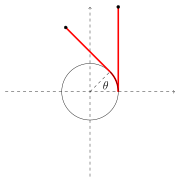
A heavy particle lies on a smooth horizontal table, and is attached to one end of a light inextensible string of length \(L\). The other end of the string is attached to a point \(P\) on the circumference of the base of a vertical post which is fixed into the table. The base of the post is a circle of radius \(a\) with its centre at a point \(O\) on the table. Initially, at time \(t=0\), the string is taut and perpendicular to the line \(OP.\) The particle is then struck in such a way that the string starts winding round the post and remains taut. At a later time \(t\), a length \(a\theta(t)\ (< L)\) of the string is in contact with the post. Using cartesian axes with origin \(O\), find the position and velocity vectors of the particle at time \(t\) in terms of \(a,L,\theta\) and \(\dot{\theta},\) and hence show that the speed of the particle is \((L-a\theta)\dot{\theta}.\) If the initial speed of the particle is \(v\), show that the particle hits the post at a time \(L^{2}/(2av).\)
Solution:
1988 Paper 2 Q12
One end of a thin uniform inextensible, but perfectly flexible, string of length \(l\) and uniform mass per unit length is held at a point on a smooth table a distance \(d(< l)\) away from a small vertical hole in the surface of the table. The string passes through the hole so that a length \(l-d\) of the string hangs vertically. The string is released from rest. Assuming that the height of the table is greater than \(l\), find the time taken for the end of the string to reach the top of the hole.
Solution: Consider some point once the string is moving, there will be \(x\) above the table and \(l - x\) hanging in the air. For the hanging string we must have \((l-x)mg - T = -(l-x)m\ddot{x}\). For the string on the table we must have that \(T = -xm \ddot{x}\). Eliminating T, we have \((l-x)g = -l \ddot{x}\) Solving the differential equation, we must have \(x = A \cosh \sqrt \frac{g}{l}t+B \sinh\sqrt \frac{g}{l}t+l\), Since \(x(0) = d, \dot{x}(0) = 0 \Rightarrow B = 0, A = (-d)\). Therefore \(x = l-(l-d) \cosh \sqrt \frac{g}{l} t \Rightarrow t =\sqrt \frac{l}{g} \cosh^{-1} \l \frac{l-x}{l-d} \r\) and we go over the edge when \(x = 0\), ie \(\sqrt \frac{l}{g} \cosh^{-1} \l \frac{l}{l-d} \r\)
1988 Paper 2 Q13
A librarian wishes to pick up a row of identical books from a shelf, by pressing her hands on the outer covers of the two outermost books and lifting the whole row together. The covers of the books are all in parallel vertical planes, and the weight of each book is \(W\). With each arm, the librarian can exert a maximum force of \(P\) in the vertical direction, and, independently, a maximum force of \(Q\) in the horizontal direction. The coefficient of friction between each pair of books and also between each hand and a book is \(\mu.\) Derive an expression for the maximum number of books that can be picked up without slipping, using this method. {[}You may assume that the books are thin enough for the rotational effect of the couple on each book to be ignored.{]}
Solution:

1988 Paper 2 Q14
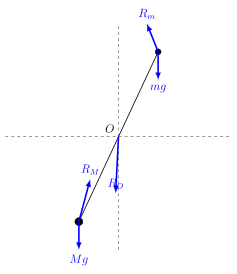
Two particles of mass \(M\) and \(m\) \((M>m)\) are attached to the ends of a light rod of length \(2l.\) The rod is fixed at its midpoint to a point \(O\) on a horizontal axle so that the rod can swing freely about \(O\) in a vertical plane normal to the axle. The axle rotates about a vertical axis through \(O\) at a constant angular speed \(\omega\) such that the rod makes a constant angle \(\alpha\) \((0<\alpha<\frac{1}{2}\pi)\) with the vertical. Show that \[ \omega^{2}=\left(\frac{M-m}{M+m}\right)\frac{g}{l\cos\alpha}. \] Show also that the force of reaction of the rod on the axle is inclined at an angle \[ \tan^{-1}\left[\left(\frac{M-m}{M+m}\right)^{2}\tan\alpha\right] \] with the downward vertical.
Solution:
1988 Paper 2 Q15
An examination consists of several papers, which are marked independently. The mark given for each paper can be an integer from \(0\) to \(m\) inclusive, and the total mark for the examination is the sum of the marks on the individual papers. In order to make the examination completely fair, the examiners decide to allocate the mark for each paper at random, so that the probability that any given candidate will be allocated \(k\) marks \((0\leqslant k\leqslant m)\) for a given paper is \((m+1)^{-1}\). If there are just two papers, show that the probability that a given candidate will receive a total of \(n\) marks is \[ \frac{2m-n+1}{\left(m+1\right)^{2}} \] for \(m< n\leqslant2m\), and find the corresponding result for \(0\leqslant n\leqslant m\). If the examination consists of three papers, show that the probability that a given candidate will receive a total of \(n\) marks is \[ \frac{6mn-4m^{2}-2n^{2}+3m+2}{2\left(m+1\right)^{2}} \] in the case \(m< n\leqslant2m\). Find the corresponding result for \(0\leqslant n\leqslant m\), and deduce the result for \(2m< n\leqslant3m\).
Solution: In order to receive \(n\) marks over the two papers, where \(m < n \leq 2m\) the student must receive \(k\) and \(n-k\) marks in each paper. Since \(n > m\), \(n-k\) is a valid mark when \(n-k \leq m\) ie when \(n-m\leq k\), therefore the probability is: \begin{align*} \sum_{k = n-m}^m \mathbb{P}(\text{scores }k\text{ and }n-k) &= \sum_{k=n-m}^m \frac{1}{(m+1)^2} \\ &= \frac{m-(n-m-1)}{(m+1)^2} \\ &= \frac{2m-n+1}{(m+1)^2} \end{align*} If \(0 \leq n \leq m\) then we need \(n-k\) marks in the second paper to be positive, ie \(n-k \geq 0 \Rightarrow n \geq k\), so \begin{align*} \sum_{k = 0}^n \mathbb{P}(\text{scores }k\text{ and }n-k) &= \sum_{k = 0}^n \frac{1}{(m+1)^2} \\ &= \frac{n+1}{(m+1)^2} \end{align*} On the first paper, they can score any number of marks, since \(n > m\), so we must have: \begin{align*} \sum_{k=0}^m \mathbb{P}(\text{scores }k\text{ and }n-k) &= \frac{1}{m+1} \sum_{k=0}^m \mathbb{P}(\text{scores }n-k\text{ on second papers}) \\ &= \frac{1}{m+1}\l \sum_{k=0}^{n-m} \frac{2m-(n-k)+1}{(m+1)^2} +\sum_{k=n-m+1}^m \frac{n-k+1}{(m+1)^2}\r \end{align*}
1988 Paper 2 Q16
Find the probability that the quadratic equation \[ X^{2}+2BX+1=0 \] has real roots when \(B\) is normally distributed with zero mean and unit variance. Given that the two roots \(X_{1}\) and \(X_{2}\) are real, find:
- the probability that both \(X_{1}\) and \(X_{2}\) are greater than \(\frac{1}{5}\);
- the expected value of \(\left|X_{1}+X_{2}\right|\);
Solution: The roots are \(X_1, X_2 = -B \pm \sqrt{B^2-1}\)
- The smallest root will be \(-B - \sqrt{B^2-1}\). For this to be larger than \(\frac15\) we must have, \begin{align*} && -B -\sqrt{B^2-1} &\geq \frac15 \\ \Rightarrow && -B - \frac15 &\geq \sqrt{B^2 - 1} \\ \Rightarrow && B^2 + \frac25 B + \frac1{25} &\geq B^2 - 1 \\ \Rightarrow && \frac25 B \geq -\frac{26}{25} \\ \Rightarrow && B \geq -\frac{13}{5} \end{align*} Therefore \(-\frac{13}5 \leq B \leq -1\). Therefore we want: \begin{align*} \frac{\P(-\frac{13}5 \leq B \leq -1)}{\P(B < -1) + \P(B > 1)} &= \frac{\Phi(-1) - \Phi(-\frac{13}{5})}{\Phi(-1)+1-\Phi(1)} \\ &= \frac{0.1586\ldots - 0.0046\ldots}{0.1586\ldots + 1- 0.8413\ldots} \\ &= 0.4853\ldots \\ &= 0.485 \,\,(3 \text{ s.f.}) \end{align*}
- \(X_1 + X_2 = -2B\). Therefore we want: \begin{align*} \mathbb{E}(|X_1 + X_2| &= \mathbb{E}(|2B|) \\ &= 2 \l\frac{1}{2\Phi(-1)} \int_1^{\infty} B \frac{1}{\sqrt{2 \pi}} e^{-\frac12 B^2} \, \d B+\frac{1}{2\Phi(-1)} \int_{-\infty}^{-1} B \frac{1}{\sqrt{2 \pi}} e^{-\frac12 B^2} \, \d B \r \\ &= \frac{4}{2\Phi(-1)} \int_1^{\infty} B \frac{1}{\sqrt{2 \pi}} e^{-\frac12 B^2} \, \d B \\ &=\frac{4}{2\sqrt{2 \pi} \Phi(-1)} \left [ -e^{-\frac12 B^2}\right]_1^{\infty} \\ &= \frac{4}{2\sqrt{2 \pi} \Phi(-1) \sqrt{e}} \\ &= 3.0502\ldots \\ &= 3.05\,\, (3\text{ s.f.}) \end{align*}
1988 Paper 3 Q1
Sketch the graph of \[ y=\frac{x^{2}\mathrm{e}^{-x}}{1+x}, \] for \(-\infty< x< \infty.\) Show that the value of \[ \int_{0}^{\infty}\frac{x^{2}\mathrm{e}^{-x}}{1+x}\,\mathrm{d}x \] lies between \(0\) and \(1\).
Solution:

1988 Paper 3 Q2
The real numbers \(u_{0},u_{1},u_{2},\ldots\) satisfy the difference equation \[ au_{n+2}+bu_{n+1}+cu_{n}=0\qquad(n=0,1,2,\ldots), \] where \(a,b\) and \(c\) are real numbers such that the quadratic equation \[ ax^{2}+bx+c=0 \] has two distinct real roots \(\alpha\) and \(\beta.\) Show that the above difference equation is satisfied by the numbers \(u_{n}\) defined by \[ u_{n}=A\alpha^{n}+B\beta^{n}, \] where \[ A=\frac{u_{1}-\beta u_{0}}{\alpha-\beta}\qquad\mbox{ and }\qquad B=\frac{u_{1}-\alpha u_{0}}{\beta-\alpha}. \] Show also, by induction, that these numbers provide the only solution. Find the numbers \(v_{n}\) \((n=0,1,2,\ldots)\) which satisfy \[ 8(n+2)(n+1)v_{n+2}-2(n+3)(n+1)v_{n+1}-(n+3)(n+2)v_{n}=0 \] with \(v_{0}=0\) and \(v_{1}=1.\)
Solution: First notice that \(u_n = \alpha^n\) and \(u_n = \beta^n\) both satisfy the recurrence, since: \begin{align*} && a \alpha^2 + b \alpha + c &= 0 \\ \Rightarrow && a \alpha^{n+2} + b \alpha^{n+1} + c \alpha^n &= 0 \\ \Rightarrow && a u_{n+2} + bu_{n+1} + cu_n &=0 \end{align*} Notice also that if \(u_n\) and \(v_n\) both satisfy the recurrence, then any linear combination of them will satisfy the recurrence: \begin{align*} && \begin{cases} au_{n+2} + bu_{n+1} + cu_n &= 0 \\ av_{n+2} + bv_{n+1} + cv_n &= 0 \\ \end{cases} \\ \Rightarrow && a (\lambda u_{n+2}+ \mu v_{n+2}) + b (\lambda u_{n+1}+ \mu v_{n+1}) + c (\lambda u_{n}+ \mu v_{n}) &= 0 \end{align*} by adding a linear combination of the top two equations. Therefore it suffices to check that the constants \(A\) and \(B\) are such that we match \(u_0\) and \(u_1\). \(\frac{u_1 - \beta u_0}{\alpha - \beta} + \frac{u_1 - \alpha u_0}{\beta - \alpha} = u_0\) and \(\frac{u_1 - \beta u_0}{\alpha - \beta}\alpha + \frac{u_1 - \alpha u_0}{\beta - \alpha}\beta = u_1\). So we are done. Suppose we have another sequence, then we first notice that the first and second terms must be identical to each other. Suppose the first \(k\) terms are identical, then since the \(k+1\)th term depends only on the \(k\) and \(k-1\)th terms (both of which are equal) the \(k+1\)th term is the same. Therefore, by the principle of mathematical induction, all terms are the same. First notice that if you put \(v_n = (n+1)w_n\) we have \begin{align*} && 8(n+3)(n+2)(n+1)w_{n+2} - 2(n+3)(n+2)(n+1)w_{n+1} - (n+3)(n+2)(n+1)w_n &= 0 \\ \Rightarrow && 8w_{n+2}-2w_{n+1}-w_n &= 0 \end{align*} This has characteristic equation \(8\lambda^2 - 2\lambda - 1 = 0 \Rightarrow \lambda = \frac12, -\frac14\). Therefore the general solution is \(w_n = A \l \frac12 \r^n + B \l -\frac14\r^n\) and \(v_n = (n+1)\l A \l \frac12 \r^n + B \l -\frac14\r^n \r\). When \(n = 0\) we have \(A+B = 0 \Rightarrow B =-A\). When \(n=1\) we have \(1 = 2 \l \frac{A}{2} + \frac{A}{4} \r \Rightarrow A = \frac{4}{3}\), therefore \[ v_n = \frac{4}{3}(n+1) \l \frac{1}{2^n} + \l -\frac14\r^n \r\]
1988 Paper 3 Q3
Give a parametric form for the curve in the Argand diagram determined by \(\left|z-\mathrm{i}\right|=2.\) Let \(w=(z+\mathrm{i})/(z-\mathrm{i}).\) Find and sketch the locus, in the Argand diagram, of the point which represents the complex number \(w\) when \begin{questionparts} \item \(\left|z-\mathrm{i}\right|=2;\) \item \(z\) is real; \item \(z\) is imaginary. \end{questionpart}
Solution: There are many possible parametric forms, for example \(z = i + 2e^{it}, z = 2\ cos \theta + (1 + 2\sin \theta)i\) etc. It is a circle radius \(2\) about the point \(i\).
- \begin{align*}
w &= \frac{z+i}{z-i} \\
&= \frac{2i + 2e^{it}}{2e^{it}} \\
&= 2 + ie^{-it}
\end{align*}
This is obvious a circle radius \(1\) about the point \(2\).

- If \(z\) is real, then \begin{align*} w &= \frac{z+i}{z-i} \\ &= \frac{(z+i)^2}{z^2+1} \\ &= \frac{z^2-1 + 2zi}{z^2+1} \end{align*} We can quickly notice this describes a circle radius \(1\) about \(0\). Alternatively, \(|z+i| = |z-i| \Rightarrow |\frac{z+i}{z-i}| = 1\) so we must be talking about points on the unit circle. Since this is a Mobius transform we know it maps lines and circles to lines and circles, therefore it must map to the unit circle;
- If \(z\) is purely imaginary, say \(it\) then:
\begin{align*}
w &= \frac{z+i}{z-i} \\
&= \frac{(it+i)(i-it)}{(-1+t)^2} \\
&= \frac{t^2-1}{(t-1)^2}
\end{align*}
Which is purely real, and can take all real values.
