Problems
Filters
1989 Paper 1 Q14
The prevailing winds blow in a constant southerly direction from an enchanted castle. Each year, according to an ancient tradition, a princess releases 96 magic seeds from the castle, which are carried south by the wind before falling to rest. South of the castle lies one league of grassy parkland, then one league of lake, then one league of farmland, and finally the sea. If a seed falls on land it will immediately grow into a fever tree. (Fever trees do not grow in water). Seeds are blown independently of each other. The random variable \(L\) is the distance in leagues south of the castle at which a seed falls to rest (either on land or water). It is known that the probability density function \(\mathrm{f}\) of \(L\) is given by \[ \mathrm{f}(x)=\begin{cases} \frac{1}{2}-\frac{1}{8}x & \mbox{ for }0\leqslant x\leqslant4,\\ 0 & \mbox{ otherwise.} \end{cases} \] What is the mean number of fever trees which begin to grow each year?
- The random variable \(Y\) is defined as the distance in leagues south of the castle at which a new fever tree grows from a seed carried by the wind. Sketch the probability density function of \(Y\), and find the mean of \(Y\).
- One year messengers bring the king the news that 23 new fever trees have grown in the farmland. The wind never varies, and so the king suspects that the ancient tradition have not been followed properly. Is he justified in his suspicions?
Solution: \begin{align*} \mathbb{P}(\text{fever tree grows}) &= \mathbb{P}(0 \leq L \leq 1) + \mathbb{P}(2 \leq L \leq 3) \\ &= \int_0^1 \frac12 -\frac18 x \d x + \int_2^3 \frac12 - \frac18 x \d x \\ &= \left [\frac12 x - \frac1{16}x^2 \right]_0^1+ \left [\frac12 x - \frac1{16}x^2 \right]_2^3 \\ &= \frac12 - \frac1{16}+\frac32-\frac9{16} - 1 + \frac{4}{16} \\ &= \frac58 \end{align*} The expected number of fever trees is just \(96 \cdot \frac58 = 60\).
- \(f_Y(t)\) must match the distribution for \(L\), but limited to the points we care about, therefore it should be:
$f_Y(t) = \begin{cases} ( \frac45 - \frac15t ) & \text{if } t \in [0,1]\cup[2,3] \\
0 & \text{otherwise} \end{cases}$
\begin{align*} \mathbb{E}(Y) &= \frac12 \cdot \frac15 (4 - \frac12)+\frac52 \cdot (1 - \frac15 (4 - \frac12)) \\ &= \frac12 \cdot \frac7{10} + \frac52 \cdot \frac3{10} \\ &= \frac{22}{20} \\ &= \frac{11}{10} \end{align*}

- Given the seeds are blown independently and the wind hasn't changed, it is reasonable to model the number of fever trees as \(B(96, \frac{5}{8})\), it is also acceptable to approximate this using a Normal distribution, ie \(N(60, 22.5)\), \(23\) is \(\frac{23-60}{\sqrt{22.5}}\) is a very negative number, so he should be extremely suspicious.
1989 Paper 1 Q15
I can choose one of three routes to cycle to school. Via Angle Avenue the distance is 5\(\,\)km, and I am held up at a level crossing for \(A\) minutes, where \(A\) is a continuous random variable uniformly distributed between \(0\) and 10. Via Bend Boulevard the distance is 4\(\,\)km, and I am delayed, by talking to each of \(B\) friends for 3\(\,\)minutes, for a total of \(3B\) minutes, where \(B\) is a random variable whose distribution is Poisson with mean 4. Via Detour Drive the distance should be only 2\(\,\)km, but in addition, due to never-ending road works, there are five places at each of which, with probability \(\frac{4}{5},\) I have to make a detour that increases the distance by 1\(\,\)km. Except when delayed by talking to friends or at the level crossing, I cycle at a steady 12\(\,\)km\(\,\)h\(^{-1}\). For each of the three routs, calculate the probability that a journey lasts at least 27 minutes. Each day I choose one of the three routes at random, and I am equally likely to choose any of the three alternatives. One day I arrive at school after a journey of at least 27 minutes. What is the probability that I came via Bend Boulevard? Which route should I use all the time: \begin{questionparts} \item if I wish my average journey time to be as small as possible; \item if I wish my journey time to be less than 32 minutes as often as possible? \end{questionpart} Justify your answers.
Solution: \(A \sim 5\cdot 5 + U[0,10]\) \(B \sim 4 \cdot 5 + 3 \textrm{Po}(4)\) \(C \sim 2 \cdot 5 + B(5, \frac{4}{5}) \cdot 5\) \begin{align*} && \mathbb{P}(A \leq 27) &= \mathbb{P}(U \leq 2) = 0.2 \\ && \mathbb{P}(B \leq 27) &= \mathbb{P}(3 \textrm{Po}(4) \leq 7) \\\ &&&= \mathbb{P}(Po(4) \leq 2) \\ &&&= e^{-4}(1 + 4 + \frac{4^2}{2}) \\ &&&= 0.23810\ldots \\ && \mathbb{P}(C \leq 27) &= \mathbb{P}(5 \cdot B(5,\tfrac45) \leq 17) \\ &&&= \mathbb{P}(B(5,\tfrac45) \leq 3) \\ &&&= \binom{5}{0} (\tfrac15)^5 + \binom{5}{1} (\tfrac45)(\tfrac 15)^4+ \binom{5}{2} (\tfrac45)^2(\tfrac 15)^3 + \binom{5}3 (\tfrac45)^3(\tfrac 15)^2+\\ &&&= 0.26272 \end{align*} \begin{align*} \mathbb{P}(\text{came via B} | \text{at least 27 minutes}) &= \frac{\mathbb{P}(\text{came via B and at least 27 minutes})}{\mathbb{P}(\text{at least 27 minutes})} \\ &= \frac{\frac13 \cdot 0.23810\ldots }{\frac13 \cdot 0.2 + \frac13 \cdot 0.23810\ldots + \frac13 \cdot 0.26272} \\ &= 0.3397\ldots \\ &= 0.340 \, \, (3\text{ s.f.}) \end{align*}
- \begin{align*} \mathbb{E}(A) &= 25 + 5 &= 30 \\ \mathbb{E}(B) &= 20 + 3\cdot 4 &= 32 \\ \mathbb{E}(C) &= 10 + 5 \cdot 4 &= 30 \end{align*} \(A\) and \(C\) are equally good.
- \begin{align*} \mathbb{P}(A \leq 32) &= \mathbb{P}(U \leq 7) &= 0.7 \\ \mathbb{P}(B \leq 32) &= \mathbb{P}(Po(4) \leq 4) \\ &= e^{-4}(1 + 4 + 8 + \frac{4^3}{6}) &= 0.4334\ldots \\ \mathbb{P}(C \leq 32) &= \mathbb{P}(B(5,\tfrac45) \leq 4) \\ &= 1 - \mathbb{P}(B(5,\tfrac45) = 5) \\ &= 1 - \frac{4^5}{5^5} &=0.67232 \end{align*} So you should choose route \(A\).
1989 Paper 1 Q16
A and B play a guessing game. Each simultaneously names one of the numbers \(1,2,3.\) If the numbers differ by 2, whoever guessed the smaller pays the opponent £\(2\). If the numbers differ by 1, whoever guessed the larger pays the opponent £\(1.\) Otherwise no money changes hands. Many rounds of the game are played.
- If A says he will always guess the same number \(N\), explain (for each value of \(N\)) how B can maximise his winnings.
- In an attempt to improve his play, A announces that he will guess each number at random with probability \(\frac{1}{3},\) guesses on different rounds being independent. To counter this, B secretly decides to guess \(j\) with probability \(b_{j}\) (\(j=1,2,3,\, b_{1}+b_{2}+b_{3}=1\)), guesses on different rounds being independent. Derive an expression for B's expected winnings on any round. How should the probabilities \(b_{j}\) be chosen so as to maximize this expression?
- A now announces that he will guess \(j\) with probability \(a_{j}\) (\(j=1,2,3,\, a_{1}+a_{2}+a_{3}=1\)). If B guesses \(j\) with probability \(b_{j}\) (\(j=1,2,3,\, b_{1}+b_{2}+b_{3}=1\)), obtain an expression for his expected winnings in the form \[ Xa_{1}+Ya_{2}+Za_{3}. \] Show that he can choose \(b_{1},b_{2}\) and \(b_{3}\) such that \(X,Y\) and \(Z\) are all non-negative. Deduce that, whatever values for \(a_{j}\) are chosen by A, B can ensure that in the long run he loses no money.
Solution:
- Suppose A always plays \(1\), then B should always play \(2\) and every time they will win 1. Suppose A always plays \(2\) then B should always play \(3\) and every time they will win 1. If A always plays \(3\) then B should always play \(1\) and every time they will win 2.
- \begin{array}{cccc} & b_1 & b_2 & b_3 \\ \frac13 & (0, \frac{b_1}{3}) & (1, \frac{b_2}{3}) & (-2, \frac{b_3}{3}) \\ \frac13 & (-1, \frac{b_1}{3}) & (0, \frac{b_2}{3}) & (1, \frac{b_3}{3}) \\ \frac13 & (2, \frac{b_1}{3}) & (-1, \frac{b_2}{3}) & (0, \frac{b_3}{3}) \\ \end{array} Therefore the expected value is: \(\frac{b_1}{3} - \frac{b_3}{3}\) and to maximise this he should always guess \(1\) (ie \(b_1 = 1, b_2 = 0, b_3 = 0\).)
- \begin{array}{cccc} & b_1 & b_2 & b_3 \\ a_1 & (0, a_1b_1) & (1, a_1b_2) & (-2, a_1b_3) \\ a_2 & (-1, a_2b_1) & (0, a_2b_2) & (1, a_2b_3) \\ a_3 & (2, a_3b_1) & (-1, a_3b_2) & (0, a_3b_3) \\ \end{array} Therefore the expected value is: \((b_2-2b_3)a_1 + (b_3-b_1)a_2 + (2b_1-b_2)a_3\) We need \(b_2 \geq 2b_3, b_3 \geq b_1, 2b_1 \geq b_2\) so \(b_1 \leq b_3 \leq \frac12 b_2 \leq b_1\) so we could take \(b_1 = b_3 = \frac12 b_2\) or \(b_1 = b_3 = \frac14, b_2 = \frac12\) and all values would be \(0\). Therefore by choosing these values \(B\) can guarantee his expected value is \(0\) and therefore shouldn't expect to lose money in the long run.
1989 Paper 2 Q1
Prove that \(\cos3\theta=4\cos^{3}\theta-3\cos\theta\). Show how the cubic equation \[ 24x^{3}-72x^{2}+66x-19=0\tag{*} \] can be reduced to the form \[ 4z^{3}-3z=k \] by means of the substitution \(y=x+a\) and \(z=by\), for suitable values of the constants \(a\) and \(b\). Hence find the three roots of the equation \((*)\), to three significant figures. Show, by means of a counterexample, or otherwise, that not all cubic equations of the form \[ x^{3}+\alpha x^{2}+\beta x+\gamma=0 \] can be solved by this method.
Solution: \begin{align*} \cos 3\theta &= \cos 2\theta\cos\theta - \sin 2\theta \sin \theta \\ &= (2\cos^2\theta-1)\cos \theta - 2\cos \theta \sin^2 \theta \\ &= 2\cos^3\theta-\cos \theta - 2\cos \theta(1- \cos^2 \theta) \\ &= 4\cos^3 \theta - 3\cos \theta \end{align*} \begin{align*} 0 &= 24x^{3}-72x^{2}+66x-19 \\ &= 24(y+1)^3-72(y+1)^2+66(y+1)-19 \\ &= 24(y^3+3y^2+3y+1)-72(y^2+2y+1)+66(y+1)-19\\ &= 24y^3+(72-144+66)y+(24-72+66-19) \\ &= 24y^3-6y-1 \\ &= 24b'^3z^3 - 6b'z - 1 \\ &= \frac{2}{\sqrt{3}}(4 z^3 -3z) - 1 \\ \end{align*} Therefore if \(b = \sqrt{3}, a = 1\), we have: \(4z^3 - 3z = \frac{\sqrt{3}}{2}\) So if \(z = \cos \theta \Rightarrow \cos 3\theta = \frac{\sqrt{3}}2 \Rightarrow 3 \theta = \frac{\pi}{6}, \frac{11\pi}{6}, \frac{13\pi}{6} \Rightarrow \theta = \frac{\pi}{18}, \frac{11\pi}{18}, \frac{13\pi}{18}\). Since \(\frac{\cos x}{\sqrt{3}} < 1\) we only need to approximate the first part to 2 significant figures. Therefore: \begin{align*} \sqrt{3} &\approx 1 + \frac{1}{1 + \frac{1}{2+\frac11}} = \frac{7}{4} = 1.75\\ \cos \tfrac{\pi}{18} &\approx \cos \frac{1}{6} \approx 1 - \frac{1}{2} \frac{1}{6^2} = \frac{71}{72} \approx 1 - \frac{1}{70} = 1 - 0.014 = 0.986 \\ \frac{\cos \tfrac{\pi}{18}}{\sqrt{3}} & \approx \frac{.986}{1.75} = 0.57 \\ \end{align*} Final answers: \(1.57, 0.803, 0.629\). We wouldn't be able to solve \(x^3 + 1= 0\) using this method, as we would have 2 non-real roots
1989 Paper 2 Q2
Let \begin{alignat*}{2} \tan x & =\ \ \, \quad{\displaystyle \sum_{n=0}^{\infty}a_{n}x^{n}} & & \text{ for small }x,\\ x\cot x & =1+\sum_{n=1}^{\infty}b_{n}x^{n}\quad & & \text{ for small }x\text{ and not zero}. \end{alignat*} Using the relation \[ \cot x-\tan x=2\cot2x,\tag{*} \] or otherwise, prove that \(a_{n-1}=(1-2^{n})b_{n}\), for \(n\geqslant1\). Let \[ x\mathrm{cosec}x=1+{\displaystyle \sum_{n=1}^{\infty}c_{n}x^{n}\quad\text{ for small }x\neq0. \qquad \qquad \, } \] Using a relation similar to \((*)\) involving \(2\mathrm{cosec}2x\), or otherwise, prove that \[ c_{n}=\frac{2^{n-1}-1}{2^{n}-1}\frac{1}{2^{n-1}}a_{n-1}\qquad(n\geqslant1). \]
Solution: \begin{align*} && \cot x - \tan x &= 2 \cot 2x \\ \Rightarrow && x\cot x - x\tan x &= 2x\cot 2x \\ \Rightarrow && 1 + \sum_{n=1}^{\infty} b_n x^n - \sum_{n=0}^{\infty}a_n x^{n+1} &= 1 + \sum_{n=1}^{\infty} b_n (2x)^n \\ \Rightarrow && \sum_{n=1}^{\infty}(1-2^n)b_nx^n &= \sum_{n=1}^{\infty} a_{n-1}x^n \\ \Rightarrow && a_{n-1} &= (1-2^n)b_n \quad \text{if }n \geq 1 \end{align*} \begin{align*} \cot x + \tan x &= 2 \cosec 2x \end{align*} So \begin{align*} && \cot x + \tan x &= 2 \cosec 2x \\ \Rightarrow && x \cot x + x\tan x &= 2x \cosec 2x \\ \Rightarrow && 1 + \sum_{n=1}^{\infty} b_n x^n + \sum_{n=0}^{\infty} a_n x^{n+1} &= 1+\sum_{n=1}^\infty c_n (2x)^n \\ \Rightarrow && \sum_{n=1}^{\infty} \frac{1}{1-2^n}a_{n-1} +\sum_{n=1}^{\infty}a_{n-1}x^n &= \sum_{n=1}^{\infty} 2^nc_n x^n \\ \Rightarrow && c_n &= \frac{1}{2^n} \left ( 1 + \frac{1}{1-2^n} \right)a_{n-1} \\ &&&= \frac1{2^n} \frac{2^n-2}{2^n-1} a_{n-1}\\ &&&= \frac1{2^{n-1}}\frac{2^{n-1}-1}{2^n-1} a_{n-1} \end{align*}
1989 Paper 2 Q3
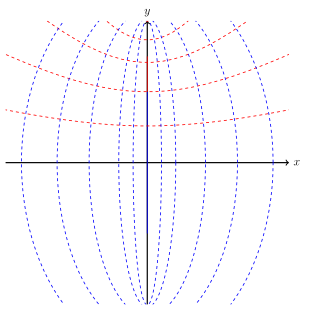
The real numbers \(x\) and \(y\) are related to the real numbers \(u\) and \(v\) by \[ 2(u+\mathrm{i}v)=\mathrm{e}^{x+\mathrm{i}y}-\mathrm{e}^{-x-\mathrm{i}y}. \] Show that the line in the \(x\)-\(y\) plane given by \(x=a\), where \(a\) is a positive constant, corresponds to the ellipse \[ \left(\frac{u}{\sinh a}\right)^{2}+\left(\frac{v}{\cosh a}\right)^{2}=1 \] in the \(u\)-\(v\) plane. Show also that the line given by \(y=b\), where \(b\) is a constant and \(0<\sin b<1,\) corresponds to one branch of a hyperbola in the \(u\)-\(v\) plane. Write down the \(u\) and \(v\) coordinates of one point of intersection of the ellipse and hyperbola branch, and show that the curves intersect at right-angles at this point. Make a sketch of the \(u\)-\(v\) plane showing the ellipse, the hyperbola branch and the line segments corresponding to:
- \(x=0\);
- \(y=\frac{1}{2}\pi,\) \(\quad 0\leqslant x\leqslant a.\)
Solution: \begin{align*} && 2(u+iv) &= e^{a+iy} - e^{-a-iy} \\ && &=(e^a \cos y - e^{-a} \cos y) + (e^a \sin y + e^{-a} \sin y)i \\ &&&= 2 \sinh a \cos y + 2\cosh a \sin y i\\ \Rightarrow && \frac{u}{\sinh a} &= \cos y \\ && \frac{v}{\cosh a} &= \sin y \\ \Rightarrow && 1 &= \left(\frac{u}{\sinh a}\right)^{2}+\left(\frac{v}{\cosh a}\right)^{2} \end{align*} \begin{align*} && 2(u+iv) &= e^{x+ib} - e^{-x-ib} \\ &&&= 2\sinh x \cos b + 2\cosh x \sin b i \\ \Rightarrow && \frac{u}{\cos b} &= \sinh x \\ && \frac{v}{\sin b} &= \cosh x \\ \Rightarrow && 1 &= \left (\frac{v}{\sin b} \right)^2 - \left (\frac{u}{\cos b} \right)^2 \end{align*} Therefore all the points lie of a hyperbola, and since \(\frac{v}{\sin b} > 0 \Rightarrow v > 0\) it's one branch of the hyperbola. (And all points on it are reachable as \(x\) varies from \(-\infty < x < \infty\). \begin{align*} 2(u+iv) &= e^{a+ib} - e^{-a-ib} \\ &= 2 \sinh a \cos b + 2 \cosh a \sin b i \end{align*} so we can take \(u = \sinh a \cos b, v = \cosh a \sin b\). \begin{align*} \frac{\d }{\d u} && 0 &= \frac{2 u}{\sinh^2 a} + \frac{2v}{\cosh^2 a} \frac{\d v}{\d u} \\ \Rightarrow && \frac{\d v}{\d u} &= -\frac{u}{v} \coth^2 a \\ \\ && \frac{\d v}{\d u} \rvert_{(u,v)} &= -\frac{\sinh a \cos b}{\cosh a \sin b} \coth^2 a \\ &&&= -\cot b \coth a \\ \frac{\d }{\d u} && 0 &= \frac{2 v}{\sin^2 b} \frac{\d v}{\d u} - \frac{2u}{\cos^2 b} \\ \Rightarrow && \frac{\d v}{\d u} &= \frac{u}{v} \tan^2 b \\ && \frac{\d v}{\d u} \rvert_{(u,v)} &= \frac{\sinh a \cos b}{\cosh a \sin b} \tan^2 b \\ &&&= \tanh a \tan b \end{align*} Therefore they are negative reciprocals and hence perpendicular.
1989 Paper 2 Q4
The function \(\mathrm{f}\) is defined by \[ \mathrm{f}(x)=\frac{\left(x-a\right)\left(x-b\right)}{\left(x-c\right)\left(x-d\right)}\qquad\left(x\neq c,\ x\neq d\right), \] where \(a,b,c\) and \(d\) are real and distinct, and \(a+b\neq c+d\). Show that \[ \frac{x\mathrm{f}'(x)}{\mathrm{f}(x)}=\left(1-\frac{a}{x}\right)^{-1}+\left(1-\frac{b}{x}\right)^{-1}-\left(1-\frac{c}{x}\right)^{-1}-\left(1-\frac{d}{x}\right)^{-1}, \] \((x\neq0,x\neq a,x\neq b)\) and deduce that when \(\left|x\right|\) is much larger than each of \(\left|a\right|,\left|b\right|,\left|c\right|\) and \(\left|d\right|,\) the gradient of \(\mathrm{f}(x)\) has the same sign as \((a+b-c-d).\) It is given that there is a real value of real value of \(x\) for which \(\mathrm{f}(x)\) takes the real value \(z\) if and only if \[ [\left(c-d\right)^{2}z+\left(a-c\right)\left(b-d\right)+\left(a-d\right)\left(b-c\right)]^{2}\geqslant4\left(a-c\right)\left(b-d\right)\left(a-d\right)\left(b-c\right). \] Describe briefly a method by which this result could be proved, but do not attempt to prove it. Given that \(a < b\) and \(a < c < d\), make sketches of the graph of \(\mathrm{f}\) in the four distinct cases which arise, indicating the cases for which the range of \(\mathrm{f}\) is not the whole of \(\mathbb{R}.\)
Solution: Notice that \(\ln f(x) = \ln (x - a) + \ln (x-b) - \ln (x-c) - \ln (x-d)\) therefore: \begin{align*} \frac{\d}{\d x}: && \frac{f'(x)}{f(x)} &= (x-a)^{-1}+(x-b)^{-1}-(x-c)^{-1} - (x-d)^{-1} \\ &&&= \frac{1}{x} \left ( (1-\frac{a}{x})^{-1}+(1-\frac{b}{x})^{-1}-(1-\frac{c}{x})^{-1} - (1-\frac{d}{x})^{-1}\right) \end{align*} Multiplying by \(x\) gives the desired result. When \(|x|\) is very large then: \begin{align*} \frac{x f'(x)}{f(x)} &\approx 1 + \frac{a}{x} + o(\frac{1}{x^2})+ 1 + \frac{b}{x} + o(\frac{1}{x^2})-(1 + \frac{c}{x} + o(\frac{1}{x^2}))-(1 + \frac{d}{x} + o(\frac{1}{x^2})) \\ &= \frac{a+b-c-d}{x} + o(x^{-2}) \end{align*} Dividing by \(x\) we obtain \(\frac{f'(x)}{f(x)} \approx \frac{a+b-c-d}{x^2} + o(x^{-3})\) if \(|x|\) is sufficiently large this will be dominated by the \(\frac{a+b-c-d}{x^2}\) term which will have the same sign as \((a+b-c-d)\). When \(|x|\) is very large all of the brackets will have the same sign, and therefore \(f(x)\) will be positive, and so \(f'(x)\) must have the same sign as \(a+b-c-d\). To prove this result, we could set \(f(x) = k\) and rearrange to form a quadratic in \(x\). We could then check the discriminant is non-zero. Case 1: \(a < c < d < b\) and \(a+b > c+d \Rightarrow\) not all values reached and approx asymtope from below on the right and above on the left.


1989 Paper 2 Q5
- Show that in polar coordinates, the gradient of any curve at the point
\((r,\theta)\) is
\[
\left.\left(\frac{\mathrm{d}r}{\mathrm{d}\theta}\tan\theta+r\right)\right/\left(\frac{\mathrm{d}r}{\mathrm{d}\theta}-r\tan\theta\right).
\]

- A mirror is designed so that any ray of light which hits one side of the mirror and which is parallel to a certain fixed line \(L\) is reflected through a fixed point \(O\) on \(L\). For any ray hitting the mirror, the normal to the mirror at the point of reflection bisects the angle between the incident ray and the reflected ray, as shown in the figure. Prove that the mirror intersects any plane containing \(L\) in a parabola.
Solution:
- Suppose our curve is \(r(\theta)\), then \(y = r \sin \theta, x = r \cos \theta\) and \begin{align*} && \frac{\d y}{\d \theta} &= \frac{\d r}{\d \theta} \sin \theta + r \cos \theta \\ && \frac{\d x}{\d \theta} &= \frac{\d r}{\d \theta} \cos \theta - r \sin \theta \\ \Rightarrow && \frac{\d y}{\d x} &= \frac{\d y}{\d \theta} \Bigg / \frac{\d x}{\d \theta} \\ &&&= \frac{\frac{\d r}{\d \theta} \sin \theta + r \cos \theta}{\frac{\d r}{\d \theta} \cos \theta - r \sin \theta} \\ &&&= \frac{\frac{\d r}{\d \theta} \tan\theta + r }{\frac{\d r}{\d \theta} - r \tan\theta} \end{align*} as required.
- Set up a system of polar coordinates such that the origin is at \(O\) and all points in the plane containing \(L\) are represented by \((r, \theta)\). The constraint we have is that the angle of the normal, is \(\frac12 \theta\). Let \(\tan \tfrac12 \theta = t\), then \(\tan \theta = \frac{2t}{1-t^2}\) \begin{align*} && \tan \frac12 \theta &= -\frac{\frac{\d r}{\d \theta} - r \tan\theta}{\frac{\d r}{\d \theta} \tan\theta + r } \\ \Rightarrow && t &= -\frac{r'-r\frac{2t}{1-t^2}}{r' \frac{2t}{1-t^2}+r} \\ &&&= \frac{2tr-(1-t^2)r'}{2tr'+(1-t^2)r} \\ \Rightarrow && (2t^2+1-t^2)r' &= (2t-t+t^3)r \\ && (1+t^2)r' &= t(t^2+1) r \\ \Rightarrow && r' &= t r \\ \Rightarrow && \frac{\d r}{\d \theta} &= \tan \tfrac12 \theta r \\ \Rightarrow && \int \frac1r \d r &= \int \tan \frac12 \theta \d \theta \\ && \ln r &= -2\ln \cos \tfrac12 \theta+C \\ \Rightarrow && r\cos^2 \frac12 \theta &= C \\ \Rightarrow && r + r\cos \theta &= D \\ \Rightarrow && r &= D-x \\ \Rightarrow && x^2 + y^2 &= D^2 - 2Dx + x^2 \\ \Rightarrow && y^2 &= D^2-2Dx \end{align*} Therefore it is a parabola
1989 Paper 2 Q6
The function \(\mathrm{f}\) satisfies the condition \(\mathrm{f}'(x)>0\) for \(a\leqslant x\leqslant b\), and \(\mathrm{g}\) is the inverse of \(\mathrm{f}.\) By making a suitable change of variable, prove that \[ \int_{a}^{b}\mathrm{f}(x)\,\mathrm{d}x=b\beta-a\alpha-\int_{\alpha}^{\beta}\mathrm{g}(y)\,\mathrm{d}y, \] where \(\alpha=\mathrm{f}(a)\) and \(\beta=\mathrm{f}(b)\). Interpret this formula geometrically, in the case where \(\alpha\) and \(a\) are both positive. Prove similarly and interpret (for \(\alpha>0\) and \(a>0\)) the formula \[ 2\pi\int_{a}^{b}x\mathrm{f}(x)\,\mathrm{d}x=\pi(b^{2}\beta-a^{2}\alpha)-\pi\int_{\alpha}^{\beta}\left[\mathrm{g}(y)\right]^{2}\,\mathrm{d}y. \]
Solution: Let \(u = f(x)\) then \(\frac{\d u}{\d x} = f'(x)\) and \begin{align*} \int_a^b f(x) \d x &\underbrace{=}_{\text{IBP}} \left [ xf(x) \right]_a^b - \int_a^b x f'(x) \d x \\ &\underbrace{=}_{u = f(x)} b \beta - a \alpha - \int_{u = f(a) = \alpha}^{u = f(b) = \beta} g(u) \d u \\ &= b \beta - a \alpha - \int_{\alpha}^{\beta} g(u) \d u \end{align*}

1989 Paper 2 Q7
By means of the substitution \(x^{\alpha},\) where \(\alpha\) is a suitably chosen constant, find the general solution for \(x>0\) of the differential equation \[ x\frac{\mathrm{d}^{2}y}{\mathrm{d}x^{2}}-b\frac{\mathrm{d}y}{\mathrm{d}x}+x^{2b+1}y=0, \] where \(b\) is a constant and \(b>-1\). Show that, if \(b>0\), there exist solutions which satisfy \(y\rightarrow1\) and \(\mathrm{d}y/\mathrm{d}x\rightarrow0\) as \(x\rightarrow0\), but that these conditions do not determine a unique solution. For what values of \(b\) do these conditions determine a unique solution?
Solution: Let \(z = x^\alpha, \frac{\d z}{\d x}=\alpha x^{\alpha-1} \), then \begin{align*} \frac{\d y}{\d x} &= \frac{\d y}{\d z} \frac{\d z}{\d x} \\ &= \alpha x^{\alpha-1}\frac{\d y}{\d z} \\ \\ \frac{\d^2 y}{\d x^2} &= \frac{\d }{\d x} \left ( \alpha x^{\alpha-1}\frac{\d y}{\d z} \right) \\ &= \alpha (\alpha-1)x^{\alpha-2} \frac{\d y}{\d z} + \alpha x^{\alpha-1} \frac{\d ^2 y}{\d z^2} \frac{\d z}{\d x} \\ &= \alpha(\alpha-1)x^{\alpha-2} \frac{\d y}{\d z} + \alpha^2 x^{2\alpha-2} \frac{\d ^2y}{\d z^2} \end{align*} \begin{align*} && 0 &=x\frac{\mathrm{d}^{2}y}{\mathrm{d}x^{2}}-b\frac{\mathrm{d}y}{\mathrm{d}x}+x^{2b+1}y \\ &&&= x \left ( \alpha(\alpha-1)x^{\alpha-2} \frac{\d y}{\d z} + \alpha^2 x^{2\alpha-2} \frac{\d ^2y}{\d z^2}\right) - b \left ( \alpha x^{\alpha-1}\frac{\d y}{\d z} \right) + x^{2b+1}y \\ &&&= \alpha^2 x^{2\alpha-1} \frac{\d^2 y}{\d z^2} +\left (\alpha(\alpha-1)x^{\alpha-1}-b\alpha x^{\alpha-1} \right) \frac{\d y}{\d z} + x^{2b+1} y \\ \end{align*} If we set \(\alpha = b +1\) the middle term disappears, so we get \begin{align*} && 0 &= (b+1)^2 x^{2b+1} \frac{\d^2 y}{\d z^2} + x^{2b+1} y \\ \Rightarrow && 0 &= (b+1)^2 \frac{\d^2 y}{\d z^2} + y \\ \Rightarrow && y &= A \sin \left (\frac{z}{b+1} \right) + B \cos \left (\frac{z}{b+1} \right) \\ &&&= \boxed{A \sin \left (\frac{x^{b+1}}{b+1} \right) + B \cos \left (\frac{x^{b+1}}{b+1} \right)} \\ \\ \lim_{x \to 0}: && y &\to B \\ && \frac{\d y}{\d x} &= A x^b \cos\left (\frac{x^{b+1}}{b+1} \right) - B x^b \sin\left (\frac{x^{b+1}}{b+1} \right) \\ b>0: && \frac{\d y}{\d x} &\to 0 \\ \end{align*} So there are infinitely many different solutions with \(B = 1\) and \(A\) is anything it wants to be. If \(b = 0\) \(y' \to A\) so \(A =0 \) and unique. If \(b < 0\) \(x^b \to \infty\) so we need \(A = 0\), unique. However, we also need \(y' \to 0\), so we need to check \(y' = -x^b \sin \left ( \frac{x^{b+1}}{b+1}\right) \to 0\), \begin{align*} y' &= -x^b \sin \left ( \frac{x^{b+1}}{b+1}\right) \\ &\approx -x^b \left ( \frac{x^{b+1}}{b+1}\right) \\ &= - \frac{x^{2b+1}}{b+1} \end{align*} so we need \(2b+1>0 \Rightarrow b > -\frac12\). Therefore the solution is unique on \((-\frac12,0]\)