Problems
Filters
1989 Paper 1 Q4
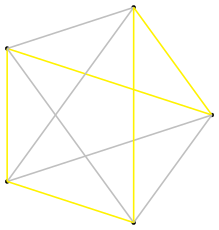
Six points \(A,B,C,D,E\) and \(F\) lie in three dimensional space and are in general positions, that is, no three are collinear and no four lie on a plane. All possible line segments joining pairs of points are drawn and coloured either gold or silver. Prove that there is a triangle whose edges are entirely of one colour. {[}\(Hint\): consider segments radiating from \(A.\){]} Give a sketch showing that the result is false for five points in general positions.
Solution: Consider the \(5\) segements radiating from \(A\). By the pigeonhole principle, at least \(3\) of them must be the same colour (say gold and say reaching \(B,C,D\)). If any of the segments joining any of \(B,C,D\) are gold then we have found a monochromatic gold triangle. But if none of them are gold, they are all silver, therefore \(BCD\) is a monochromatic silver triangle.
1989 Paper 1 Q5
Write down the binomial expansion of \((1+x)^{n}\), where \(n\) is a positive integer.
- By substituting particular values of \(x\) in the above expression, or otherwise, show that, if \(n\) is an even positive integer, \[ \binom{n}{0}+\binom{n}{2}+\binom{n}{4}+\cdots+\binom{n}{n}=\binom{n}{1}+\binom{n}{3}+\binom{n}{5}+\cdots+\binom{n}{n-1}=2^{n-1}. \]
- Show that, if \(n\) is any positive integer, then \[ \binom{n}{1}+2\binom{n}{2}+3\binom{n}{3}+\cdots+n\binom{n}{n}=n2^{n-1}. \]
Solution: \[ (1+x)^n = \sum_{k=0}^n \binom{n}{k} x^k \]
- \begin{align*} (1+1)^n &= \sum_{k=0}^n \binom{n}{k} \\ (1-1)^n &= \sum_{k=0}^n (-1)^n\binom{n}{k} \\ &= \sum_{\text{even }k, 0 \leq k \leq n} \binom{n}{k} -\sum_{\text{odd }k, 0 \leq k \leq n} \binom{n}{k} \end{align*} Therefore \(\displaystyle \sum_{\text{even }k, 0 \leq k \leq n} \binom{n}{k} = \sum_{\text{odd }k, 0 \leq k \leq n} \binom{n}{k} = \frac{2^n}{2} = 2^{n-1}\)
- \begin{align*} && (1+x)^n &= \sum_{k=0}^n \binom{n}{k}x^k \\ \frac{\d}{\d x}: && n(1+x)^{n-1} &= \sum_{k=0}^n k\binom{n}{k} x^{k-1} \\ x = 1: && n2^{n-1} &= \sum_{k=1}^n k\binom{n}{k} \end{align*} as required
1989 Paper 1 Q6
The normal to the curve \(y=\mathrm{f}(x)\) at the point \(P\) with coordinates \((x,\mathrm{f}(x))\) cuts the \(y\)-axis at the point \(Q\). Derive an expression in terms of \(x\), \(\mathrm{f}(x)\) and \(\mathrm{f}'(x)\) for the \(y\)-coordinate of \(Q\). If, for all \(x\), \(PQ=\sqrt{\mathrm{e}^{x^{2}}+x^{2}}\), find a differential equation satisfied by \(\mathrm{f}(x)\). If the curve also has a minimum point \((0,-2)\), find its equation.
Solution: The normal to the curve \(y = f(x)\) has gradient \(-\frac{1}{f'(x)}\) and so has equation: \begin{align*} && \frac{Y - f(x)}{X - x} &= -\frac{1}{f'(x)} \\ \Rightarrow && Y &= -\frac{1}{f'(x)}X + \frac{x}{f'(x)}+f(x) \end{align*} Hence the \(Q\) is \(\displaystyle \left (0, f(x) + \frac{x}{f'(x)} \right)\). \begin{align*} && |PQ|^2 &= x^2 + \frac{x^2}{(f'(x))^2} \\ \Rightarrow && x^2 + e^{x^2} &= x^2 + \frac{x^2}{(f'(x))^2} \\ \Rightarrow && (f'(x))^2 &=x^2 e^{-x^2} \end{align*} Therefore \(f'(x) = \pm x e^{-x^2/2}\). If \(f(x)\) has a minimum at \((0,-2)\) then \(f''(0) > 0\), and \(f''(x) = \pm (e^{-x^2/2} - x^2e^{-x^2/2}) = \pm e^{-x^2/2}(1-x^2)\) so we should take the positive branch of the solution, ie \(f'(x) = xe^{-x^2/2}\). Therefore \(f(x) = - e^{-x^2/2}+C\). Since \(f(0) = -2\) we must have \(-2 = -1 + C\), ie \(C = -1\). Therefore \(f(x) = -1 - e^{-x^2/2}\)
1989 Paper 1 Q7
Sketch the curve \(y^{2}=1-\left|x\right|\). A rectangle, with sides parallel to the axes, is inscribed within this curve. Show that the largest possible area of the rectangle is \(8/\sqrt{27}\). Find the maximum area of a rectangle similarly inscribed within the curve given by \(y^{2m}=\left(1-\left|x\right|\right)^{n}\), where \(m\) and \(n\) are positive integers, with \(n\) odd.
Solution:

1989 Paper 1 Q8
By using de Moivre's theorem, or otherwise, show that
- \(\cos4\theta=8\cos^{4}\theta-8\cos^{2}\theta+1;\)
- \(\cos6\theta=32\cos^{6}\theta-48\cos^{4}\theta+18\cos^{2}\theta-1.\)
Solution: Given that \(e^{i \theta} = \cos \theta + i \sin \theta\) we must have that
- \begin{align*} \cos 4 \theta &= \textrm{Re} \l e^{i 4 \theta} \r \\ &= \textrm{Re} \l (\cos \theta + i \sin \theta)^4 \r \\ &= \cos^4 \theta - \binom{4}{2}\cos^2 \theta \sin^2 \theta +\sin^4 \theta \\ &= \cos^4 \theta - 6\cos^2 \theta (1-\cos^2 \theta) +(1-\cos^2 \theta)^2 \\ &= 8\cos^4 \theta - 8\cos^2 \theta + 1 \end{align*}
- Similarly, \begin{align*} \cos 6 \theta &= \textrm{Re} \l e^{i 6 \theta} \r \\ &= \textrm{Re} \l (\cos \theta + i \sin \theta)^6 \r \\ &= \cos^6 \theta -\binom{6}{2}\cos^4 \theta \sin^2 \theta +\binom{6}{4} \cos^2\theta \sin^4 \theta - \sin^6 \theta \\ &= \cos^6 \theta - 15 \cos^4 \theta (1-\cos^2 \theta) + 15\cos^2 \theta (1-\cos^2\theta)^2 - (1-\cos^2 \theta)^3\\ &= 31\cos^6 \theta-45\cos^4\theta+15\cos^2\theta-1+3\cos^2 \theta-3\cos^4 \theta+\cos^6 \theta \\ &= 32 \cos^6 \theta-48\cos^4 \theta+18\cos^2 \theta-1 \end{align*}
1989 Paper 1 Q9
Sketch the graph of \(8y=x^{3}-12x\) for \(-4\leqslant x\leqslant4\), marking the coordinates of the turning points. Similarly marking the turning points, sketch the corresponding graphs in the \((X,Y)\)-plane, if \begin{alignat*}{3} \rm{(a)} & \quad & & X=\tfrac{1}{2}x, & \qquad & Y=y,\\ \rm{(b)} & & & X=x, & & Y=\tfrac{1}{2}y,\\ \rm{(c)} & & & X=\tfrac{1}{2}x+1, & & Y=y,\\ \rm{(d)} & & & X=x, & & Y=\tfrac{1}{2}y+1. \end{alignat*} Find values for \(a,b,c,d\) such that, if \(X=ax+b,\) \(Y=cy+d\), then the graph in the \((X,Y)\)-plane corresponding to \(8y=x^{3}-12x\) has turning points at \((X,Y)=(0,0)\) and \((X,Y)=(1,1)\).
Solution: \(8\frac{\d y}{\d x} = 3(x^2-4)\) so the turning points are at \((\pm 2, \mp 2)\)


1989 Paper 1 Q10
A spaceship of mass \(M\) is travelling at constant speed \(V\) in a straight line when it enters a force field which applies a resistive force acting directly backwards and of magnitude \(M\omega(v^{2}+V^{2})/v\), where \(v\) is the instantaneous speed of the spaceship, and \(\omega\) is a positive constant. No other forces act on the spaceship. Find the distance travelled from the edge of the force field until the speed is reduced to \(\frac{1}{2}V\). As soon as the spaceship has travelled this distance within the force field, the field is altered to a constant resistive force, acting directly backwards, whose magnitude is within 10% of that of the force acting on the spaceship immediately before the change. If \(z\) is the extra distance travelled by the spaceship before coming instantaneously to rest, determine limits between which \(z\) must lie.
Solution: Using Newton's second law, we have: \begin{align*} && -M\omega(v^2+V^2)/v &= M v \frac{\d v}{\d x} \\ \Rightarrow && \frac{v^2}{v^2+V^2} \frac{\d v}{\d x} &= -\omega \\ \Rightarrow && \omega X &= \int_{V/2}^V \frac{v^2}{v^2+V^2} \d v \\ &&&= \int_{V/2}^V \l 1 - \frac{V^2}{v^2+V^2} \r \d v \\ &&&= \left [v - V\tan^{-1} \frac{v}{V} \right]_{V/2}^V \\ &&&= V \l \frac12 - \tan^{-1} 1 + \tan^{-1} \frac12 \r \\ \Rightarrow X &= \frac{V}{\omega} \l \tan^{-1} \frac12 + \frac12 - \frac{\pi}{4} \r \end{align*}. The resistive force just before the field changes is \(M \omega (\frac{V^2}{4} + V^2)/\frac{V}{2} = \frac52MV\omega\). Therefor the constant resistive force is between \(\frac{11}4MV\omega\) and \(\frac{9}{4}MV \omega\) and acceleration is \(\frac{11}{4}V\omega, \frac{9}{4}V\omega\). Since \(v^2 = u^2 + 2as \Rightarrow s = \frac{v^2-u^2}{2a} = \frac{\frac{V^2}{4}}{2kV\omega} = \frac{V}{8k\omega}\) therefore \(z \in \left [ \frac{V}{22\omega},\frac{V}{18 \omega} \right]\)
1989 Paper 1 Q11
A shot-putter projects a shot at an angle \(\theta\) above the horizontal, releasing it at height \(h\) above the level ground, with speed \(v\). Show that the distance \(R\) travelled horizontally by the shot from its point of release until it strikes the ground is given by \[ R=\frac{v^{2}}{2g}\sin2\theta\left(1+\sqrt{1+\frac{2hg}{v^{2}\sin^{2}\theta}}\right). \] The shot-putter's style is such that currently \(\theta=45^{\circ}\). Determine (with justification) whether a small decrease in \(\theta\) will increase \(R\). [Air resistance may be neglected.]
Solution: Notice that \(u_x = v \cos \theta, u_y = v \sin \theta\). We are interested in the time taken for the shot to hit the ground. \(-h = u_y t -\frac12 g t^2\) since our distance will be \(v \cos \theta \cdot t\). Solving this quadratic for \(t\) we obtain: \begin{align*} && 0 &= h + v \sin \theta \cdot t - \frac12 g \cdot t^2 \\ \Rightarrow && t_\pm &= \frac{-v \sin \theta \pm \sqrt{v^2 \sin^2 \theta+2hg}}{-g} \\ \Rightarrow && t_- &= \frac{v \sin \theta+v\sin \theta \sqrt{1 + \frac{2hg}{v^2 \sin^2 \theta}}}{g} \\ \Rightarrow && v \cos \theta t_{-} &= \frac{v^2}{g} \cos \theta \sin \theta \left( 1 + \sqrt{1 + \frac{2hg}{v^2 \sin^2 \theta}} \right) \\ &&&= \frac{v^2}{2g} \sin 2 \theta \left( 1 + \sqrt{1 + \frac{2hg}{v^2 \sin^2 \theta}} \right) \end{align*} Differentiating \(R\) wrt to \(\theta\) at \(\frac{\pi}{4}\) we obtain: \begin{align*} \frac{\d R}{\d \theta} &= \frac{v^2}{2g} \left (2 \cos 2 \theta + 2 \cos 2 \theta \sqrt{1 + \frac{2hg}{v^2 \sin^2 \theta}} + \sin 2\theta \left ( 1 + \frac{2hg}{v^2 \sin^2 \theta}\right)^{-\frac12} \frac12 \frac{2hg} {v^2}(-2) \frac{\cos \theta}{\sin^3 \theta}\right) \\ \frac{\d R}{\d \theta} \biggr \rvert_{\theta = \frac{\pi}{4}} &=\frac{v^2}{2g}\left(0+0- 4\left ( 1 + \frac{4hg}{v^2 }\right)^{-\frac12} \frac{hg} {v^2} \right) \\ &< 0 \end{align*} Therefore, since \(R\) is locally decreasing in \(\theta\) he should reduce his angle of projection slightly.
1989 Paper 1 Q12
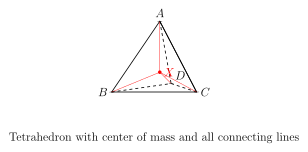
A regular tetrahedron \(ABCD\) of mass \(M\) is made of 6 identical uniform rigid rods, each of length \(2a.\) Four light elastic strings \(XA,XB,XC\) and \(XD\), each of natural length \(a\) and modulus of elasticity \(\lambda,\) are fastened together at \(X\), the other end of each string being attached to the corresponding vertex. Given that \(X\) lies at the centre of mass of the tetrahedron, find the tension in each string. The tetrahedron is at rest on a smooth horizontal table, with \(B,C\) and \(D\) touching the table, and the ends of the strings at \(X\) attached to a point \(O\) fixed in space. Initially the centre of mass of the tetrahedron coincides with \(O.\) Suddenly the string \(XA\) breaks, and the tetrahedron as a result rises vertically off the table. If the maximum height subsequently attained is such that \(BCD\) is level with the fixed point \(O,\) show that (to 2 significant figures) \[ \frac{Mg}{\lambda}=0.098. \]
Solution:
1989 Paper 1 Q13
A uniform ladder of mass \(M\) rests with its upper end against a smooth vertical wall, and with its lower end on a rough slope which rises upwards towards the wall and makes an angle of \(\phi\) with the horizontal. The acute angle between the ladder and the wall is \(\theta\). If the ladder is in equilibrium, show that \(N\) and \(F\), the normal reaction and frictional force at the foot of the ladder are given by \[ N=Mg\left(\cos\phi-\frac{\tan\theta\sin\phi}{2}\right), \] \[ F=Mg\left(\sin\phi+\frac{\tan\theta\cos\phi}{2}\right). \] If the coefficient of friction between the ladder and the slope is \(2\), and \(\phi=45^{\circ}\), what is the largest value of \(\theta\) for which the ladder can rest in equilibrium?
Solution: \begin{align*} \overset{\curvearrowleft}{X}: && 0&= \frac{l}{2} Mg\sin \theta - l R_1 \cos \theta \\ \Rightarrow && R_1 &= \frac12 \tan \theta Mg \\ \text{N2}(\uparrow): && 0 &= R\cos \phi +F \sin \phi - Mg \\ \text{N2}(\rightarrow):&& 0&=R_1-F \cos \phi + R \sin \phi \\ \Rightarrow && \frac12 \tan \theta Mg &= F \cos \phi- R \sin \phi \\ && Mg &= F \sin \phi +R \cos \phi \\ \Rightarrow && F &= Mg \left ( \sin \phi + \frac12 \tan \theta \cos \phi \right) \\ && N &= Mg \left (\cos \phi - \frac12 \tan \theta \sin \phi \right ) \end{align*} If \(\mu = 2\) and \(\phi = 45^{\circ}\), we must have \(F \leq 2 N\), so: \begin{align*} && Mg \left ( \sin \phi + \frac12 \tan \theta \cos \phi \right) &\leq 2 Mg \left (\cos \phi - \frac12 \tan \theta \sin \phi \right ) \\ \Rightarrow && 1 + \frac12 \tan \theta \leq 2-\tan \theta \\ \Rightarrow && \frac 32 \tan \theta \leq 1 \\ \Rightarrow && \tan \theta \leq \frac23 \\ \Rightarrow && \theta \leq \tan^{-1} \frac23 \end{align*}