Problems
Filters
1990 Paper 3 Q10
By considering the graphs of \(y=kx\) and \(y=\sin x,\) show that the equation \(kx=\sin x,\) where \(k>0,\) may have \(0,1,2\) or \(3\) roots in the interval \((4n+1)\frac{\pi}{2} < x < (4n+5)\frac{\pi}{2},\) where \(n\) is a positive integer. For a certain given value of \(n\), the equation has exactly one root in this interval. Show that \(k\) lies in an interval which may be written \(\sin\delta < k < \dfrac{2}{(4n+1)\pi},\) where \(0 < \delta < \frac{1}{2}\pi\) and \[ \cos\delta=\left((4n+5)\frac{\pi}{2}-\delta\right)\sin\delta. \] Show that, if \(n\) is large, then \(\delta\approx\dfrac{2}{(4n+5)\pi}\) and obtain a second, improved, approximation.
Solution:

- be below \(((4n+1)\tfrac{\pi}{2}, 1)\) and
- not touch the second gradient
1990 Paper 3 Q11
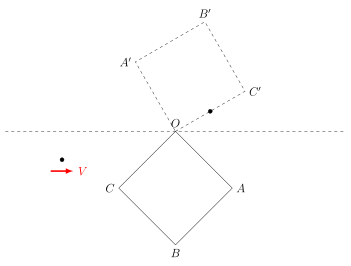
The points \(O,A,B\) and \(C\) are the vertices of a uniform square lamina of mass \(M.\) The lamina can turn freely under gravity about a horizontal axis perpendicular to the plane of the lamina through \(O\). The sides of the lamina are of length \(2a.\) When the lamina is haning at rest with the diagonal \(OB\) vertically downwards it is struck at the midpoint of \(OC\) by a particle of mass \(6M\) moving horizontally in the plane of the lamina with speed \(V\). The particle adheres to the lamina. Find, in terms of \(a,M\) and \(g\), the value which \(V^{2}\) must exceed for the lamina and particle to make complete revolutions about the axis.
Solution:
1990 Paper 3 Q12
A uniform smooth wedge of mass \(m\) has congruent triangular end faces \(A_{1}B_{1}C_{1}\) and \(A_{2}B_{2}C_{2},\) and \(A_{1}A_{2},B_{1}B_{2}\) and \(C_{1}C_{2}\) are perpendicular to these faces. The points \(A,B\) and \(C\) are the midpoints of \(A_{1}A_{2},B_{1}B_{2}\) and \(C_{1}C_{2}\) respectively. The sides of the triangle \(ABC\) have lengths \(AB=AC=5a\) and \(BC=6a.\) The wedge is placed with \(BC\) on a smooth horizontal table, a particle of mass \(2m\) is placed at \(A\) on \(AC,\) and the system is released from rest. The particle slides down \(AC,\) strikes the table, bounces perfectly elastically and lands again on the table at \(D\). At this time the point \(C\) of the wedge has reached the point \(E\). Show that \(DE=\frac{192}{19}a.\)
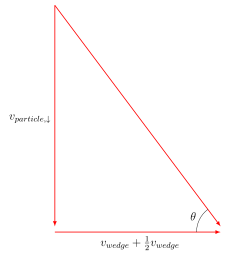
Solution: Conservation of energy, tells us that \(2m \cdot g \cdot 4a = 8amg\) is equal to \(\frac12 m v_{wedge}^2 + \frac12(2m)v_{particle}^2\). Conservation of momentum (horizontally) tells us that \(m v_{wedge}+2mv_{particle, \rightarrow} = 0 \Rightarrow v_{particle, \rightarrow} = -\frac12 v_{wedge}\).
1990 Paper 3 Q13
A particle \(P\) is projected, from the lowest point, along the smooth inside surface of a fixed sphere with centre \(O\). It leaves the surface when \(OP\) makes an angle \(\theta\) with the upward vertical. Find the smallest angle that must be exceeded by \(\theta\) to ensure that \(P\) will strike the surface below the level of \(O\). You may find it helpful to find the time at which the particle strikes the sphere.
Solution:

1990 Paper 3 Q14
The edges \(OA,OB,OC\) of a rigid cube are taken as coordinate axes and \(O',A',B',C'\) are the vertices diagonally opposite \(O,A,B,C,\) respectively. The four forces acting on the cube are \[ \begin{pmatrix}\alpha\\ \beta\\ \gamma \end{pmatrix}\mbox{ at }O\ (0,0,0),\ \begin{pmatrix}\lambda\\ 0\\ 1 \end{pmatrix}\mbox{ at }O'\ (a,a,a),\ \begin{pmatrix}-1\\ 0\\ 2 \end{pmatrix}\mbox{ at }B\ (0,a,0),\ \mbox{ and }\begin{pmatrix}1\\ \mu\\ \nu \end{pmatrix}\mbox{ at }B'\ (a,0,a). \] The moment of the system about \(O\) is zero: find \(\lambda,\mu\) and \(\nu\).
- Given that \(\alpha=\beta=\gamma=0,\) find the system consisting of a single force at \(B\) together with a couple which is equivalent to the given system.
- Given that \(\alpha=2,\beta=3\) and \(\gamma=2,\) find the equation of the locus about each point of which the moment of the system is zero. Find the number of units of work done on the cube when it moves (without rotation) a distance in the direction of this line under the action of the given forces only.
Solution: \begin{align*} &&\mathbf{M} &= \begin{pmatrix}\lambda \\ 0\\ 1 \end{pmatrix} \times \begin{pmatrix}a\\ a \\ a \end{pmatrix} + \begin{pmatrix}-1\\ 0\\ 2 \end{pmatrix} \times \begin{pmatrix} 0 \\ a \\ 0 \end{pmatrix} + \begin{pmatrix}1\\ \mu\\ \nu \end{pmatrix} \times \begin{pmatrix} a \\ 0 \\ a \end{pmatrix} \\ &&&= \begin{pmatrix} -a \\ -a(\lambda -1) \\ \lambda a \end{pmatrix} + \begin{pmatrix} -2a \\ 0 \\ -a \end{pmatrix} + \begin{pmatrix} \mu a \\ -a(1-\nu) \\ -a \mu \end{pmatrix} \\ &&&=a \begin{pmatrix} \mu - 3 \\ \nu - \lambda \\ \lambda-1-\mu \end{pmatrix} \\ \Rightarrow && \mu &= 3, \lambda = 4, \nu = 4 \end{align*}
- To find the force we add all vectors: \begin{align*} \mathbf{F} &= \begin{pmatrix}\lambda \\ 0\\ 1 \end{pmatrix} + \begin{pmatrix}-1\\ 0\\ 2 \end{pmatrix} + \begin{pmatrix}1\\ \mu\\ \nu \end{pmatrix} \\ &= \begin{pmatrix}4\\ 0\\ 1 \end{pmatrix} + \begin{pmatrix}-1\\ 0\\ 2 \end{pmatrix} + \begin{pmatrix}1\\ 3 \\ 4 \end{pmatrix} \\ &= \begin{pmatrix} 4 \\ 3 \\ 7 \end{pmatrix} \end{align*} Since the moment about \(O\) is \(0\), we have the moment about \(B\) is: \begin{align*} \mathbf{M} &= \begin{pmatrix} 0 \\ a \\ 0 \end{pmatrix} \times \begin{pmatrix} 4 \\ 3 \\ 7\end{pmatrix} \\ &= \begin{pmatrix} 7a \\ 0 \\ -4a\end{pmatrix} \end{align*}
- \begin{align*} \mathbf{0} &= \mathbf{r} \times \begin{pmatrix} 4 + 2 \\ 3+3 \\ 7+2 \end{pmatrix} \\ &= \mathbf{r} \times \begin{pmatrix} 6 \\ 6 \\ 9 \end{pmatrix} \\ \end{align*} Therefore \(\mathbf{r} = t\begin{pmatrix} 2 \\ 2 \\ 3 \end{pmatrix}\) (ie a line) \begin{align*} \text{Work done} &= \text{Force} \cdot \text{distance} \end{align*} Since they are parallel, it's just the magnitude of the force, which is \(3\sqrt{2^2+2^2+3^2} = 3\sqrt{17}\)
1990 Paper 3 Q15
An unbiased twelve-sided die has its faces marked \(A,A,A,B,B,B,B,B,B,B,B,B.\) In a series of throws of the die the first \(M\) throws show \(A,\) the next \(N\) throws show \(B\) and the \((M+N+1)\)th throw shows \(A\). Write down the probability that \(M=m\) and \(N=n\), where \(m\geqslant0\) and \(n\geqslant1.\) Find
- the marginal distributions of \(M\) and \(N\),
- the mean values of \(M\) and \(N\).
Solution: \begin{align*} \mathbb{P}(M = m, N = n) &= \left ( \frac{3}{12} \right)^m \left ( \frac{9}{12} \right)^n \frac{3}{12} \\ &= \frac{3^n}{4^{m+n+1}} \end{align*}
- \begin{align*} \mathbb{P}(M = m) &= \sum_{n = 1}^{\infty} \mathbb{P}(M=m,N=n) \\ &= \sum_{n = 1}^{\infty} \frac{3^n}{4^{m+n+1}} \\ &= \frac{1}{4^{m+1}} \sum_{n = 1}^{\infty} \left ( \frac34\right)^n \\ &= \frac{1}{4^{m+1}} \frac{3/4}{1/4} \\ &= \frac{3}{4^{m+1}} \\ \\ \mathbb{P}(N = n) &= \sum_{m = 0}^{\infty} \mathbb{P}(M=m,N=n) \\ &= \sum_{m = 0}^{\infty} \frac{3^n}{4^{m+n+1}} \\ &= \frac{3^n}{4^{n+1}} \sum_{m = 0}^{\infty} \left ( \frac14\right)^n \\ &= \frac{3^n}{4^{n+1}} \frac{1}{3/4} \\ &= \frac{3^{n-1}}{4^{n}} \\ \end{align*}
- \(M+1 \sim Geo(\frac34) \Rightarrow \mathbb{E}(M) = \frac43 -1 = \frac13\) \(N \sim Geo(\frac14) \Rightarrow \mathbb{E}(N) = 4\)
1990 Paper 3 Q16
- A rod of unit length is cut into pieces of length \(X\) and \(1-X\); the latter is then cut in half. The random variable \(X\) is uniformly distributed over \([0,1].\) For some values of \(X\) a triangle can be formed from the three pieces of the rod. Show that the conditional probability that, if a triangle can be formed, it will be obtuse-angled is \(3-2\sqrt{2.}\)
- The bivariate distribution of the random variables \(X\) and \(Y\) is uniform over the triangle with vertices \((1,0),(1,1)\) and \((0,1).\) A pair of values \(x,y\) is chosen at random from this distribution and a (perhaps degenerate) triangle \(ABC\) is constructed with \(BC=x\) and \(CA=y\) and \(AB=2-x-y.\) Show that the construction is always possible and that \(\angle ABC\) is obtuse if and only if \[ y>\frac{x^{2}-2x+2}{2-x}. \] Deduce that the probability that \(\angle ABC\) is obtuse is \(3-4\ln2.\)
Solution:
- The construction is possible if \(x + y > 2-x-y \Rightarrow x+y > 1\) (which is as the triangle is above the diagonal line), and \(x + (2-x-y) > y \Rightarrow 1 > y\) (true as the triangle is below the horizontal line) and \(y + (2-x-y) > x \Rightarrow 1 > x\) (true as the triangle is left of the vertical arrow). By the cosine rule: \begin{align*} && y^2 &= x^2 + (2-x-y)^2 - 2 x (2-x-y) \cos \angle ABC \\ \Rightarrow && \cos \angle ABC &= \frac{x^2+(2-x-y)^2 - y^2}{2x(2-x-y)} \\ &&&= \frac{4+2x^2-4x-4y+2xy}{2x(2-x-y)} \\ \underbrace{\Rightarrow}_{\cos \angle ABC < 0} && 0 &> 4+2x^2-4x-4y+2xy \\ \Rightarrow && 0 &> 2x^2-4x+4 - 2(x-2)y \\ \Rightarrow && y &> \frac{x^2-2x+2}{2-x} \\ &&&= -x + \frac{2}{2-x} \end{align*}
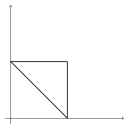 Therefore the area we want is: \begin{align*} A &= 1 - \int_0^1 \left ( -x + \frac{2}{2-x} \right)\d x \\ &= 1 - \left [-\frac12 x^2 - 2 \ln(2-x) \right]_0^1 \\ &= 1 + \frac12 -2 \ln 2 \\ &= \frac32 - 2 \ln 2 \end{align*} Therefore the relative area is: \(\frac{\frac32 - 2 \ln 2}{1/2} = 3 - 4 \ln 2\)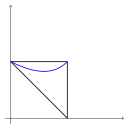
1989 Paper 1 Q1

Solution: \(AG = r\), therefore the area is: \begin{align*} A &= [AHG] - 2*[ABC] + [CDE] \\ &= \frac12 \pi r^2 - \pi h^2 + \frac12 \pi (r-2h)^2 \\ &= \frac12 \pi \l r^2 - 2h^2 + r^2 -4rh+4h^2 \r \\ &= \frac12 \pi \l 2r^2 -4rh + 2h^2\r \\ &= \pi (r-h)^2 \end{align*} This is the same area as a circle radius \(r-h\) But \(HD = r + (r-2d) = 2(r-d)\), ie the circle with diameter \(HD\) has radius \(r-h\) as required. Suppose \(A = (-h, 0), C = (h, 0), B = (0, h)\) then our parabola is \(y = \frac1{h}(h^2-x^2)\)

1989 Paper 1 Q2
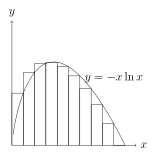
For \(x>0\) find \(\int x\ln x\,\mathrm{d}x\). By approximating the area corresponding to \(\int_{0}^{1}x\ln(1/x)\, \d x\) by \(n\) rectangles of equal width and with their top right-hand vertices on the curve \(y=x\ln(1/x)\), show that, as \(n\rightarrow\infty\), \[ \frac{1}{2}\left(1+\frac{1}{n}\right)\ln n-\frac{1}{n^{2}}\left[\ln\left(\frac{n!}{0!}\right)+\ln\left(\frac{n!}{1!}\right)+\ln\left(\frac{n!}{2!}\right)+\cdots+\ln\left(\frac{n!}{(n-1)!}\right)\right]\rightarrow\frac{1}{4}. \] {[}You may assume that \(x\ln x\rightarrow0\) as \(x\rightarrow0\).{]}
Solution: Integrating by parts we obtain: \begin{align*} \int x \ln x \, \d x &= [\frac12 x^2 \ln x] - \int \frac12x^2 \cdot \frac1x \d x \\ &= \frac12 x^2 \ln x - \frac14 x^2 + C \end{align*}
1989 Paper 1 Q3
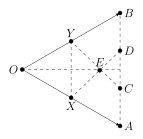
In the triangle \(OAB,\) \(\overrightarrow{OA}=\mathbf{a},\) \(\overrightarrow{OB}=\mathbf{b}\) and \(OA=OB=1\). Points \(C\) and \(D\) trisect \(AB\) (i.e. \(AC=CD=DB=\frac{1}{3}AB\)). \(X\) and \(Y\) lie on the line-segments \(OA\) and \(OB\) respectively, in such a way that \(CY\) and \(DX\) are perpendicular, and \(OX+OY=1\). Denoting \(OX\) by \(x\), obtain a condition relating \(x\) and \(\mathbf{a\cdot b}\), and prove that \[ \frac{8}{17}\leqslant\mathbf{a\cdot b}\leqslant1. \] If the angle \(AOB\) is as large as possible, determine the distance \(OE,\) where \(E\) is the point of intersection of \(CY\) and \(DX\).
Solution: