Problems
Filters
1990 Paper 2 Q16
Each day, I choose at random between my brown trousers, my grey trousers and my expensive but fashionable designer jeans. Also in my wardrobe, I have a black silk tie, a rather smart brown and fawn polka-dot tie, my regimental tie, and an elegant powder-blue cravat which I was given for Christmas. With my brown or grey trousers, I choose ties (including the cravat) at random, except of course that I don\textquoteright t wear the cravat with the brown trousers or the polka-dot tie with the grey trousers. With the jeans, the choice depends on whether it is Sunday or one of the six weekdays: on weekdays, half the time I wear a cream-coloured sweat-shirt with \(E=mc{}^{2}\) on the front and no tie; otherwise, and on Sundays (when naturally I always wear a tie), I just pick at random from my four ties. This morning, I received through the post a compromising photograph of myself. I often receive such photographs and they are equally likely to have been taken on any day of the week. However, in this particular photograph, I am wearing my black silk tie. Show that, on the basis of this information, the probability that the photograph was taken on Sunday is \(11/68\). I should have mentioned that on Mondays I lecture on calculus and I therefore always wear my jeans (to make the lectures seem easier to understand). Find, on the basis of the complete information, the probability that the photograph was taken on Sunday. [The phrase `at random' means `with equal probability'.]
1990 Paper 3 Q1
Show, using de Moivre's theorem, or otherwise, that \[ \tan9\theta=\frac{t(t^{2}-3)(t^{6}-33t^{4}+27t^{2}-3)}{(3t^{2}-1)(3t^{6}-27t^{4}+33t^{2}-1)},\qquad\mbox{ where }t=\tan\theta. \] By considering the equation \(\tan9\theta=0,\) or otherwise, obtain a cubic equation with integer coefficients whose roots are \[ \tan^{2}\left(\frac{\pi}{9}\right),\qquad\tan^{2}\left(\frac{2\pi}{9}\right)\qquad\mbox{ and }\qquad\tan^{2}\left(\frac{4\pi}{9}\right). \] Deduce the value of \[ \tan\left(\frac{\pi}{9}\right)\tan\left(\frac{2\pi}{9}\right)\tan\left(\frac{4\pi}{9}\right). \] Show that \[ \tan^{6}\left(\frac{\pi}{9}\right)+\tan^{6}\left(\frac{2\pi}{9}\right)+\tan^{6}\left(\frac{4\pi}{9}\right)=33273. \]
Solution: Writing \(c = \cos \theta, s = \sin \theta\) then de Moivre states that: \begin{align*} && \cos 9 \theta + i \sin 9 \theta &= (c +i s)^9 \\ &&&= c^9 + 9ic^8s - 36c^7s^2-84ic^6s^3+126c^5s^4 + 126ic^4s^5 -84c^3s^6 -36ic^2s^7+9cs^8+is^9 \\ &&&= (c^9-36c^7s^2+126c^5s^3-84c^3s^6+8cs^8)+i(9c^8s-75c^6s^3+126c^4s^5-36c^2s^7+s^9) \\ \Rightarrow && \tan 9\theta &= \frac{(9c^8s-75c^6s^3+126c^4s^5-36s^2c^7+s^9)}{(c^9-36c^7s^2+126c^5s^4-84c^3s^6+8cs^8)} \\ &&&= \frac{9t-75t^3+126s^5-36t^7+t^9}{1-36t^2+126t^4-84t^6+8t^8} \\ &&&= \frac{t(t^{2}-3)(t^{6}-33t^{4}+27t^{2}-3)}{(3t^{2}-1)(3t^{6}-27t^{4}+33t^{2}-1)} \end{align*} If we consider \(\tan 9\theta = 0\) it will have the roots \(\theta = \frac{n \pi}{9}, n \in \mathbb{Z}\), in particular, the numerator of our fraction for \(\tan 9 \theta\) will be zero for \(t = 0, \tan \frac{\pi}{9}, \tan \frac{2\pi}{9}, \tan \frac{3\pi}{9}, \tan \frac{4 \pi}{9}, \tan \frac{5\pi}{9}, \tan \frac{6 \pi}{9}, \tan \frac{7 \pi}{9}, \tan \frac{8\pi}{9}\). It's worth noting all other values of \(\theta\) will repeat these values. Also note that \(0,\tan \frac{\pi}{3}, \tan \frac{2\pi}{3}\) are the roots of \(t\) and \(t^2-3\) respectively. Therefore the other values are the roots of our sextic. However, also note that \(\tan \frac{8\pi}{9} = - \tan \frac{\pi}{9}\) and similar, therefore we can notice that all the roots in pairs can be mapped to \(\tan \frac{\pi}{9}, \tan \frac{2 \pi}{9}\) and \(\tan \frac{4 \pi}{9}\) and all those values are squared, so the roots of: \(x^3 - 33x^2+27x-3\) will be \(\tan^2 \frac{\pi}{9}, \tan^2 \frac{2 \pi}{9}\) and \(\tan^2 \frac{4 \pi}{9}\). The product of the roots will be \(3\), so \begin{align*} && \tan^2 \frac{\pi}{9} \tan^2 \frac{2 \pi}{9} \tan^2 \frac{4 \pi}{9} &= 3 \\ \Rightarrow && \tan \frac{\pi}{9} \tan \frac{2 \pi}{9} \tan \frac{4 \pi}{9} &= \pm \sqrt{3} \\ \underbrace{\Rightarrow}_{\text{all positive}} && \tan \frac{\pi}{9} \tan \frac{2 \pi}{9} \tan \frac{4 \pi}{9} &= \sqrt{3} \\ \end{align*} Notice that \(x^3 + y^3 +z^3 - 3xyz = (x+y+z)((x+y+z)^2-3(xy+yz+zx))\) Therefore \begin{align*} \tan^{6}\left(\frac{\pi}{9}\right)+\tan^{6}\left(\frac{2\pi}{9}\right)+\tan^{6}\left(\frac{4\pi}{9}\right) &= 33(33^2-3\cdot27) + 3 \cdot 3 \\ &= 33\,273 \end{align*}
1990 Paper 3 Q2
The distinct points \(O\,(0,0,0),\) \(A\,(a^{3},a^{2},a),\) \(B\,(b^{3},b^{2},b)\) and \(C\,(c^{3},c^{2},c)\) lie in 3-dimensional space.
- Prove that the lines \(OA\) and \(BC\) do not intersect.
- Given that \(a\) and \(b\) can vary with \(ab=1,\) show that \(\angle AOB\) can take any value in the interval \(0<\angle AOB<\frac{1}{2}\pi\), but no others.
Solution:
- The line \(OA\) is \(\lambda \begin{pmatrix} a^3 \\ a^2 \\ a \end{pmatrix}\). The line \(BC\) is \(\begin{pmatrix} b^3 \\ b^2 \\ b \end{pmatrix} + \mu \begin{pmatrix} c^3-b^3 \\ c^2-b^2 \\ c-b \end{pmatrix}\). If these lies are concurrent then there would be \(\mu\) and \(\lambda\) such that they are equal, and in particular, \begin{align*} && \frac{b^2 + \mu(c^2-b^2)}{b + \mu (c-b)} &= \frac{b^3 + \mu(c^3-b^3)}{b^2 + \mu (c^2-b^2)} \\ \Leftrightarrow && (b^2 + \mu(c^2-b^2))^2 &= (b+\mu(c-b))(b^3+\mu(c^3-b^3)) \\ && b^4 +2\mu b^2 (c^2-b^2) + \mu^2 (c^2-b^2) &= b^4 + \mu(c-b)b^3 + \mu b(c^3-b^3) + \mu^2 (c-b)(c^3-b^3) \\ \Leftrightarrow && 2\mu b^2 (c+b) + \mu^2(c-b)(c+b)^2 &= \mu (b^3 + b(c^2+bc+b^2)) + \mu^2 (c^3-b^3) \\ && \mu = 0 & \Rightarrow a = b \\ \Leftrightarrow && b^2c - bc^2 &= \mu (c^3-b^3-(c-b)(c+b)^2) \\ \Leftrightarrow && bc(b-c) &= \mu (c-b)(c^2+bc+b^2-c^2-2bc-b^2) \\ \Leftrightarrow && bc &= \mu (bc) \\ \Leftrightarrow && \mu &= 1 \\ && \mu = -1 & \Rightarrow a = c \end{align*} Therefore there are no solutions.
- \begin{align*} \cos \angle AOB &= \frac{ab+a^2b^2+a^3b^3}{\sqrt{a^2+a^4+a^6}\sqrt{b^2+b^4+b^6}} \\ &= \frac{3}{\sqrt{1 + a^2 + a^4} \sqrt{1 + b^2 + b^4}} \\ &> 0 \end{align*} Therefore the angle satisfies \(\angle AOB < \tfrac12 \pi\). We cannot achieve \(0\), since that would require \(a = b = 1\), therefore it falls in the range \(0 < \angle AOB < \tfrac12 \pi\)
1990 Paper 3 Q3
The elements \(a,b,c,d\) belong to the group \(G\) with binary operation \(*.\) Show that
- if \(a,b\) and \(a*b\) are of order 2, then \(a\) and \(b\) commute;
- \(c*d\) and \(d*c\) have the same order;
- if \(c^{-1}*b*c=b^{r},\) then \(c^{-1}*b^{s}*c=b^{sr}\) and \(c^{-n}*b^{s}*c^{n}=b^{sr^{n}}.\)
Solution: \begin{questionparts} \item \((ab)^2 = abab = e\) (since \(ab\) has order \(2\)), but \(a^2 = e, b^2 = e \Rightarrow a^{-1} = a, b^{-1} = b\) (since \(a\) and \(b\) have order 2) so \(ba = ab\) by multiplication on the left by \(a\) and right by \(b\). \item Suppose \((cd)^n = e \Leftrightarrow d(cd)^nc = dc \Leftrightarrow (dc)^n(dc) = e \Leftrightarrow (dc)^n = e\) Therefore any number for which \((cd)^n = e\) has the property that \((dc)^n = e\) and vice-versa, in particular the smallest number for either \(cd\) or \(dc\) will also be the smallest number for the other. \item Given \(c^{-1}bc=b^r\), then \(b^{rs} = (b^r)^s = (c^{-1}bc)^s =\underbrace{(c^{-1}bc)(c^{-1}bc) \cdots (c^{-1}bc)}_{s \text{ times}} = c^{-1}\underbrace{bb\cdots b}_{s \text{ times}}c = c^{-1}b^sc\) We proceed by induction on \(n\). When \(n = 0\), we have \(b^s = b^{sr^0}\) so the base case is true. Suppose it is true for some \(n = k\), ie \(c^{-k}b^sc^k = b^{sr^k}\). Now consider \(c^{-{k+1}}b^sc^{k+1} = c^{-1}c^{-k}b^sc^kc = c^{-1}b^{sr^k}c = (b^{sr^k \cdot r}) = b^{sr^{k+1}}\) (where the second to last equality was by the previous part). Therefore if our statement is true for \(n=k\) it is true for \(n = k+1\). Therefore, since it is also true for \(n=0\), by the principle of mathematical induction it is true for all non-negative integers \(n\).
1990 Paper 3 Q4
Given that \(\sin\beta\neq0,\) sum the series \[ \cos\alpha+\cos(\alpha+2\beta)+\cdots+\cos(\alpha+2r\beta)+\cdots+\cos(\alpha+2n\beta) \] and \[ \cos\alpha+\binom{n}{1}\cos(\alpha+2\beta)+\cdots+\binom{n}{r}\cos(\alpha+2r\beta)+\cdots+\cos(\alpha+2n\beta). \] Given that \(\sin\theta\neq0,\) prove that \[ 1+\cos\theta\sec\theta+\cos2\theta\sec^{2}\theta+\cdots+\cos r\theta\sec^{r}\theta+\cdots+\cos n\theta\sec^{n}\theta=\frac{\sin(n+1)\theta\sec^{n}\theta}{\sin\theta}. \]
Solution: \begin{align*} \sum_{r = 0}^n \cos (\alpha + 2r \beta) &= \sum_{r = 0}^n \textrm{Re} \left ( \exp(i(\alpha + 2r \beta)) \right) \\ &= \textrm{Re} \left (\sum_{r = 0}^n \exp(i(\alpha + 2r \beta)) \right) \\ &= \textrm{Re} \left (e^{i \alpha} \sum_{r = 0}^n \ (e^{i 2 \beta})^r\right) \\ &= \textrm{Re} \left (e^{i \alpha} \frac{e^{2(n+1)\beta i}-1}{e^{2\beta i}-1} \right) \\ &= \textrm{Re} \left (e^{i \alpha} \frac{e^{(n+1)\beta i} (e^{(n+1)\beta i}-e^{-(n+1)\beta i})}{e^{\beta i}(e^{\beta i}-e^{-\beta i})} \right) \\ &= \textrm{Re} \left (\frac{e^{i \alpha} e^{(n+1)\beta i}}{e^{\beta i}} \frac{\sin (n+1) \beta}{\sin \beta} \right) \\ &= \textrm{Re} \left ( e^{i(\alpha + n \beta)}\frac{\sin (n+1) \beta}{\sin \beta} \right) \\ &= \frac{\cos (\alpha + n \beta)\sin (n+1) \beta}{\sin \beta} \end{align*} \begin{align*} \sum_{r = 0}^n \binom{n}{r} \cos (\alpha + 2r \beta) &= \sum_{r = 0}^n \textrm{Re} \left ( \binom{n}{r}\exp(i(\alpha + 2r \beta)) \right) \\ &= \textrm{Re} \left (\sum_{r = 0}^n \binom{n}{r} \exp(i(\alpha + 2r \beta)) \right) \\ &= \textrm{Re} \left (e^{i \alpha}(e^{2\beta i}+1)^n \right) \\ &= \textrm{Re} \left (e^{i \alpha}e^{n\beta i}(e^{\beta i}+e^{-\beta i})^n \right) \\ &= \textrm{Re} \left (e^{i \alpha}e^{n\beta i}2^n \cos^n \beta \right) \\ &= 2^n \cos(\alpha + n \beta) \cos ^n \beta \end{align*} \begin{align*} \sum_{r = 0}^n \cos r \theta \sec^r \theta &= \sum_{r = 0}^n \textrm{Re} ( e^{i r \theta})\sec^r \theta \\ &= \textrm{Re} \left ( \sum_{r=0}^n e^{i r \theta} \sec^r \theta\right) \\ &= \textrm{Re} \left ( \frac{e^{i (n+1) \theta}\sec^{n+1} \theta -1}{e^{i \theta}\sec \theta -1} \right) \\ &= \textrm{Re} \left ( \frac{e^{i (n+1) \theta}\sec^{n} \theta -\cos \theta}{e^{i \theta} -\cos \theta} \right) \\ &= \textrm{Re} \left ( \frac{e^{i (n+1) \theta}\sec^{n} \theta -\cos \theta}{i \sin \theta} \right) \\ &= \frac{1}{\sin \theta} \textrm{Im} \left ( e^{i (n+1) \theta}\sec^{n} \theta -\cos \theta \right) \\ &= \frac{\sin(n+1) \theta \sec^{n} \theta}{\sin \theta} \end{align*}
1990 Paper 3 Q5
Prove that, for any integers \(n\) and \(r\), with \(1\leqslant r\leqslant n,\) \[ \binom{n}{r}+\binom{n}{r-1}=\binom{n+1}{r}. \] Hence or otherwise, prove that \[ (uv)^{(n)}=u^{(n)}v+\binom{n}{1}u^{(n-1)}v^{(1)}+\binom{n}{2}u^{(n-2)}v^{(2)}+\cdots+uv^{(n)}, \] where \(u\) and \(v\) are functions of \(x\) and \(z^{(r)}\) means \(\dfrac{\mathrm{d}^{r}z}{\mathrm{d}x^{r}}\). Prove that, if \(y=\sin^{-1}x,\) then \((1-x^{2})y^{(n+2)}-(2n+1)xy^{(n+1)}-n^{2}y^{(n)}=0.\)
Solution: \begin{align*} \binom{n}{r} + \binom{n}{r-1} &= \frac{n!}{r!(n-r)!} + \frac{n!}{(r-1)!(n-r+1)!} \\ &= \frac{n!}{(r-1)!(n-r)!} \left ( \frac{1}{r} + \frac{1}{n-r+1} \right) \\ &= \frac{n!}{(r-1)!(n-r)!} \frac{(n-r+1)+r}{r(n-r+1)} \\ &= \frac{n! (n+1)}{r! (n-r+1)!} \\ &= \frac{(n+1)!}{r!(n+1-r)!} \\ &= \binom{n+1}{r} \end{align*} Claim: \(\displaystyle (uv)^{(n)} = \sum_{r=0}^n \binom{n}{r} u^{(n-r)} v^{(r)}\) Proof: (By induction on \(n\)). Base case: \(n = 0\) is clear. Inductive step: Suppose it is true for \(n = k\), then consider \begin{align*} (uv)^{(k+1)} &= \left ( (uv)^{(k)} \right)' \\ &= \left ( \sum_{r=0}^k \binom{k}{r} u^{(k-r)} v^{(r)} \right)' \tag{by assumption} \\ &=\sum_{r=0}^k \binom{k}{r} \left ( u^{(k-r)} v^{(r)}\right)' \tag{linearity} \\ &=\sum_{r=0}^k \binom{k}{r} \left ( u^{(k-r+1)} v^{(r)} + u^{(k-r)}v^{(r+1)}\right) \\ &= \sum_{r=0}^{k} \binom{k}{r} u^{(k-r+1)} v^{(r)} + \sum_{r=0}^{k} \binom{k}{r} u^{(k-r)}v^{(r+1)} \\ &= \sum_{r=0}^{k} \binom{k}{r} u^{(k-r+1)} v^{(r)} + \sum_{r=1}^{k+1} \binom{k}{r-1} u^{(k-r+1)}v^{(r)} \\ &= u^{(k+1)}v + \sum_{r=1}^k \left (\binom{k}{r} + \binom{k}{r-1} \right)u^{(k-r+1)}v^{(r)} + u v^{(k+1)}\\ &= u^{(k+1)}v + \sum_{r=1}^k \binom{k+1}{r} u^{(k-r+1)}v^{(r)} + u v^{(k+1)}\\ &= \sum_{r=0}^{k+1} \binom{k+1}{r} u^{(k-r+1)}v^{(r)}\\ \end{align*} Therefore if our statement is true for \(n = k\) it is true for \(n = k+1\). Since it is true for \(n = 0\) by the principle of mathematical induction it is true for all integer \(n \geq 0\) Suppose \( y = \sin^{-1} x\), then \(y' = \frac{1}{\sqrt{1-x^2}}\), \(y'' = \frac{x}{(1-x^2)^{3/2}}\). Not that this means that \((1-x^2)y'' - xy' = 0\) (which is our formula when \(n = 0\)). Now apply Leibniz's formula to this. \begin{align*} 0 &= \left ( (1-x^2)y'' - xy' \right)^{(n)} \\ &= \left ( (1-x^2)y'' \right)^{(n)} -\left ( xy' \right)^{(n)} \\ &= \left ( (1-x^2)y^{(n+2)} - n\cdot 2x \cdot y^{(n+1)}-\binom{n}{2} \cdot 2 \cdot y^{(n)} \right )- \left (xy^{(n+1)}+ny^{(n)} \right) \\ &= (1-x^2)y^{(n+2)} - (2n+1)y^{(n+1)} - \left ( n(n-1)+n \right)y^{(n)} \\ &= (1-x^2)y^{(n+2)} - (2n+1)y^{(n+1)} - n^2y^{(n)} \\ \end{align*} as required
1990 Paper 3 Q6
The transformation \(T\) from \(\begin{pmatrix} x \\ y \end{pmatrix}\) to \(\begin{pmatrix} X \\ Y \end{pmatrix}\) is given by \[ \begin{pmatrix}X\\ Y \end{pmatrix}=\frac{2}{5}\begin{pmatrix}9 & -2\\ -2 & 6 \end{pmatrix}\begin{pmatrix}x\\ y \end{pmatrix}. \] Show that \(T\) leaves the vector \(\begin{pmatrix} 1\\ 2 \end{pmatrix}\) unchanged in direction but multiplied by a scalar, and that \(\begin{pmatrix} 2\\ -1 \end{pmatrix}\) is similarly transformed. The circle \(C\) whose equation is \(x^{2}+y^{2}=1\) transforms under \(T\) to a curve \(E\). Show that \(E\) has equation \[ 8X^{2}+12XY+17Y^{2}=80, \] and state the area of the region bounded by \(E\). Show also that the greatest value of \(X\) on \(E\) is \(2\sqrt{17/5}.\) Find the equation of the tangent to \(E\) at the point which corresponds to the point \(\frac{1}{5}(3,4)\) on \(C\).
Solution: \begin{align*} T\begin{pmatrix}1\\ 2 \end{pmatrix} &= \frac{2}{5}\begin{pmatrix}9 & -2\\ -2 & 6 \end{pmatrix}\begin{pmatrix}1\\ 2 \end{pmatrix} \\ &= \frac25\begin{pmatrix}9 - 4\\ -2+12 \end{pmatrix} \\ &= \begin{pmatrix}2\\ 4 \end{pmatrix} \\ &= 2 \begin{pmatrix}1\\ 2 \end{pmatrix} \end{align*} \begin{align*} T\begin{pmatrix}1\\ 2 \end{pmatrix} &= \frac{2}{5}\begin{pmatrix}9 & -2\\ -2 & 6 \end{pmatrix}\begin{pmatrix}2\\ -1 \end{pmatrix} \\ &= \frac25\begin{pmatrix}18+2\\ -4-6 \end{pmatrix} \\ &= \begin{pmatrix}8\\ -4 \end{pmatrix} \\ &= 4 \begin{pmatrix}2\\ -1 \end{pmatrix} \end{align*} Consider $T^{-1} = \frac{5}{2} \frac{1}{50}\begin{pmatrix}6 & 2\\ 2 & 9 \end{pmatrix}\(, so \)T^{-1} \begin{pmatrix}X\\ Y \end{pmatrix} = \begin{pmatrix}x\\ y \end{pmatrix}$ and so: \begin{align*} x^2 + y^2 & = \begin{pmatrix}x& y \end{pmatrix}\begin{pmatrix}x\\ y \end{pmatrix} \\ &= \begin{pmatrix}X& Y \end{pmatrix} (T^{-1})^T T^{-1} \begin{pmatrix}X\\ Y \end{pmatrix} \\ &= \frac{1}{400}\begin{pmatrix}X& Y \end{pmatrix}\begin{pmatrix}6 & 2\\ 2 & 9 \end{pmatrix}\begin{pmatrix}6 & 2\\ 2 & 9 \end{pmatrix} \begin{pmatrix}X\\ Y \end{pmatrix} \\ &= \frac{1}{400}\begin{pmatrix}X& Y \end{pmatrix}\begin{pmatrix}6 & 2\\ 2 & 9 \end{pmatrix} \begin{pmatrix}6X+2Y\\ 2X+9Y \end{pmatrix} \\ &= \frac{1}{400}\begin{pmatrix}X& Y \end{pmatrix} \begin{pmatrix}6(6X+2Y)+2(2X+9Y)\\ 2(6X+2Y)+9(2X+9Y) \end{pmatrix} \\ &= \frac{1}{400}\begin{pmatrix}X& Y \end{pmatrix} \begin{pmatrix}40X+30Y\\ 30X +85Y \end{pmatrix} \\ &= \frac{1}{80}\begin{pmatrix}X& Y \end{pmatrix} \begin{pmatrix}8X+6Y\\ 6X +17Y \end{pmatrix} \\ &= \frac{1}{80} \l 8X^2 + 12XY + 17Y^2\r \end{align*} Therefore \(8X^2 + 12XY + 17Y^2 = 80\). The area will be \(\det T \cdot \pi = \frac{4}{25} \cdot 50 \cdot \pi = 8 \pi\). Differentiating we obtain \(2 \cdot 8 \cdot X \cdot \frac{dX}{dY} + 2 \cdot 6 \cdot X + 2 \cdot 6 \cdot Y \cdot \frac{dX}{dY} + 2 \cdot 17 Y \Rightarrow \frac{dX}{dY} = -\frac{6X + 17Y}{8X+6Y}\), at a maximum (or minimum, \(6X = -17Y\)). Therefore \begin{align*} \Rightarrow && 8X^2 + 12 \cdot \frac{6}{17}X^2 + 17 ( -\frac{6}{17} X)^2 &= 80 \\ \Rightarrow && \frac{100}{17}X^2 &= 80 \\ \Rightarrow &&X^2 &= \frac{17 \cdot 4}{5} \\ \Rightarrow && |X| = 2 \sqrt {\frac{17}{5}} \end{align*} The point \(\frac15 (3,4)\) maps to \begin{align*} \frac{2}{5}\frac{1}{5}\begin{pmatrix}9 & -2\\ -2 & 6 \end{pmatrix}\begin{pmatrix}3\\ 4 \end{pmatrix} &= \frac{2}{25} \begin{pmatrix}19\\ 18 \end{pmatrix} \end{align*} So the point is \((\frac{38}{25}, \frac{36}{25})\), with gradient \(\frac{dY}{dX} = -\frac{8X+6Y}{6X + 17Y}\) which is \(-\frac{8 \cdot 19+6 \cdot 18}{6\cdot 19 + 17 \cdot 18} = -\frac{13}{21}\) therefore the equation is \(21Y+13X = 50\)
1990 Paper 3 Q7
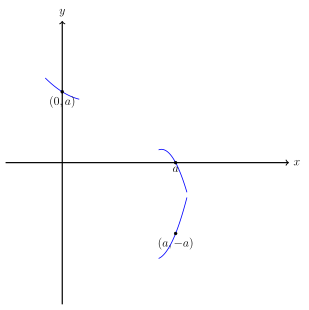
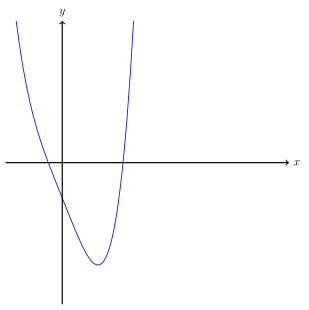
The points \(P\,(0,a),\) \(Q\,(a,0)\) and \(R\,(a,-a)\) lie on the curve \(C\) with cartesian equation \[ xy^{2}+x^{3}+a^{2}y-a^{3}=0,\qquad\mbox{ where }a>0. \] At each of \(P,Q\) and \(R\), express \(y\) as a Taylor series in \(h\), where \(h\) is a small increment in \(x\), as far as the term in \(h^{2}.\) Hence, or otherwise, sketch the shape of \(C\) near each of these points. Show that, if \((x,y)\) lies on \(C\), then \[ 4x^{4}-4a^{3}x-a^{4}\leqslant0. \] Sketch the graph of \(y=4x^{4}-4a^{3}x-a^{4}.\) Given that the \(y\)-axis is an asymptote to \(C\), sketch the curve \(C\).
Solution: \begin{align*} && 0 &= xy^{2}+x^{3}+a^{2}y-a^{3} \\ \frac{\d }{\d x} : && 0 &= y^2+2xyy' + 3x^2+a^2y' \\ \Rightarrow && y' &= -\frac{y^2+3x^2}{a^2+2xy} \\ \\ \frac{\d^2 }{\d x^2}: && 0 &= 2yy'+2yy'+2x(y')^2+2xyy''+6x+a^2y'' \\ \Rightarrow && y'' &= -\frac{4yy'+2x(y')^2+6x}{a^2+2xy} \\ \\ P: && y &= a \\ && y' &= -\frac{a^2}{a^2} = -1 \\ && y'' &= -\frac{-4a}{a^2} = \frac{4}{a} \\ \Rightarrow && y &\approx a - h+\frac{2}{a}h^2 \\ \\ Q: && y &= 0 \\ && y' &= -\frac{3a^2}{a^2} = -3 \\ && y'' &= -\frac{18a+6a}{a^2} = -\frac{24}{a} \\ \Rightarrow && y &\approx 0-3h-\frac{12}{a}h \\ \\ R: && y &= -a \\ && y' &= -\frac{a^2+3a^2}{a^2-2a^2} = 4 \\ && y'' &= -\frac{-16a+32a+6a}{a^2-2a^2} = \frac{22}{a} \\ \Rightarrow && y &\approx -a+4h + \frac{11}{a}h^2 \end{align*} Alternatively: \begin{align*} && 0 &= xy^{2}+x^{3}+a^{2}y-a^{3} \\ P(0,a): && y &\approx a + c_1h + c_2h^2 \\ && 0 &= h(a+c_1h)^2 + a^2(a + c_1h + c_2h^2)-a^3 \\ &&&= a^3-a^3 + (a^2+a^2c_1)h+(2ac_1+a^2c_2)h^2 \\ \Rightarrow && c_1 &=-1, c_2 =\frac{2}{a} \\ \Rightarrow && y &\approx a - h + \frac{2}{a}h^2 \\ \\ Q(a,0): && y &\approx c_1h + c_2h^2 \\ && 0 &= (a+h)(c_1h)^2+(a+h)^3+a^2(c_1h + c_2h^2 )-a^3 \\ &&&= a^3-a^3+(3a^2+a^2c_1)h + (ac_1^2+3a+a^2c_2)h^2 + \cdots \\ \Rightarrow && c_1 &=-3, c_2 = -\frac{12}{a} \\ \Rightarrow && y &\approx -3h -\frac{12}{a}h \\ \\ R(a,-a): && y &\approx -a + c_1h + c_2h^2 \\ && 0 &= (a+h)(-a + c_1h+c_2h^2)^2+(a+h)^3+a^2(-a + c_1h + c_2h^2)-a^3 \\ &&&= (a^2-2a^2c_1+3a^2+a^2c_1)h+(-2ac_1+c_1^2+\cdots)h^2 \\ \Rightarrow && c_1 &=4, c_2 = \frac{11}{a} \\ \Rightarrow && y &\approx -a + 4h + \frac{11}{a} \end{align*}

1990 Paper 3 Q8
Let \(P,Q\) and \(R\) be functions of \(x\). Prove that, for any function \(y\) of \(x\), the function \[ Py''+Qy'+Ry \] can be written in the form \(\dfrac{\mathrm{d}}{\mathrm{d}x}(py'+qy),\) where \(p\) and \(q\) are functions of \(x\), if and only if \(P''-Q'+R=0.\) Solve the differential equation \[ (x-x^{4})y''+(1-7x^{3})y'-9x^{2}y=(x^{3}+3x^2)\mathrm{e}^{x}, \] given that when \(x=2,y=2\mathrm{e}^{2}\) and \(y'=0.\)
Solution: Suppose \(Py'' + Qy' + Ry = \frac{\d}{\d x}(p y' + qy)\), then \begin{align*} Py'' + Qy' + Ry &= \frac{\d}{\d x}(p y' + qy) \\ &= py'' + p'y' + qy' + q' y \\ &= py'' + (p'+q)y' + q' y \end{align*} Therefore \(P = p, Q = p'+q, R = q'\), Therefore \(q = Q-P'\) and \(R = Q'-P''\) or \(P'' -Q'+R = 0\). \((\Rightarrow)\) Suppose it can be written in that form, then the logic we have applied shows that equation is true. \((\Leftarrow)\) Suppose \(P''-Q'+R = 0\), then letting \(p = P, q = Q-P'\) we find functions of the form which will be expressed correctly. Notice that if \(P = x-x^4, Q = (1-7x^3), R = -9x^2\) then: \begin{align*} P'' - Q' + R &= -12x^2+21x^2-9x^2 \\ &= 0 \end{align*} Therefore we can write our second order ODE as: \begin{align*} && (x^{3}+3x)\mathrm{e}^{x} &= \frac{\d}{\d x} \left ( (x-x^4) y' +(1-7x^3-(1-4x^3))y \right) \\ &&&= \frac{\d}{\d x} \left ( (x-x^4) y' -3x^3y \right) \end{align*} Suppose \(z = (x-x^4)y' - 3x^2y\), then \(z = (2-2^4) \cdot 0 - 3 \cdot 2^2 \cdot 2e^2 = -24e^2\) when \(x = 2\). and we have: \begin{align*} && \frac{\d z}{\d x} &= (x^3+3x^2)e^x \\ \Rightarrow && z &= \int (x^3+3x^2)e^x \d x \\ &&&= x^3 e^x+c \\ \Rightarrow && -48e^2 &= e^2(8) + c \\ \Rightarrow && c &= -56e^2 \\ \Rightarrow && z &= e^x(x^3)-56e^2 \\ \end{align*} So our differential equation is: \begin{align*} && (x-x^4)y'-3x^3 y &= x^3e^x -5 6e^2 \\ \Rightarrow && (1-x^3)y' -3x^2y &= x^2 e^x - \frac{6e^2}{x} \\ \Rightarrow && \frac{\d }{\d x} \left ( (1-x^3)y \right) &= x^2e^x - \frac{56e^2}{x} \\ \Rightarrow && (1-x^3)y &= (x^2-2x+2)e^x - 56e^2 \ln x + k \\ \underbrace{\Rightarrow}_{x=2} && (1-2^3)2e^2 &= (2^2-2\cdot2 + 2)e^2 -56e^2 \ln 2 + k \\ \Rightarrow && k &= -16e^2+56 \ln 2 \cdot e^2 \\ \Rightarrow && y &= \frac{(x^2-2x+2)e^x - 56e^2 \ln x -16e^2+56 \ln 2 \cdot e^2}{(1-x^3)} \end{align*}
1990 Paper 3 Q9
The real variables \(\theta\) and \(u\) are related by the equation \(\tan\theta=\sinh u\) and \(0\leqslant\theta<\frac{1}{2}\pi.\) Let \(v=\mathrm{sech}u.\) Prove that
- \(v=\cos\theta;\)
- \(\dfrac{\mathrm{d}\theta}{\mathrm{d}u}=v;\)
- \(\sin2\theta=-2\dfrac{\mathrm{d}v}{\mathrm{d}u}\quad\) and \(\quad\cos2\theta=-\cosh u\dfrac{\mathrm{d}^{2}v}{\mathrm{d}u^{2}};\)
- \({\displaystyle \frac{\mathrm{d}u}{\mathrm{d}\theta}\frac{\mathrm{d}^{2}v}{\mathrm{d}\theta^{2}}+\frac{\mathrm{d}v}{\mathrm{d}\theta}\frac{\mathrm{d}^{2}u}{\mathrm{d}\theta^{2}}+\left(\frac{\mathrm{d}u}{\mathrm{d}\theta}\right)^{2}=0.}\)
Solution:
- \begin{align*} v &= \mathrm{sech} u \\ &= \frac{1}{\mathrm{cosh } u} \\ &= \frac{1}{\sqrt{1+\mathrm{sinh}^2 u}} \tag{\(u > 0\)} \\ &= \frac{1}{\sqrt{1+\tan^2 \theta}} \\ &= \frac{1}{\sqrt{\mathrm{sec}^2 \theta}} \\ &= \cos \theta \tag{\(0 < \theta < \tfrac{\pi}{2}\)} \end{align*}
- \begin{align*} && \tan \theta &= \textrm{sinh} u \\ \underbrace{\Rightarrow}_{\frac{\d}{\d u}} && \sec^2 \theta \cdot \frac{\d \theta}{\d u} &= \cosh u \\ \Rightarrow && \frac{\d \theta}{\d u} &=\cosh u \cdot \cos^2 \theta \\ &&&= \frac{1}{v} \cdot v^2 \\ &&&=v \end{align*}
- \begin{align*} \sin 2 \theta &= 2 \sin \theta \cos \theta \\ &= 2 \sin \theta \cdot \frac{\d \theta}{\d u} \\ &= -2 \frac{\d v}{\d \theta} \cdot \frac{\d \theta}{\d u} \tag{\(\cos \theta = v\)} \\ &= -2 \frac{\d v}{\d u} \end{align*} \begin{align*} && \sin 2 \theta &= -2 \frac{\d v}{\d u} \\ \underbrace{\Rightarrow}_{\frac{\d}{\d u}} && 2 \cos 2 \theta \cdot \frac{\d \theta}{\d u} &= -2 \frac{\d^2 v}{\d u^2} \\ \Rightarrow && \cos 2 \theta &= - \frac{\d^2 v}{\d u^2} \frac{1}{v} \\ &&&= -\frac{\d ^2v}{\d u^2} \cosh u \end{align*}
- \begin{align*} && \frac{\d u}{\d \theta} &= \frac{1}{v} \\ \Rightarrow && \frac{\d^2 u}{\d \theta^2} &= -\frac{1}{v^2} \frac{\d v}{\d \theta} \\ &&&= \frac{1}{v^2} \sin \theta \\ && \frac{\d v}{\d \theta} &= -\sin \theta \\ \Rightarrow && \frac{\d^2 v}{\d \theta^2} &= -\cos \theta \\ &&&= - v \\ \end{align*} Therefore \begin{align*} \frac{\mathrm{d}u}{\mathrm{d}\theta}\frac{\mathrm{d}^{2}v}{\mathrm{d}\theta^{2}}+\frac{\mathrm{d}v}{\mathrm{d}\theta}\frac{\mathrm{d}^{2}u}{\mathrm{d}\theta^{2}}+\left(\frac{\mathrm{d}u}{\mathrm{d}\theta}\right)^{2} &= \frac{1}{v} \cdot \left (-v\right) + \left ( - \sin \theta \right ) \cdot \left (\frac{1}{v^2} \sin \theta \right) + \frac{1}{v^2} \\ &= -1 + \frac{1-\sin^2 \theta}{v^2} \\ &= -1 + \frac{\cos^2 \theta}{v^2} \\ &= -1 + 1 \\ &= 0 \end{align*}