Problems
Filters
1990 Paper 1 Q2
Let \(\omega=\mathrm{e}^{2\pi\mathrm{i}/3}.\) Show that \(1+\omega+\omega^{2}=0\) and calculate the modulus and argument of \(1+\omega^{2}.\) Let \(n\) be a positive integer. By evaluating \((1+\omega^{r})^{n}\) in two ways, taking \(r=1,2\) and \(3\), or otherwise, prove that \[ \binom{n}{0}+\binom{n}{3}+\binom{n}{6}+\cdots+\binom{n}{k}=\frac{1}{3}\left(2^{n}+2\cos\left(\frac{n\pi}{3}\right)\right), \] where \(k\) is the largest multiple of \(3\) less than or equal to \(n\). Without using a calculator, evaluate \[ \binom{25}{0}+\binom{25}{3}+\cdots+\binom{25}{24} \] and \[ \binom{24}{2}+\binom{24}{5}+\cdots+\binom{24}{23}\,. \] {[}\(2^{25}=33554432.\){]}
Solution: Since \(\omega^3 = 1\) and \(\omega \neq 1\) we must have that \((\omega-1)(1 + \omega + \omega^2) = 0\) but by dividing by \(\omega - 1\) we obtain the desired result. \(1+\omega^2 = -\omega\) so \(|1 + \omega^2| = |-\omega| = 1\) and \(\arg ( 1 + \omega^2) = \arg(-\omega) = \pi - \frac{2\pi}{3} = \frac{\pi}{3}\) \begin{align*} && (1 + 1)^n &= \sum_{k=0}^n \binom{n}{k}\\ && (1+ \omega)^n &= \sum_{k=0}^n \binom{n}{k} \omega^{k} \\ && (1+ \omega^2)^n &= \sum_{k=0}^n \binom{n}{k} \omega^{2k} \\ \Rightarrow && 2^n+(-\omega^2)^n + (-\omega)^n &= \sum_{k=0, k \equiv 0 \pmod{3}}^n (1+1+1)\binom{n}{k} + \sum_{k=0, k \equiv 1 \pmod{3}}^n (1 + \omega + \omega^2) \binom{n}{k} + \sum_{k=0, k \equiv 2 \pmod{3}}^n (1 + \omega^2 + \omega) \binom{n}{k} \\ \Rightarrow && 2^n +((-\omega)^n)^{-1}+(-\omega)^n &= \sum_{k=0, k \equiv 0 \pmod{3}}^n \binom{n}{k} \end{align*} \(2^n +((-\omega)^n)^{-1}+(-\omega)^n = 2^n + 2 \textrm{Re}(-\omega^n) = 2^n + 2 \cos \frac{n\pi}{3}\) Therefore our answer follows. \begin{align*} \binom{25}{0}+\binom{25}{3}+\cdots+\binom{25}{24} &= \frac13 \l 2^{25} + 2\cos (\frac{25 \pi}{3}) \r \\ &= \frac13 \l 2^{25} + 2 \cos \frac{\pi}{3} \r \\ &= \frac13 \l 2^{25} + 1 \r \\ &= \frac13 \l (4096 \cdot 4096 \cdot 2) + 1 \r \\ &= 11\,184\,811 \end{align*} Notice that \(S_2 = \binom{24}{2} + \cdots +\binom{24}{23} = \binom{24}{1} + \cdots + \binom{24}{22} = S_1\) and \(S_0 = \binom{24}0 + \cdots + \binom{24}{21} = \frac13 \l 2^{24} + 2 \r\) Therefore since \(S_0 + 2 \cdot S_2 = 2^{24}\) we must have \begin{align*} S_2 &= \frac12 \l 2^{24} - \frac13 \l 2^{24} + 2 \r \r \\ &= \frac13 \l 2^{24} - 1 \r \\ &= \frac13 \l 16777216- 1 \r \\ &= \frac13 \cdot 16777215 \\ &= 5\,592\,405 \end{align*}
1990 Paper 1 Q3
Given a curve described by \(y=\mathrm{f}(x)\), and such that \(y\geqslant0\), a push-off of the curve is a new curve obtained as follows: for each point \((x,\mathrm{f}(x))\) with position vector \(\mathbf{r}\) on the original curve, there is a point with position vector \(\mathbf{s}\) on the new curve such that \(\mathbf{s-r}=\mathrm{p}(x)\mathbf{n},\) where \(\mathrm{p}\) is a given function and \(\mathbf{n}\) is the downward-pointing unit normal to the original curve at \(\mathbf{r}\).
- For the curve \(y=x^{k},\) where \(x>0\) and \(k\) is a positive integer, obtain the function \(\mathrm{p}\) for which the push-off is the positive \(x\)-axis, and find the value of \(k\) such that, for all points on the original curve, \(\left|\mathbf{r}\right|=\left|\mathbf{r-s}\right|\).
- Suppose that the original curve is \(y=x^{2}\) and \(\mathrm{p}\) is such that the gradient of the curves at the points with position vectors \(\mathbf{r}\) and \(\mathbf{s}\) are equal (for every point on the original curve). By writing \(\mathrm{p}(x)=\mathrm{q}(x)\sqrt{1+4x^{2}},\) where \(\mathrm{q}\) is to be determined, or otherwise, find the form of \(\mathrm{p}\).
Solution:
- Suppose we have \(y = x^k\), then the tangent at \((t,t^k)\) has gradient \(\frac{\d y}{\d x} = kx^{k-1} = kt^{k-1}\) and the normal has gradient \(-\frac1k x^{1-k}\). For the push-off to be the positive \(x\)-axis, we need \(p(x)\) to be the length of the line. The line will have the equation: \begin{align*} && \frac{y - t^k}{x - t} &= -\frac1k t^{1-k} \\ y = 0: && x-t &= \frac{kt^k}{t^{1-k}} \\ && x& =t + kt^{2k-1} \end{align*} The distance from \((t,t^k)\) to \((t+kt^{2k-1},0)\) is \(\sqrt{t^{2k} + k^2t^{4k-2}} = t^k \sqrt{1+k^2t^{2k-2}} = y \sqrt{1+k^2 \frac{y^2}{x^2}} = \frac{y}{x} \sqrt{x^2 + k^2y^2}\), ie \(p(x) = \frac{y}{x}\sqrt{x^2+k^2y^2}\) If \(\left|\mathbf{r}\right|=\left|\mathbf{r-s}\right|\), then we need \(\sqrt{x^2+y^2} = \frac{y}{x}\sqrt{x^2+ky^2}\), but clearly this is satisfied when \(k = 1\).
- The points are \((t, t^2)\) and the normal has graident \(-\frac{1}{2t}\), the normal vector is \(\frac{1}{\sqrt{1+\frac{1}{4t^2}}}\binom{1}{-\frac1{2t}} = \frac{1}{\sqrt{4t^2+1}} \binom{2t}{-1}\). If we write \(p(x) = q(x)\sqrt{4x^2+1}\) then the the new points are at \(\binom{t+q(t)2t}{t^2-\q(t)}\) an the gradient will be \(\frac{2t-q'(t)}{1+q'(t)2t+2q(t)}\). We need it to be the case that \begin{align*} && 2t &= \frac{2t-q'(t)}{1+2q(t)+2tq'(t)} \\ \Rightarrow && 4tq(t) &= -q'(t)(1+4t^2) \\ \Rightarrow && \frac{q'(t)}{q(t)} &= -\frac{4t}{1+4t^2} \\ \Rightarrow && \ln q(t) &= -\frac12 \ln(1+4t^2)+C \\ \Rightarrow && q(t) &= A(1+4t^2)^{-1/2} \\ \Rightarrow && p(x) &= A \end{align*} So the push-off's are constants.
1990 Paper 1 Q4
The sequence \(a_{1},a_{2},\ldots,a_{n},\ldots\) forms an arithmetic progression. Establish a formula, involving \(n,\) \(a_{1}\) and \(a_{2}\) for the sum \(a_{1}+a_{2}+\cdots+a_{n}\) of the first \(n\) terms. A sequence \(b_{1},b_{2},\ldots,b_{n},\ldots\) is called a double arithmetic progression if the sequence of differences \[ b_{2}-b_{1},b_{3}-b_{2},\ldots,b_{n+1}-b_{n},\ldots \] is an arithmetic progression. Establish a formula, involving \(n,b_{1},b_{2}\) and \(b_{3}\), for the sum \(b_{1}+b_{2}+b_{3}+\cdots+b_{n}\) of the first \(n\) terms of such a progression. A sequence \(c_{1},c_{2},\ldots,c_{n},\ldots\) is called a factorial progression if \(c_{n+1}-c_{n}=n!d\) for some non-zero \(d\) and every \(n\geqslant1\). Suppose \(1,b_{2},b_{3},\ldots\) is a double arithmetic progression, and also that \(b_{2},b_{4},b_{6}\) and \(220\) are the first four terms in a factorial progression. Find the sum \(1+b_{2}+b_{3}+\cdots+b_{n}.\)
Solution: Since the common difference is \(a_2 - a_1\) we can find that \(a_n = a_1 + (n-1)(a_2-a_1)\), then \begin{align*} && a_1 &&+&& a_2 &&+&& \cdots &&+&& (a_1 + (n-2)(a_2 - a_1) && + && (a_1 + (n-1) (a_2 - a_1)) \\ + && (a_1 + (n-1) (a_2 - a_1))&&+&& (a_1 + (n-2)(a_2 - a_1)&&+&& \cdots &&+&& a_2 && + && a_1 \\ \hline \\ = && 2a_1 + (n-1)(a_2 - a_1) && + && 2a_1 + (n-1)(a_2 - a_1) && + && \cdots && + 2a_1 + (n-1)(a_2 - a_1) && + 2a_1 + (n-1)(a_2 - a_1) \\ = && n(2a_1 + (n-1) (a_2 - a_1)) \end{align*} Therefore the sum is \(a_1 n + \frac{n(n-1)}{2} (a_2 - a_1)\). Since \(b_n - b_1 = (b_n - b_{n-1}) + (b_{n-1} - b_{n-2}) + \cdots (b_2 - b_1)\), \(b_n - b_1 = a_1 (n-1) + \frac{(n-1)(n-2)}{2}(a_2 - a_1) = (b_2-b_1)(n-1) + \frac{(n-1)(n-2)}{2}(b_3 -2b_2 +b_1)\). So \(b_n = b_1 + (b_2 - b_1)(n-1) + \frac{(n-1)(n-2)}{2} (b_3 - 2b_2 + b_1)\). In particular \begin{align*} \sum_{i=1}^n b_i &= \sum_{i=1}^n \l b_1 + (b_2 - b_1)(n-1) + \frac{(n-1)(n-2)}{2} (b_3 - 2b_2 + b_1)\r \\ &= nb_1 + (b_2-b_1) \frac{n(n-1)}{2} + \frac{n(n-1)(n-2)}{6}(b_3-2b_2+b_1) \end{align*} Let \(b_2 - b_1 = x\) and \(b_3 - 2b_2+b_1 = y\), then \begin{align*} b_4 - b_2 &= d &= &2x + 3y \\ b_6-b_4 &= 2d &=& 2x +(10-3)y \\ &&=&2x + 7y \\ 220-b_6&=6d &=& 220-(1 + 5x + 10y) \\ \end{align*} \begin{align*} && 4x + 6y &= 2x + 7y \\ && 6x+21y &= 219-5x-10y \\ \Rightarrow && 2x - y &= 0 \\ && 11x + 31y &= 219 \\ \Rightarrow && x &= 3 \\ && y &= 6 \end{align*} Therefore the final sum is \begin{align*} n + 3 \frac{n(n-1)}{2} + 6 \frac{n(n-1)(n-2)}{6} &= n^3-\frac32n^2+\frac32n \end{align*}
1990 Paper 1 Q5
- Evaluate \[ \int_{1}^{3}\frac{1}{6x^{2}+19x+15}\,\mathrm{d}x\,. \]
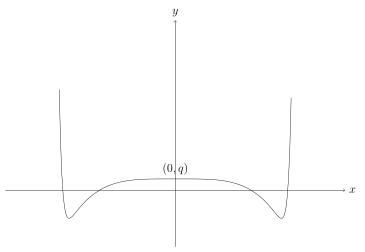
- Sketch the graph of the function \(\mathrm{f}\), where \(\mathrm{f}(x)=x^{1760}-x^{220}+q\), and \(q\) is a constant. Find the possible numbers of \textit{distinct }roots of the equation \(\mathrm{f}(x)=0\), and state the inequalities satisfied by \(q\).
Solution:
- \begin{align*} \int_{1}^{3}\frac{1}{6x^{2}+19x+15}\,\mathrm{d}x &= \int_1^3 \frac1{(2x+3)(3x+5)} \d x \\ &= \int_1^3 \l \frac{2}{2x+3} - \frac{3}{3x+5} \r \d x \\ &= \left [\ln(2x+3) - \ln(3x+5) \right ]_1^3 \\ &= \l \ln9 - \ln14 \r - \l \ln 5 - \ln 8 \r \\ &= \ln \frac{72}{70} \\ &= \ln \frac{36}{35} \end{align*}
- When \(q = 0\) the roots are \(-1, 0, 1\) There can be \(0, 2, 3, 4\) roots. There will be no roots if \(q > -\min (x^{1760} - x^{220})\) since the whole graph will be above the axis. There will be \(2\) roots if \(q = -\min (x^{1760} - x^{220})\) or \(q > 0\) There will be \(4\) roots if \(0 > q > -\min (x^{1760} - x^{220})\). There will be \(3\) roots if \(q =0\)
1990 Paper 1 Q6
Let \(ABCD\) be a parallelogram. By using vectors, or otherwise, prove that:
- \(AB^{2}+BC^{2}+CD^{2}+DA^{2}=AC^{2}+BD^{2}\);
- \(|AC^{2}-BD^{2}|\) is 4 times the area of the rectangle whose sides are any side of the parallelogram and the projection of an adjacent side on that side.
Solution: Set up coordinates such that \(A\) at the origin and \(\vec{AB} = \mathbf{x}\) and \(\vec{AD} = \mathbf{y}\) and so \(\vec{AC} = \mathbf{x}+\mathbf{y}\)
- \begin{align*} AC^2 + BD^2 &= (\mathbf{x}+\mathbf{y})\cdot (\mathbf{x}+\mathbf{y}) + (\mathbf{y}-\mathbf{x})\cdot(\mathbf{y}-\mathbf{x}) \\ &= 2\mathbf{x}\cdot\mathbf{x} + 2\mathbf{y}\cdot\mathbf{y} \\ &= AB^2 + CD^2 +AD^2 + BC^2 \end{align*}
- \begin{align*} AC^2 -BD^2 &= (\mathbf{x}+\mathbf{y})\cdot (\mathbf{x}+\mathbf{y}) - (\mathbf{y}-\mathbf{x})\cdot(\mathbf{y}-\mathbf{x}) \\ &= 4 \mathbf{x}\cdot \mathbf{y} \end{align*} \(\mathbf{x}\cdot\mathbf{y} = |\mathbf{x}||\mathbf{y}|\cos \theta\) which is exactly the lenth of one side mutliplied by the length of the projection to that same side.
1990 Paper 1 Q7
Let \(y,u,v,P\) and \(Q\) all be functions of \(x\). Show that the substitution \(y=uv\) in the differential equation \[ \frac{\mathrm{d}y}{\mathrm{d}x}+Py=Q \] leads to an equation for \(\dfrac{\mathrm{d}v}{\mathrm{d}x}\) in terms of \(x,Q\) and \(u\), provided that \(u\) satisfies a suitable first order differential equation. Hence or otherwise solve \[ \frac{\mathrm{d}y}{\mathrm{d}x}-\frac{2y}{x+1}=\left(x+1\right)^{\frac{5}{2}}, \] given that \(y(1)=0\). For what set of values of \(x\) is the solution valid?
Solution: Suppose \(y = uv\) then and suppose \(\frac{\d u}{\d x} + P u = 0\) then \begin{align*} && \frac{\d y}{\d x} + Py &= Q \\ && uv' + u'v + Puv &= Q \\ && uv' &= Q \\ && \frac{\d v}{\d x} &= \frac{Q}{u} \end{align*} Consider \begin{align*} && 0 &= \frac{\d u}{\d x} - \frac{2u}{x+1} \\ \Rightarrow && \ln u &= 2\ln (1 + x) + C \\ \Rightarrow && u &= A(1+x)^2 \end{align*} and \begin{align*} && \frac{\d v}{\d x} &= \frac1{A}(x+1)^{\frac12} \\ \Rightarrow && v &= \frac2{3A}(x+1)^{\frac32} + k \\ \Rightarrow && y &= \frac23(x+1)^\frac72 + k(x+1)^2 \\ && 0 &= y(1) \\ &&&= \frac23 2^{7/2}+k2^2 \\ \Rightarrow && k &= -\frac{2^{5/2}}{3} \\ \Rightarrow && y &= \frac23 (x+1)^{7/2} - \frac{2^{5/2}}{3}(x+1)^2 \end{align*}
1990 Paper 1 Q8
Show that \[ \cos\left(\frac{\alpha}{2}\right)\cos\left(\frac{\alpha}{4}\right)=\frac{\sin\alpha}{4\sin\left(\dfrac{\alpha}{4}\right)}\,, \] where \(\alpha\neq k\pi\), \(k\) is an integer. Prove that, for such \(\alpha\), \[ \cos\left(\frac{\alpha}{2}\right)\cos\left(\frac{\alpha}{4}\right)\cdots\cos\left(\frac{\alpha}{2^{n}}\right)=\frac{\sin\alpha}{2^{n}\sin\left(\dfrac{\alpha}{2^{n}}\right)}\,, \] where \(n\) is a positive integer. Deduce that \[ \alpha=\frac{\sin\alpha}{\cos\left(\dfrac{\alpha}{2}\right)\cos\left(\dfrac{\alpha}{4}\right)\cos\left(\dfrac{\alpha}{8}\right)\cdots}\,, \] and hence that \[ \frac{\pi}{2}=\frac{1}{\sqrt{\frac{1}{2}}\sqrt{\frac{1}{2}+\frac{1}{2}\sqrt{\frac{1}{2}}}\sqrt{\frac{1}{2}+\frac{1}{2}\sqrt{\frac{1}{2}+\frac{1}{2}\sqrt{\frac{1}{2}}}}\cdots}\,. \]
Solution: \begin{align*} &&\sin \alpha &= 2 \sin \frac{\alpha}{2} \cos \frac{\alpha}{2} \\ &&&= 4 \sin \frac{\alpha}{4} \cos \frac{\alpha}{4} \cos \frac{\alpha}{2} \\ \Rightarrow && \frac{\sin \alpha}{4 \sin \frac{\alpha}{4}} &= \cos \frac{\alpha}{2} \cos \frac{\alpha}{4} \end{align*} We proceed by induction on \(n\). Clearly this is true for \(n = 1\) (as we just established). Assume it is true for \(n=k\). Then: \begin{align*} && \frac{\sin \alpha}{2^n \sin \frac{\alpha}{2^n}} &= \cos\left(\frac{\alpha}{2}\right)\cos\left(\frac{\alpha}{4}\right)\cdots\cos\left(\frac{\alpha}{2^{n}}\right) \\ \Rightarrow && \frac{\sin \alpha}{2^{n+1} \sin \frac{\alpha}{2^{n+1}} \cos \frac{\alpha}{2^{n+1}}} &= \cos\left(\frac{\alpha}{2}\right)\cos\left(\frac{\alpha}{4}\right)\cdots\cos\left(\frac{\alpha}{2^{n}}\right) \\ \Rightarrow && \frac{\sin \alpha}{2^{n+1} \sin \frac{\alpha}{2^{n+1}} } &= \cos\left(\frac{\alpha}{2}\right)\cos\left(\frac{\alpha}{4}\right)\cdots\cos\left(\frac{\alpha}{2^{n}}\right)\cos \left ( \frac{\alpha}{2^{n+1}} \right) \\ \end{align*} Therefore it is true for \(n=k+1\) Therefore since it is true for \(n=1\) and if it is true for \(n=k\) it is also true for \(n=k+1\) by the principle of mathematical induction it is true for all \(n \geq 1\) \begin{align*} \lim_{n \to \infty} \frac{\sin \alpha}{\cos\left(\frac{\alpha}{2}\right)\cdots\cos\left(\frac{\alpha}{2^{n}}\right)} &= \lim_{n \to \infty} 2^n \sin \frac{\alpha}{2^n} \\ &= \lim_{n \to \infty} \alpha \frac{\sin \frac{\alpha}{2^n}}{\frac{\alpha}{2^n}} \\ &= \alpha \lim_{t \to 0} \frac{\sin t}{t} \\ &= \alpha \end{align*} When \(\alpha = \frac{\pi}{2}\) notice that \(\sin \alpha =1\), \(\cos \frac{\alpha}{2} = \sqrt{\frac12}\) and \(2\cos^2 \frac{\alpha}{2^{n+1}}-1 = \cos \frac{\alpha}{2} \Rightarrow \cos \frac{\alpha}{2^{n+1}} = \sqrt{\frac12 + \cos \frac{\alpha}{2^n}}\) exactly the series we see.
1990 Paper 1 Q9
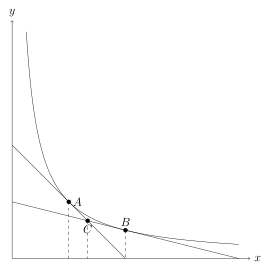
Let \(A\) and \(B\) be the points \((1,1)\) and \((b,1/b)\) respectively, where \(b>1\). The tangents at \(A\) and \(B\) to the curve \(y=1/x\) intersect at \(C\). Find the coordinates of \(C\). Let \(A',B'\) and \(C'\) denote the projections of \(A,B\) and \(C\), respectively, to the \(x\)-axis. Obtain an expression for the sum of the areas of the quadrilaterals \(ACC'A'\) and \(CBB'C'\). Hence or otherwise prove that, for \(z>0\), \[ \frac{2z}{2+z}\leqslant\ln\left(1+z\right)\leqslant z. \]
Solution:
1990 Paper 1 Q10
In a certain race, runners run 5\(\,\)km in a straight line to a fixed point and then turn and run back to the starting point. A steady wind of 3\(\,\text{ms}^{-1}\) is blowing from the start to the turning point. At steady racing pace, a certain runner expends energy at a constant rate of 300\(\,\)W. Two resistive forces act. One is of constant magnitude \(50\,\text{N}\). The other, arising from air resistance, is of magnitude \(2w\,\mathrm{N}\), where \(w\,\text{ms}^{-1}\) is the runner's speed relative to the air. Give a careful argument to derive formulae from which the runner's steady speed in each half of the race may be found. Calculate, to the nearest second, the time the runner will take for the whole race. \textit{Effects due to acceleration and deceleration at the start and turn may be ignored.} The runner may use alternative tactics, expending the same total energy during the race as a whole, but applying different constant powers, \(x_{1}\,\)W in the outward trip, and \(x_{2}\,\)W on the return trip. Prove that, with the wind as above, if the outward and return speeds are \(v_{1}\,\)ms\(^{-1}\) and \(v_{2}\,\)ms\(^{-1}\) respectively, then \(v_{1}+v_{2}\) is independent of the choices for \(x_{1}\) and \(x_{2}\). Hence show that these alternative tactics allow the runner to run the whole race approximately 15 seconds faster.
Solution: Note that \(P = Fv\). Since he is running at a steady pace, we can say that \(F\) must be equal to the resistive forces (as net force is \(0\)). Therefore \(F = 50 + 2(v+3)\) on the way out. ie, \(300 = (2v + 56)v \Rightarrow 150 = v^2 + 28v \Rightarrow v = \sqrt{346}-14\) On the way back, \(F = 50 + 2(v-3)\), ie \(300 = (2v+44)v \Rightarrow 150 = v^2 +22v \Rightarrow v = \sqrt{271}-11\) Therefore the total time will be \(\frac{5000}{\sqrt{346}-150} + \frac{5000}{\sqrt{271}-11} \approx 2002\), or 33 minutes, 22 seconds. Very respectable! The total energy in this first run is \(E = Pt = 2002 \cdot 300\). Now suppose we apply two different powers as in the question, then we must have: \begin{align*} && x_1 &= 2v_1^2 + 56v_1 \\ && x_2 &= 2v_2^2 + 44v_2 \\ && E &= x_1 \frac{5000}{v_1} + x_2 \frac{5000}{v_2} \\ &&&= 5000 \left ( \frac{x_1}{v_1} + \frac{x_2}{v_2} \right) \\ \Rightarrow && \frac{x_1}{v_1} &= 2v_1 + 56 \\ && \frac{x_2}{v_2} &= 2v_2 + 44 \\ \Rightarrow && \frac{E}{5000} &= 2(v_1+v_2) + 100 \\ \Rightarrow && v_1+v_2 &\text{ is independent of the choices for }x_i \end{align*} We wish to minimize \begin{align*} && \frac{5000}{v_1} + \frac{5000}{v_2} &\underbrace{\geq}_{AM-HM} 10\,000 \cdot \frac{2}{v_1+v_2} \\ &&&= 10\,000 \cdot \frac{2}{\sqrt{346}-14+\sqrt{271}-11} \\ &&&\approx 1987 \end{align*} ie they can go 15 seconds quicker with better strategy.
1990 Paper 1 Q11
A shell of mass \(m\) is fired at elevation \(\pi/3\) and speed \(v\). Superman, of mass \(2m\), catches the shell at the top of its flight, by gliding up behind it in the same horizontal direction with speed \(3v\). As soon as Superman catches the shell, he instantaneously clasps it in his cloak, and immediately pushes it vertically downwards, without further changing its horizontal component of velocity, but giving it a downward vertical component of velocity of magnitude \(3v/2\). Calculate the total time of flight of the shell in terms of \(v\) and \(g\). Calculate also, to the nearest degree, the angle Superman's flight trajectory initially makes with the horizontal after releasing the shell, as he soars upwards like a bird. {[}Superman and the shell may be regarded as particles.{]}
Solution: The particle has initial velocity \(\displaystyle \binom{v \cos \frac{\pi}{3}}{v \sin \frac{\pi}{3}}\) and acceleration \(\displaystyle \binom{0}{-g}\). It will have zero vertical speed (ie be at the top of its trajectory) when \(t = \frac{\sqrt{3}v}{2g}\). Since \(0 = v^2-u^2 + 2as\) the height achieved will be \(\frac{3v^2}{8g}\) At this point it will need to travel the same distance again, but this time the initial speed is \(\frac{3v}{2}\) so: \begin{align*} && \frac{3v^2}{8g} &= \frac{3v}{2} t + \frac12 g t^2 \\ \Rightarrow && 0 &= 4g^2t^2+12vgt - 3v^2 \\ \Rightarrow && t &= \l \frac{-3+2\sqrt{3}}{2} \r \frac{v}{g} \end{align*} Therefore the total time is: \begin{align*} \l \frac{\sqrt{3}}{2} - \frac32 + \sqrt{3} \r \frac{v}{g} &= \frac{3\sqrt{3}-3}{2}\frac{v}{g} \end{align*} \begin{align*} COM(\uparrow): && 0 &= 2m v_y - m \frac{3}{2}v \\ \Rightarrow &&v_y &= \frac34 v \\ COM(\rightarrow): && 3mV &= 2m (3v) +m \frac{v}{2} \\ \Rightarrow && V &= \frac{13}6\\ \end{align*} Therefore superman is now travelling at a vector of \(\displaystyle \binom{\frac{13}6}{\frac34}v\) ie an angle of \(\tan^{-1} \frac 9{26}\) to the horizontal, approximately \(19^\circ\)