Problems
Filters
1993 Paper 2 Q10
Verify that if \[ \mathbf{P}=\begin{pmatrix}1 & 2\\ 2 & -1 \end{pmatrix}\qquad\mbox{ and }\qquad\mathbf{A}=\begin{pmatrix}-1 & 8\\ 8 & 11 \end{pmatrix} \] then \(\mathbf{PAP}\) is a diagonal matrix. Put $\mathbf{x}=\begin{pmatrix}x\\ y \end{pmatrix}\( and \)\mathbf{x}_{1}=\begin{pmatrix}x_{1}\\ y_{1} \end{pmatrix}.$ By writing \[ \mathbf{x}=\mathbf{P}\mathbf{x}_{1}+\mathbf{a} \] for a suitable vector \(\mathbf{a},\) show that the equation \[ \mathbf{x}^{\mathrm{T}}\mathbf{Ax}+\mathbf{b}^{\mathrm{T}}\mathbf{x}-11=0, \] where $\mathbf{b}=\begin{pmatrix}18\\ 6 \end{pmatrix}\( and \) \mathbf{x}^{\mathrm{T}} \( is the transpose of \)\mathbf{x},$ becomes \[ 3x_{1}^{2}-y_{1}^{2}=c \] for some constant \(c\) (which you should find).
Solution: \begin{align*} \mathbf{PAP} &= \begin{pmatrix}1 & 2\\ 2 & -1 \end{pmatrix}\begin{pmatrix}-1 & 8\\ 8 & 11 \end{pmatrix}\begin{pmatrix}1 & 2\\ 2 & -1 \end{pmatrix} \\ &= \begin{pmatrix}1 & 2\\ 2 & -1 \end{pmatrix}\begin{pmatrix}15 & -10\\ 30 & 5 \end{pmatrix} \\ &= \begin{pmatrix}75 & 0\\ 0 & -25 \end{pmatrix} \end{align*} Which is diagonal as required. Letting \(\mathbf{x}=\mathbf{P}\mathbf{x}_{1}+\mathbf{a}\) \begin{align*} && \mathbf{x}^{\mathrm{T}}\mathbf{Ax}+\mathbf{b}^{\mathrm{T}}\mathbf{x}-11&=0 \\ \Leftrightarrow && (\mathbf{P}\mathbf{x}_{1}+\mathbf{a})^T\mathbf{A}(\mathbf{P}\mathbf{x}_{1}+\mathbf{a}) + \mathbf{b}^T(\mathbf{P}\mathbf{x}_{1}+\mathbf{a}) - 11 &= 0 \\ \Leftrightarrow && \mathbf{x}_{1}^T\mathbf{PAP}\mathbf{x}_1 + \mathbf{x}_{1}^T\mathbf{PAa} + \mathbf{a}^T\mathbf{AP}\mathbf{x}_{1}+\mathbf{a}^T\mathbf{Aa} + \mathbf{b}^T(\mathbf{P}\mathbf{x}_{1}+\mathbf{a}) - 11 &= 0 \\ \Leftrightarrow && \mathbf{x}_{1}^T\mathbf{PAP}\mathbf{x}_1 +(2\mathbf{a}^T\mathbf{A}+\mathbf{b}^T)\mathbf{P}\mathbf{x}_{1}+\mathbf{a}^T\mathbf{Aa} + \mathbf{b}^T\mathbf{a} - 11 &= 0 \\ \end{align*} It would be nice if we picked \(\mathbf{a}\) such that \(2\mathbf{a}^T\mathbf{A}+\mathbf{b}^T = 0\), if \(\mathbf{a} = \begin{pmatrix} a_1 \\a_2 \end{pmatrix}\) then this equation becomes: \begin{align*} && 2\begin{pmatrix}-a_1 + 8a_2 & 8a_1+11a_2 \end{pmatrix} + \begin{pmatrix}18 & 6 \end{pmatrix} &= 0 \\ \Rightarrow && a_1 = 1, a_2 = -1 \end{align*} So our equation is now \begin{align*} && \mathbf{x}_{1}^T\mathbf{PAP}\mathbf{x}_1 +(2\mathbf{a}^T\mathbf{A}+\mathbf{b}^T)\mathbf{P}\mathbf{x}_{1}+\mathbf{a}^T\mathbf{Aa} + \mathbf{b}^T\mathbf{a} - 11 &= 0 \\ \Leftrightarrow && \mathbf{x}_{1}^T\mathbf{PAP}\mathbf{x}_1-6 +12 - 11 &= 0 \\ \Leftrightarrow && 25(3x_1^2 - y_1^2) &= 5 \\ \Leftrightarrow && 3x_1^2 - y_1^2 &= \frac{1}{5} \end{align*}
1993 Paper 2 Q11
In this question, take the value of \(g\) to be \(10\ \mathrm{ms^{-2}.\)} A body of mass \(m\) kg is dropped vertically into a deep pool of liquid. Once in the liquid, it is subject to gravity, an upward buoyancy force of \(\frac{6}{5}\) times its weight, and a resistive force of \(2mv^{2}\mathrm{N}\) opposite to its direction of travel when it is travelling at speed \(v\) \(\mathrm{ms}^{-1}.\) Show that the body stops sinking less than \(\frac{1}{4}\pi\) seconds after it enters the pool. Suppose now that the body enters the liquid with speed \(1\ \mathrm{ms}^{-1}.\) Show that the body descends to a depth of \(\frac{1}{4}\ln2\) metres and that it returns to the surface with speed \(\frac{1}{\sqrt{2}}\ \mathrm{ms}^{-1},\) at a time \[ \frac{\pi}{8}+\frac{1}{4}\ln\left(\frac{\sqrt{2}+1}{\sqrt{2}-1}\right) \] seconds after entering the pool.
Solution: While descending, the body experiences the force \(-\frac15mg - 2mv^2\). \begin{align*} \text{N2:} && m \dot{v} &= -\frac15 mg - 2mv^2 \\ \Rightarrow && \frac{\dot{v}}{\frac15g + 2v^2} &= -1 \\ \Rightarrow && \frac{1}{2}\tan^{-1} v_1 - \frac{1}{2}\tan^{-1} {v_0} &= -T \end{align*} We care about when \(v_1 = 0\), ie \(\displaystyle T = \frac{1}{2}\tan^{-1} {v_0} < \frac12 \frac{\pi}2 = \frac{\pi}4\) seconds. If the body enters at speed \(1\ \mathrm{ms}^{-1}.\) then for the first part of it's journey it will experience forces \(-\frac15mg - 2mv^2\) and so: \begin{align*} \text{N2:} && m v \frac{\d v}{\d x} &= -\frac15 mg - 2mv^2 \\ \Rightarrow && \int \frac{v}{2(1 + v^2)} \d v &= \int -1 \d x \\ \Rightarrow && \frac14 \ln (1 + v^2) &= -x \end{align*} Therefore the depth is \(\frac14 \ln 2\) metres. When the body is rising, it experiences forces of: \(\frac15mg - 2mv^2\) and so: \begin{align*} \text{N2:} && m v \frac{\d v}{\d x} &= \frac15mg - 2mv^2 \\ \Rightarrow && \int \frac{v}{2(1 - v^2)} \d v &= \int -1 \d x \\ \Rightarrow && -\frac14 \ln (1 - v^2) &= \frac14 \ln 2 \\ \Rightarrow && 1-v^2 &= \frac12 \\ \Rightarrow && v &= \frac{1}{\sqrt{2}} \ \mathrm{ms}^{-1} \end{align*} This will take \begin{align*} \text{N2:} && m \dot{v} &= \frac15mg - 2mv^2 \\ \Rightarrow && \frac{\dot{v}}{2(1-v^2)} &= -1 \\ \Rightarrow && \dot{v} \frac{1}{4}\l \frac{1}{1 - v} + \frac{1}{1+v} \r &= -1 \\ \Rightarrow && \frac{1}{4} \l -\ln(1 - v) + \ln(1 + v)\r &= -T \end{align*} Since \(v = \frac{1}{\sqrt{2}}\) \begin{align*} T &= \frac{1}{4} \ln \l \frac{1+ \frac1{\sqrt{2}}}{1 - \frac1{\sqrt{2}}}\r \\ &= \frac14 \ln \l \frac{\sqrt{2} + 1}{\sqrt{2}-1} \r \end{align*} and therefore the total time will be: \begin{align*} & \frac12 \tan^{-1} 1 + \frac14 \ln \l \frac{\sqrt{2} + 1}{\sqrt{2}-1} \r \\ =& \frac{\pi}{8} + \frac14 \ln \l \frac{\sqrt{2} + 1}{\sqrt{2}-1} \r \end{align*}
1993 Paper 2 Q12
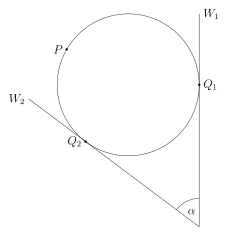
Solution:

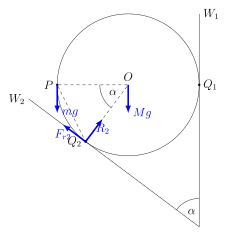
1993 Paper 2 Q13
The force \(F\) of repulsion between two particles with positive charges \(Q\) and \(Q'\) is given by \(F=kQQ'/r^{2},\) where \(k\) is a positive constant and \(r\) is the distance between the particles. Two small beads \(P_{1}\) and \(P_{2}\) are fixed to a straight horizontal smooth wire, a distance \(d\) apart. A third bead \(P_{3}\) of mass \(m\) is free to move along the wire between \(P_{1}\) and \(P_{3}.\) The beads carry positive electrical charges \(Q_{1},Q_{2}\) and \(Q_{3}.\) If \(P_{3}\) is in equilibrium at a distance \(a\) from \(P_{1},\) show that \[ a=\frac{d\sqrt{Q_{1}}}{\sqrt{Q_{1}}+\sqrt{Q_{2}}}. \] Suppose that \(P_{3}\) is displaced slightly from its equilibrium position and released from rest. Show that it performs approximate simple harmonic motion with period \[ \frac{\pi d}{(\sqrt{Q_{1}}+\sqrt{Q_{2}})^{2}}\sqrt{\frac{2md\sqrt{Q_{1}Q_{2}}}{kQ_{3}}.} \] {[}You may use the fact that \(\dfrac{1}{(a+y)^{2}}\approx\dfrac{1}{a^{2}}-\dfrac{2y}{a^{3}}\) for small \(y.\){]}
1993 Paper 2 Q14
A ball of mass \(m\) is thrown vertically upwards from the floor of a room of height \(h\) with speed \(\sqrt{2kgh},\) where \(k>1.\) The coefficient of restitution between the ball and the ceiling or floor is \(a\). Both the ceiling and floor are level. Show that the kinetic energy of the ball immediately before hitting the ceiling for the \(n\)th time is \[ mgh\left(a^{4n-4}(k-1)+\frac{a^{4n-4}-1}{a^{2}+1}\right). \] Hence show that the number of times the ball hits the ceiling is at most \[ 1-\frac{\ln[a^{2}(k-1)+k]}{4\ln a}. \]
Solution: \begin{align*} && \text{energy when projected} &= \frac12 m(2kgh) \\ &&&= kghm \\ && \text{energy when hitting ceiling the first time} &= mgh + \frac12 m v^2 \\ \text{COE}: && kghm &= mgh + \frac12 mv^2 \\ \Rightarrow && v^2 &= 2gh(k-1) \end{align*} It will rebound with speed \(\sqrt{2gh(k-1)}a\). \begin{align*} && \text{energy when rebounding from ceiling} &=gh(k-1)a^2 + mgh \\ && \text{energy before hitting the floor} &= \frac12 mv^2 \\ \text{COE}: && gh(k-1)a^2 + mgh &= \frac12 mv^2 \\ \Rightarrow && v^2 &= 2gh((k-1)a^2+1) \end{align*} The ball will rebound with kinetic energy \(m gh((k-1)a^2+1)a^2 = mgh((k-1)a^4+a^2)\) And will reach the ceiling with kinetic energy \(mgh((k-1)a^4+a^2-1)\). When \(n = 1\), the kinetic energy (before hitting the ceiling for the first time) is \(mgh(k-1)\). Suppose \(s_n\) is the expression for the kinetic energy divided by \(mgh\), ie \(s_1 = k-1\), then: Clearly \(s_1 = k-1 = a^{4\cdot1-4}(k-1) + \frac{a^{4\cdot-4}-1}{a^2+1}\), so our hypothesis holds for \(n=1\). Suppose it is true for \(n\), then the \(n+1\)th time it will be: \begin{align*} s_{n+1} &= s_n a^4+a^2-1 \\ &= \left ( a^{4n-4}(k-1)+\frac{a^{4n-4}-1}{a^{2}+1} \right) a^4 + a^2 - 1 \\ &= a^{4(n+1)-4}(k-1) + \frac{a^{4(n+1)-4}-a^4}{a^2+1} + \frac{a^4-1}{a^2+1} \\ &= a^{4(n+1)-4}(k-1) + \frac{a^{4(n+1)-4}-a^4+a^4-1}{a^2+1} \\ &= a^{4(n+1)-4}(k-1) + \frac{a^{4(n+1)-4}-1}{a^2+1} \end{align*} Which is our desired expression, therefore it is true by induction. We wont reach the ceiling if this energy is not positive, ie: \begin{align*} && 0 &\leq a^{4n-4}(k-1)+\frac{a^{4n-4}-1}{a^{2}+1} \\ \Rightarrow && \frac{1}{a^2+1}&\geq a^{4n-4}\left (k - 1 + \frac{1}{a^2+1} \right) \\ \Rightarrow && a^{4n-4} &\geq \frac{1}{a^2+1} \cdot \frac{1}{k - 1 + \frac{1}{a^2+1}} \\ \Rightarrow && a^{4n-4} &\geq \frac{1}{(k-1)(a^2+1)+1} \\ \Rightarrow && 4(n-1) \ln a &\geq - \ln[(k-1)(a^2+1)+1] \\ \underbrace{\Rightarrow}_{\ln a < 0} && (n-1) &\leq \frac{ - \ln[(k-1)(a^2+1)+1]}{4\ln a} \\ \Rightarrow && n & \leq 1 -\frac{ \ln[(k-1)(a^2+1)+1]}{4\ln a} \\ &&&= 1 -\frac{ \ln[(k-1)a^2+k]}{4\ln a} \end{align*}
1993 Paper 2 Q15
Two computers, LEP and VOZ are programmed to add numbers after first approximating each number by an integer. LEP approximates the numbers by rounding: that is, it replaces each number by the nearest integer. VOZ approximates by truncation: that is, it replaces each number by the largest integer less than or equal to the number. The fractional parts of the numbers to be added are uniformly and independently distributed. (The fractional part of a number \(a\) is \(a-\left\lfloor a\right\rfloor ,\) where \(\left\lfloor a\right\rfloor \) is the largest integer less than or equal to \(a\).) Both computers approximate and add 1500 numbers. For each computer, find the probability that the magnitude of error in the answer will exceed 15. How many additions can LEP perform before the probability that the magnitude of error is less than 10 drops below 0.9?
1993 Paper 2 Q16
At the terminus of a bus route, passengers arrive at an average rate of 4 per minute according to a Poisson process. Each minute, on the minute, one bus arrives with probability \(\frac{1}{4},\) independently of the arrival of passengers or previous buses. Just after eight o'clock there is no-one at the bus stop.
- What is the probability that the first bus arrives at \(n\) minutes past 8?
- If the first bus arrives at 8:05, what is the probability that there are \(m\) people waiting for it?
- Each bus can take 25 people and, since it is the terminus, the bus arrive empty. Explain carefully how you would calculate, to two significant figures, the probability that when the first bus arrives it is unable to pick up all the passengers. Your method should need the use of a calculator and standard tables only. There is no need to carry out the calculation.
1993 Paper 3 Q1
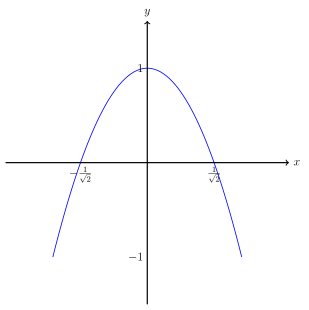
The curve \(P\) has the parametric equations $$ x= \sin\theta, \quad y=\cos2\theta \qquad\hbox{ for }-\pi/2 \le \theta \le \pi/2. $$ Show that \(P\) is part of the parabola \(y=1-2x^2\) and sketch \(P\). Show that the length of \(P\) is \(\surd (17) + {1\over 4} \sinh^{-1}4\). Obtain the volume of the solid enclosed when \(P\) is rotated through \(2\pi\) radians about the line \(y=-1\).
Solution: First notice that \(y = \cos 2 \theta = 1 - 2\sin^2 \theta = 1- 2x^2\), therefore \(P\) is lies on that parabola.
1993 Paper 3 Q2
The curve \(C\) has the equation \(x^3+y^3 = 3xy\).
- Show that there is no point of inflection on \(C\). You may assume that the origin is not a point of inflection.
- The part of \(C\) which lies in the first quadrant is a closed loop touching the axes at the origin. By converting to polar coordinates, or otherwise, evaluate the area of this loop.
1993 Paper 3 Q3
The matrices \(\mathbf{A},\mathbf{B}\) and \(\mathbf{M}\) are given by \[ \mathbf{A}=\begin{pmatrix}a & 0 & 0\\ b & c & 0\\ d & e & f \end{pmatrix},\quad\mathbf{B}=\begin{pmatrix}1 & p & q\\ 0 & 1 & r\\ 0 & 0 & 1 \end{pmatrix},\quad\mathbf{M}=\begin{pmatrix}1 & 3 & 2\\ 4 & 13 & 5\\ 3 & 8 & 7 \end{pmatrix}, \] where \(a,b,\ldots,r\) are real numbers. Given that \(\mathbf{M=AB},\) show that \(a=1,b=4,c=1,d=3,e=1,f=-2,p=3,q=2\) and \(r=-3\) gives the unique solution for \(\mathbf{A}\) and \(\mathbf{B}.\) Evaluate \(\mathbf{A}^{-1}\) and \(\mathbf{B}^{-1},\) Hence, or otherwise, solve the simultaneous equations \begin{alignat*}{1} x+3y+2z & =7\\ 4x+13y+5z & =18\\ 3x+8y+7z & =25. \end{alignat*}
Solution: \begin{align*} && \begin{pmatrix}1 & 3 & 2\\ 4 & 13 & 5\\ 3 & 8 & 7 \end{pmatrix} &= \begin{pmatrix}a & 0 & 0\\ b & c & 0\\ d & e & f \end{pmatrix}\begin{pmatrix}1 & p & q\\ 0 & 1 & r\\ 0 & 0 & 1 \end{pmatrix} \\ &&&= \begin{pmatrix} a & ap & aq \\ b & pb + c & qb + cr\\ d & pd + e & qd + er +f \end{pmatrix} \\ \Rightarrow && a,b,d,p,q&=1,4,3,3,2\\ &&&= \begin{pmatrix} 1 & 3 & 2 \\ 4 & 12 + c & 8+ cr\\ 3 & 9 + e & 6 + er +f \end{pmatrix} \\ \Rightarrow && c, e&=1,-1\\ &&&= \begin{pmatrix} 1 & 3 & 2 \\ 4 & 13 & 8+ r\\ 3 & 8 & 6 -r +f \end{pmatrix} \\ \Rightarrow && r, f &= -3, -2 \end{align*} \begin{align*} \mathbf{A}^{-1} &= \begin{pmatrix} 1 & 0 & 0 \\ 4 & 1 & 0\\ 3 & -1 & -2 \end{pmatrix}^{-1} \\ &=\frac{1}{-2} \begin{pmatrix} -2 & 0 & 0 \\ 8 & -2 & 0\\ -7 & 1 & 1 \end{pmatrix} \\ \\ \mathbf{B}^{-1} &= \begin{pmatrix} 1 & 3 & 2 \\ 0 & 1 & -3\\ 0 & 0 & 1 \end{pmatrix}^{-1} \\ &= \begin{pmatrix} 1 & -3 & -11 \\ 0 & 1 & 3\\ 0 & 0 & 1 \end{pmatrix} \\ \end{align*} We want to solve \(\mathbf{M}\mathbf{v} = \begin{pmatrix} 7 \\ 18 \\ 25 \end{pmatrix}\), ie \begin{align*} \mathbf{v} &= \mathbf{M}^{-1}\begin{pmatrix} 7 \\ 18 \\ 25 \end{pmatrix} \\ &= \mathbf{B}^{-1} \mathbf{A}^{-1}\begin{pmatrix} 7 \\ 18 \\ 25 \end{pmatrix} \\ &= \frac{1}{-2}\mathbf{B}^{-1} \begin{pmatrix} -2 & 0 & 0 \\ 8 & -2 & 0\\ -7 & 1 & 1 \end{pmatrix} \begin{pmatrix} 7 \\ 18 \\ 25 \end{pmatrix} \\ &= \frac{1}{-2}\mathbf{B}^{-1} \begin{pmatrix} -14 \\ 20 \\ -6 \end{pmatrix} \\ &= \begin{pmatrix} 1 & -3 & -11 \\ 0 & 1 & 3\\ 0 & 0 & 1 \end{pmatrix}\begin{pmatrix} 7 \\ -10 \\ 3 \end{pmatrix} \\ &= \begin{pmatrix} 4\\ -1 \\ 3 \end{pmatrix} \end{align*} This algorithm is called the "LU-decomposition"