Problems
Filters
1993 Paper 1 Q16
By making the substitution \(y=\cos^{-1}t,\) or otherwise, show that \[ \int_{0}^{1}\cos^{-1}t\,\mathrm{d}t=1. \] A pin of length \(2a\) is thrown onto a floor ruled with parallel lines equally spaced at a distance \(2b\) apart. The distance \(X\) of its centre from the nearest line is a uniformly distributed random variable taking values between \(0\) and \(b\) and the acute angle \(Y\) the pin makes with a direction perpendicular to the line is a uniformly distributed random variable taking values between \(0\) and \(\pi/2\). \(X\) and \(Y\) are independent. If \(X=x\) what is the probability that the pin crosses the line? If \(a < b\) show that the probability that the pin crosses a line for a general throw is \(\dfrac{2a}{\pi b}.\)
Solution: \begin{align*} && I &= \int_0^1 \cos^{-1} t \d t \\ \cos y = t: -\sin y \d y = \d t: &&&= \int_{\frac{\pi}{2}}^0 -y \sin y \d y \\ &&&= \int_0^{\pi/2} y \sin y \d y \\ &&&= \left [-y \cos y \right]_0^{\pi/2} + \int_0^{\pi/2} \cos y \d y \\ &&&= \left [ \sin y \right]_0^{\pi/2} = 1 \end{align*}
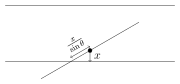
1993 Paper 2 Q1
In the game of ``Colonel Blotto'' there are two players, Adam and Betty. First Adam chooses three non-negative integers \(a_{1},a_{2}\) and \(a_{3},\) such that \(a_{1}+a_{2}+a_{3}=9,\) and then Betty chooses non-negative integers \(b_{1},b_{2}\) and \(b_{3}\), such that \(b_{1}+b_{2}+b_{3}=9.\) If \(a_{1} > b_{1}\) then Adam scores one point; if \(a_{1} < b_{1}\) then Betty scores one point; and if \(a_{1}=b_{1}\) no points are scored. Similarly for \(a_{2},b_{2}\) and \(a_{3},b_{3}.\) The winner is the player who scores the greater number of points: if the socres are equal then the game is drawn. Show that, if Betty knows the numbers \(a_{1},a_{2}\) and \(a_{3},\) she can always choose her numbers so that she wins. Show that Adam can choose \(a_{1},a_{2}\) and \(a_{3}\) in such a way that he will never win no matter what Betty does. Now suppose that Adam is allowed to write down two triples of numbers and that Adam wins unless Betty can find one triple that beats both of Adam's choices (knowing what they are). Confirm that Adam wins by writing down \((5,3,1)\) and \((3,1,5).\)
1993 Paper 2 Q2
- Evaluate \[ \int_{0}^{2\pi}\cos(mx)\cos(nx)\,\mathrm{d}x, \] where \(m,n\) are integers, taking into account any special cases that arise.
- Find \({\displaystyle \int\sqrt{1+\frac{1}{x}}\,\mathrm{d}x}.\)
1993 Paper 2 Q3
- Solve the differential equation \[ \frac{\mathrm{d}y}{\mathrm{d}x}-y-3y^{2}=-2 \] by making the substitution \(y=-\dfrac{1}{3u}\dfrac{\mathrm{d}u}{\mathrm{d}x}.\)
- Solve the differential equation \[ x^{2}\frac{\mathrm{d}y}{\mathrm{d}x}+xy+x^{2}y^{2}=1 \] by making the substitution \[ y=\frac{1}{x}+\frac{1}{v}, \] where \(v\) is a function of \(x\).
1993 Paper 2 Q4
Two non-parallel lines in 3-dimensional space are given by \(\mathbf{r}=\mathbf{p}_{1}+t_{1}\mathbf{m}_{1}\) and \(\mathbf{r}=\mathbf{p}_{2}+t_{2}\mathbf{m}_{2}\) respectively, where \(\mathbf{m}_{1}\) and \(\mathbf{m}_{2}\) are unit vectors. Explain by means of a sketch why the shortest distance between the two lines is \[ \frac{\left|(\mathbf{p}_{1}-\mathbf{p}_{2})\cdot(\mathbf{m}_{1}\times\mathbf{m}_{2})\right|}{\left|(\mathbf{m}_{1}\times\mathbf{m}_{2})\right|}. \]
- Find the shortest distance between the lines in the case \[ \mathbf{p}_{1}=(2,1,-1)\qquad\mathbf{p}_{2}=(1,0,-2)\qquad\mathbf{m}_{1}=\tfrac{1}{5}(4,3,0)\qquad\mathbf{m}_{2}=\tfrac{1}{\sqrt{10}}(0,-3,1). \]
- Two aircraft, \(A_{1}\) and \(A_{2},\) are flying in the directions given by the unit vectors \(\mathbf{m}_{1}\) and \(\mathbf{m}_{2}\) at constant speeds \(v_{1}\) and \(v_{2}.\) At time \(t=0\) they pass the points \(\mathbf{p}_{1}\) and \(\mathbf{p}_{2}\), respectively. If \(d\) is the shortest distance between the two aircraft during the flight, show that \[ d^{2}=\frac{\left|\mathbf{p}_{1}-\mathbf{p}_{2}\right|^{2}\left|v_{1}\mathbf{m}_{1}-v_{2}\mathbf{m}_{2}\right|^{2}-[(\mathbf{p}_{1}-\mathbf{p}_{2})\cdot(v_{1}\mathbf{m}_{1}-v_{2}\mathbf{m}_{2})]^{2}}{\left|v_{1}\mathbf{m}_{1}-v_{2}\mathbf{m}_{2}\right|^{2}}. \]
- Suppose that \(v_{1}\) is fixed. The pilot of \(A_{2}\) has chosen \(v_{2}\) so that \(A_{2}\) comes as close as possible to \(A_{1}.\) How close is that, if \(\mathbf{p}_{1},\mathbf{p}_{2},\mathbf{m}_{1}\) and \(\mathbf{m}_{2}\) are as in (i)?
1993 Paper 2 Q5
\noindent
1993 Paper 2 Q6
In this question, \(\mathbf{A,\mathbf{B\) }}and \(\mathbf{X\) are non-zero \(2\times2\) real matrices.} Are the following assertions true or false? You must provide a proof or a counterexample in each case.
- If \(\mathbf{AB=0}\) then \(\mathbf{BA=0}.\)
- \((\mathbf{A-B)(A+B)=}\mathbf{A}^{2}-\mathbf{B}^{2}.\)
- The equation \(\mathbf{AX=0}\) has a non-zero solution \(\mathbf{X}\) if and only if \(\det\mathbf{A}=0.\)
- For any \(\mathbf{A}\) and \(\mathbf{B}\) there are at most two matrices \(\mathbf{X}\) such that \(\mathbf{X}^{2}+\mathbf{AX}+\mathbf{B}=\mathbf{0}.\)
Solution:
- This is false, for example let \(\mathbf{A} = \begin{pmatrix} 0 & 1 \\ 0 & 1 \end{pmatrix}\) and \(\mathbf{B} = \begin{pmatrix} 0 & 1 \\ 0 & 0 \end{pmatrix}\), then \begin{align*} \mathbf{AB} &= \begin{pmatrix} 0 & 1 \\ 0 & 1 \end{pmatrix}\begin{pmatrix} 0 & 1 \\ 0 & 0 \end{pmatrix} \\ &= \begin{pmatrix}0 & 0 \\ 0 & 0\end{pmatrix} \\ \mathbf{BA} &= \begin{pmatrix} 0 & 1 \\ 0 & 0 \end{pmatrix}\begin{pmatrix} 0 & 1 \\ 0 & 1 \end{pmatrix} \\ &= \begin{pmatrix}0 & 1 \\ 0 & 0\end{pmatrix} \\ \end{align*}
- This is also false, using the same matrices from part (i), we find: \begin{align*} (\mathbf{A - B})(\mathbf{A + B}) &= \mathbf{A}^2-\mathbf{BA}+\mathbf{AB}-\mathbf{B}^2 \\ &= \mathbf{A}^2-\mathbf{B}^2+\begin{pmatrix}0 & 1 \\ 0 & 0\end{pmatrix} \\ &\neq \mathbf{A}^2-\mathbf{B}^2 \end{align*}
- This is true. Claim: The equation \(\mathbf{AX=0}\) has a non-zero solution \(\mathbf{X}\) if and only if \(\det\mathbf{A}=0.\) Proof: \((\Rightarrow)\) Suppose \(\det\mathbf{A} \neq 0\) then \(\mathbf{A}\) has an inverse, and so we must have \(\mathbf{A}^{-1}\mathbf{AX} = \mathbf{0} \Rightarrow \mathbf{X} = \mathbf{0}\). \((\Leftarrow)\) Suppose \(\det \mathbf{A} = 0\) then \(ad-bc=0\), so consider the matrix \(\mathbf{X} = \begin{pmatrix} d & d\\ -c & -c\end{pmatrix}\) (or if this is zero, \(\mathbf{X} = \begin{pmatrix} a & a\\ -b & -b\end{pmatrix}\))
- This is false. Consider \(\mathbf{A} = \mathbf{B} = \mathbf{0}\), then \(\mathbf{X} = \begin{pmatrix} 0 & x \\ 0 & 0\end{pmatrix}\) has the property that \(\mathbf{X}^2 = \mathbf{0}\) for all \(x\), so at least more than 2 values
1993 Paper 2 Q7
The integers \(a,b\) and \(c\) satisfy \[ 2a^{2}+b^{2}=5c^{2}. \] By considering the possible values of \(a\pmod5\) and \(b\pmod5\), show that \(a\) and \(b\) must both be divisible by \(5\). By considering how many times \(a,b\) and \(c\) can be divided by \(5\), show that the only solution is \(a=b=c=0.\)
Solution: \begin{array}{c|ccccc} a & 0 & 1 & 2 & 3 & 4 \\ a^2 & 0 & 1 & 4 & 4 & 1 \end{array} Therefore \(a^2 \in \{0,1,4\}\) and so we can have \begin{array} $2a^2+b^2 & 0 & 1 & 4 \\ \hline 0 & 0 & 1 & 4 \\ 1 & 2 & 3 & 1 \\ 4 & 3 & 4 & 2 \end{array} Therefore the only solution must have \(5 \mid a,b\), but then we can write them has \(5a'\) and \(5b'\) so the equation becomes \(2\cdot25 a'^2 + 25b'^2 = 5c^2\) ie \(5 \mid c^2 \Rightarrow 5 \mid c\). But that means we can always divide \((a,b,c)\) by \(5\), which is clearly a contradiction if we consider the lowest power of \(5\) dividing \(a,b,c\) for any solution.
1993 Paper 2 Q8
Suppose that \(a_{i}>0\) for all \(i>0\). Show that \[ a_{1}a_{2}\leqslant\left(\frac{a_{1}+a_{2}}{2}\right)^{2}. \] Prove by induction that for all positive integers \(m\) \[ a_{1}\cdots a_{2^{m}}\leqslant\left(\frac{a_{1}+\cdots+a_{2^{m}}}{2^{m}}\right)^{2^{m}}.\tag{\ensuremath{*}} \] If \(n<2^{m}\), put \(b_{1}=a_{2},\) \(b_{2}=a_{2},\cdots,b_{n}=a_{n}\) and \(b_{n+1}=\cdots=b_{2^{m}}=A\), where \[ A=\frac{a_{1}+\cdots+a_{n}}{n}. \] By applying \((*)\) to the \(b_{i},\) show that \[ a_{1}\cdots a_{n}A^{(2^{m}-n)}\leqslant A^{2^{m}} \] (notice that \(b_{1}+\cdots+b_{n}=nA).\) Deduce the (arithmetic mean)/(geometric mean) inequality \[ \left(a_{1}\cdots a_{n}\right)^{1/n}\leqslant\frac{a_{1}+\cdots+a_{n}}{n}. \]
1993 Paper 2 Q9
\textit{In this question, the argument of a complex number is chosen to satisfy \(0\leqslant\arg z<2\pi.\)} Let \(z\) be a complex number whose imaginary part is positive. What can you say about \(\arg z\)? The complex numbers \(z_{1},z_{2}\) and \(z_{3}\) all have positive imaginary part and \(\arg z_{1}<\arg z_{2}<\arg z_{3}.\) Draw a diagram that shows why \[ \arg z_{1}<\arg(z_{1}+z_{2}+z_{3})<\arg z_{3}. \] Prove that \(\arg(z_{1}z_{2}z_{3})\) is never equal to \(\arg(z_{1}+z_{2}+z_{3}).\)