Problems
Filters
1995 Paper 3 Q12
The random variables \(X\) and \(Y\) are independently normally distributed with means 0 and variances 1. Show that the joint probability density function for \((X,Y)\) is \[ \mathrm{f}(x,y)=\frac{1}{2\pi}\mathrm{e}^{-\frac{1}{2}(x^{2}+y^{2})}\qquad-\infty < x < \infty,-\infty < y < \infty. \] If \((x,y)\) are the coordinates, referred to rectangular axes, of a point in the plane, explain what is meant by saying that this density is radially symmetrical. The random variables \(U\) and \(V\) have a joint probability density function which is radially symmetrical (in the above sense). By considering the straight line with equation \(U=kV,\) or otherwise, show that \[ \mathrm{P}\left(\frac{U}{V} < k\right)=2\mathrm{P}(U < kV,V > 0). \] Hence, or otherwise, show that the probability density function of \(U/V\) is \[ \mathrm{g}(k)=\frac{1}{\pi(1+k^{2})}\qquad-\infty < k < \infty. \]
1995 Paper 3 Q13
A message of \(10^{k}\) binary digits is sent along a fibre optic cable with high probabilities \(p_{0}\) and \(p_{1}\) that the digits 0 and 1, respectively, are received correctly. If the probability of a digit in the original message being a 1 is \(\alpha,\) find the probability that the entire message is received correctly. Find the probability \(\beta\) that a randomly chosen digit in the message is received as a 1 and show that \(\beta=\alpha\) if, and only if \[ \alpha=\frac{q_{0}}{q_{1}+q_{0}}, \] where \(q_{0}=1-p_{0}\) and \(q_{1}=1-p_{1}.\) If this condition is satisfied and the received message consists entirely of zeros, what is the probability that it is correct? If now \(q_{0}=q_{1}=q\) and \(\alpha=\frac{1}{2},\) find the approximate value of \(q\) which will ensure that a message of one million binary digits has a fifty-fifty chance of being received entirely correctly. The probability of error \(q\) is proportional to the square of the length of the cable. Initially the length is such that the probability of a message of one million binary bits, among which 0 and 1 are equally likely, being received correctly is \(\frac{1}{2}.\) What would this probability become if a booster station were installed at its mid-point, assuming that the booster station re-transmits the received version of the message, and assuming that terms of order \(q^{2}\) may be ignored?
1995 Paper 3 Q14
A candidate finishes examination questions in time \(T\), where \(T\) has probability density function \[ \mathrm{f}(t)=t\mathrm{e}^{-t}\qquad t\geqslant0, \] the probabilities for the various questions being independent. Find the moment generating function of \(T\) and hence find the moment generating function for the total time \(U\) taken to finish two such questions. Show that the probability density function for \(U\) is \[ \mathrm{g}(u)=\frac{1}{6}u^{3}\mathrm{e}^{-u}\qquad u\geqslant0. \] Find the probability density function for the total time taken to answer \(n\) such questions.
Solution: \begin{align*} && M_T(x) &= \mathbb{E}[e^{xT}] \\ &&&= \int_0^{\infty} e^{xt}te^{-t} \d t \\ &&&= \int_0^{\infty}te^{(x-1)t} \d t \\ &&&= \left [ \frac{t}{x-1} e^{(x-1)t} \right]_0^{\infty} - \int_0^\infty \frac{e^{(x-1)t}}{x-1} \d t \\ &&&= \left [ \frac{e^{(x-1)t}}{(x-1)^2} \right]_0^{\infty} \\ &&&= \frac{1}{(x-1)^2} \\ \\ && M_U(x) &= M_{T_1+T_2}(x) \\ &&&= \frac1{(x-1)^4} \\ \\ && I_n &= \int_0^{\infty} t^ne^{(x-1)t} \d t \\ &&&= \left[ \frac{1}{(x-1)}t^ne^{(x-1)t} \right]_0^{\infty} - \frac{n}{(x-1)} \int_0^{\infty}t^{n-1}e^{(x-1)t} \d t \\ &&&= -\frac{n}{(x-1)}I_{n-1} \\ \Rightarrow && I_n &= \frac{n!}{(1-x)^{n+1}} \\ \\ \Rightarrow && \int_0^{\infty} e^{xt} \frac16u^3e^{-u} \d u &= \int_0^{\infty} \frac16u^3e^{(x-1)u} \d u \\ &&&= \frac{1}{(1-x)^4} \\ \Rightarrow && f_U(u) &= \frac16u^3e^{-u} \\ \\ && M_{X_1+\cdots+X_n}(x) &= \frac{1}{(x-1)^{2n}} \\ \Rightarrow && f_{X_1+\cdots+X_n}(t) &= \frac1{(2n-1)!} t^{2n-1}e^{-t} \end{align*} (NB: This is the gamma distribution)
1994 Paper 1 Q1
My house has an attic consisting of a horizontal rectangular base of length \(2q\) and breadth \(2p\) (where \(p < q\)) and four plane roof sections each at angle \(\theta\) to the horizontal. Show that the length of the roof ridge is independent of \(\theta\) and find the volume of the attic and the surface area of the roof.
Solution:

1994 Paper 1 Q2
Given that \(a\) is constant, differentiate the following expressions with respect to \(x\):
- \(x^{a}\);
- \(a^{x}\);
- \(x^{x}\);
- \(x^{(x^{x})}\);
- \((x^{x})^{x}.\)
Solution: \begin{align*} && y &= x^a \\ && \frac{\d y}{\d x} &= \begin{cases} ax^{a-1} & a \neq 0 \\ 0 & a = 0 \end{cases} \\ \\ && y &= a^x \\ &&&= e^{(\ln a) \cdot x} \\ && \frac{\d y}{\d x} &= \ln a e^{(\ln a) x} \\ &&&= \ln a \cdot a^ x \\ \\ && y &= x^x \\ &&&= e^{x \ln x}\\ && \frac{\d y}{\d x} &= e^{x \ln x} \cdot \left ( \ln x + x \cdot \frac1x \right) \\ &&&= x^x \left (1 + \ln x \right) \\ \\ && y&= x^{(x^x)} \\ &&&= e^{x^ x \cdot \ln x} \\ && \frac{\d y}{\d x} &= e^{x^x \cdot \ln x} \left ( x^x \left (1 + \ln x \right) \cdot \ln x + x^x \cdot \frac1x\right) \\ &&&= x^{x^x} \left (x^x (1+ \ln x) \ln x +x^{x-1} \right) \\ &&&= x^{x^x+x-1} \left (1 + x \ln x + x (\ln x)^2 \right) \\ \\ && y &= (x^x)^x \\ &&&= x^{2x} \\ &&&= e^{2x \ln x} \\ && \frac{\d y}{\d x} &= e^{2 x \ln x} \left (2 \ln x + 2 \right) \\ &&&= 2(x^x)^x(1 + \ln x) \end{align*}
1994 Paper 1 Q3
By considering the coefficient of \(x^{n}\) in the identity \((1-x)^{n}(1+x)^{n}=(1-x^{2})^{n},\) or otherwise, simplify \[ \binom{n}{0}^{2}-\binom{n}{1}^{2}+\binom{n}{2}^{2}-\binom{n}{3}^{2}+\cdots+(-1)^{n}\binom{n}{n}^{2} \] in the cases (i) when \(n\) is even, (ii) when \(n\) is odd.
Solution: The coefficient of \(x^n\) on the LHS is \begin{align*} && (1-x^2)^n &= (1-x)^n(1+x)^n \\ [x^n]: && \begin{cases} (-1)^{\lfloor \frac{n}2 \rfloor}\binom{n}{\lfloor \frac{n}2 \rfloor} &\text{if } n\text{ even} \\ 0 & \text{otherwise} \end{cases} &= \sum_{i=0}^n \underbrace{(-1)^i\binom{n}{i}}_{\text{take }(-x)^i\text{ from first bracket}} \cdot \underbrace{\binom{n}{n-i}}_{\text{take }x^{n-i}\text{ from second bracket}} \\ &&&= \sum_{i=0}^n (-1)^i\binom{n}{i}\binom{n}{i} \\ &&&= \sum_{i=0}^n (-1)^i\binom{n}{i}^2\\ \end{align*}
1994 Paper 1 Q4
Show that
- \(\dfrac{1-\cos\alpha}{\sin\alpha}=\tan\frac{1}{2}\alpha,\)
- if \(\left|k\right|<1\) then \({\displaystyle \int\frac{\mathrm{d}x}{1-2kx+x^{2}}=\frac{1}{\sqrt{1-k^{2}}}\tan^{-1}\left(\frac{x-k}{\sqrt{1-k^{2}}}\right)+C,}\) where \(C\) is a constant of integration.
Solution:
- \begin{align*} \frac{1-\cos \alpha}{\sin \alpha} &= \frac{1-(1-2\sin^2 \frac{\alpha}{2})}{2 \sin \frac \alpha2 \cos \frac\alpha2} \\ &= \frac{2 \sin^2 \frac \alpha2}{2 \sin \frac \alpha2 \cos \frac\alpha2} \\ &= \frac{\sin \frac \alpha2}{ \cos \frac\alpha2} \\ &= \tan \tfrac{\alpha}{2} \end{align*}
- \begin{align*} \int\frac{\mathrm{d}x}{1-2kx+x^{2}} &= \int \frac{\d x}{(x-k)^2+1-k^2} \\ &= \frac{1}{1-k^2}\int \frac{\d x}{\left (\frac{x-k}{\sqrt{1-k^2}} \right)^2+1} \\ &= \frac{1}{\sqrt{1-k^2}} \tan^{-1} \left (\frac{x-k}{\sqrt{1-k^2}} \right)+C \end{align*}
1994 Paper 1 Q5
A parabola has the equation \(y=x^{2}.\) The points \(P\) and \(Q\) with coordinates \((p,p^{2})\) and \((q,q^{2})\) respectively move on the parabola in such a way that \(\angle POQ\) is always a right angle.
- Find and sketch the locus of the midpoint \(R\) of the chord \(PQ.\)
- Find and sketch the locus of the point \(T\) where the tangents to the parabola at \(P\) and \(Q\) intersect.
Solution:
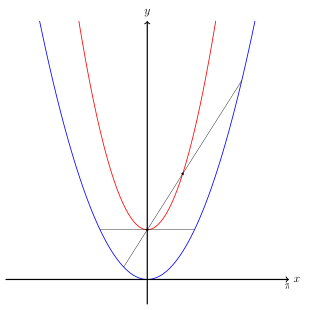
- The line \(PO\) has gradient \(\frac{p^2}{p} = p\) and teh line \(QO\) has gradient \(q\), therefore we must have that \(pq = -1\). Therefore, \(R\) is the point
\begin{align*}
&& R &= \left ( \frac{p-\frac{1}{p}}{2}, \frac{p^2+\frac{1}{p^2}}{2} \right) \\
&&&= \left ( \frac12\left ( p - \frac{1}{p} \right),2\left (\frac12 \left(p-\frac{1}{p}\right) \right)^2+1 \right) \\
&&&= \left ( t, 2t^2+1\right)
\end{align*}
So we are looking at another parabola.
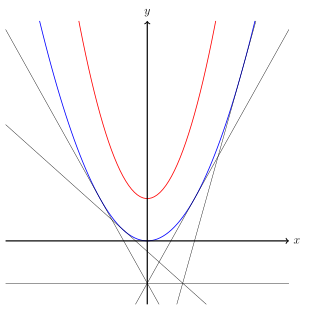
- The tangents are \(y = 2px+c\), ie \(p^2 = 2p^2+c\), ie \(y = 2px -p^2\) so we have
\begin{align*}
&& y - 2px &= -p^2 \\
&& y - 2qx &= -q^2 \\
\Rightarrow && (2p-2q)x &= p^2-q^2 \\
\Rightarrow && x &= \frac12 (p+q)\\
&& y &= p(p+q)-p^2 \\
&& y &= pq = -1
\end{align*}
Therefore \(x = \frac12(p - \frac1p), y= -1\), so we have the line \(y = -1\) (the directrix)
1994 Paper 1 Q6
The function \(\mathrm{f}\) is defined, for any complex number \(z\), by \[ \mathrm{f}(z)=\frac{\mathrm{i}z-1}{\mathrm{i}z+1}. \] Suppose throughout that \(x\) is a real number.
- Show that \[ \mathrm{Re}\,\mathrm{f}(x)=\frac{x^{2}-1}{x^{2}+1}\qquad\mbox{ and }\qquad\mathrm{Im}\,\mathrm{f}(x)=\frac{2x}{x^{2}+1}. \]
- Show that \(\mathrm{f}(x)\mathrm{f}(x)^{*}=1,\) where \(\mathrm{f}(x)^{*}\) is the complex conjugate of \(\mathrm{f}(x)\).
- Find expressions for \(\mathrm{Re}\,\mathrm{f}(\mathrm{f}(x))\) and \(\mathrm{Im}\,\mathrm{f}(\mathrm{f}(x)).\)
- Find \(\mathrm{f}(\mathrm{f}(\mathrm{f}(x))).\)
Solution:
- \begin{align*} && f(x) &= \frac{ix-1}{ix+1} \\ &&&= \frac{ix-1}{ix+1} \frac{1-ix}{1-ix} \\ &&&= \frac{ix-1+x^2+ix}{1^2+x^2} \\ &&&= \frac{x^2-1}{x^2+1} + i \frac{2x}{x^2+1} \\ \Rightarrow && \textrm{Re}(f(x)) &= \frac{x^2-1}{x^2+1} \\ && \textrm{Im}(f(x)) &= \frac{2x}{x^2+1} \end{align*}
- \begin{align*} && f(x)f(x)^* &= \frac{ix-1}{ix+1} \frac{(ix-1)^*}{(ix+1)^*} \\ &&&= \frac{ix-1}{ix+1} \frac{-ix-1}{-ix+1} \\ &&&= \frac{ix-1}{ix+1} \frac{-(ix+1)}{-(ix-1)} \\ &&&= 1
- \begin{align*} && \begin{pmatrix} i & -1 \\ i & 1 \end{pmatrix}^2 &= \begin{pmatrix} -1-i & -i-1 \\ -1+i & -i+1 \end{pmatrix} \\ \Rightarrow && f(f(z)) &= \frac{-(1+i)(z+1)}{(-1+i)(z-1)} \\ &&&= \frac{2i}{2} \frac{z+1}{z-1} \\ &&&= i \frac{z+1}{z-1} \\ \Rightarrow && \textrm{Re}(f(f(x))) &= 0 \\ && \textrm{Im}(f(f(x))) &= \frac{x+1}{x-1} \end{align*}
- \begin{align*} && \begin{pmatrix} i & -1 \\ i & 1 \end{pmatrix} \begin{pmatrix} i & i \\ 1 & -1 \end{pmatrix} &= \begin{pmatrix} -2 & 0 \\ 0 & -2 \end{pmatrix} \\ \Rightarrow && f(f(f(z))) &= z \end{align*}
1994 Paper 1 Q7
From the facts \begin{alignat*}{2} 1 & \quad=\quad & & 0\\ 2+3+4 & \quad=\quad & & 1+8\\ 5+6+7+8+9 & \quad=\quad & & 8+27\\ 10+11+12+13+14+15+16 & \quad=\quad & & 27+64 \end{alignat*} guess a general law. Prove it. Hence, or otherwise, prove that \[ 1^{3}+2^{3}+3^{3}+\cdots+N^{3}=\tfrac{1}{4}N^{2}(N+1)^{2} \] for every positive integer \(N\). [Hint. You may assume that \(1+2+3+\cdots+n=\frac{1}{2}n(n+1)\).]
Solution: \begin{align*} && (n^2+1) + (n^2+2) + \cdots + (n+1)^2 &= n^3+(n+1)^3 \\ \Leftrightarrow && \sum_{i=n^2+1}^{(n+1)^2} i &= n^3 + (n+1)^3 \\ && \sum_{i=n^2+1}^{(n+1)^2} i &= \sum_{i=1}^{(n+1)^2} i- \sum_{i=1}^{n^2} i \\ &&&= \frac{(n+1)^2((n+1)^2+1)}{2} - \frac{n^2(n^2+1)}{2} \\ &&&= \frac{(n+1)^2(n^2+2n+2) - n^2(n^2+1)}{2} \\ &&&= \frac{2(n+1)^3+n^2(n^2+2n+1) - n^2(n^2+1)}{2}\\ &&&= \frac{2(n+1)^3+2n^3 + n^2(n^2+1) - n^2(n^2+1)}{2}\\ &&&= (n+1)^3+n^3 \end{align*} \begin{align*} && \sum_{i=1}^{N^2} i &=(0^3+1^3)+ (1^3+2^3)+(2^3+3^3) + \cdots + ((N-1)^3+N^3) \\ &&&= 2 \left (1^3+2^3 + 3^3 + \cdots + (N-1)^3 \right) + N^3 \\ \Rightarrow && \sum_{i=1}^N i^3 &= \frac12 \left ( N^3+ \sum_{i=1}^{N^2} i \right) \\ &&&= \frac12 \left ( N^3 + \frac{N^2(N^2+1)}{2} \right) \\ &&&= \frac{N^2(N^2+1)+2N^3}{4} \\ &&&= \frac{N^2(N^2+2N+1)}{4} \\ &&&= \frac{N^2(N+1)^2}{4} \\ \end{align*}